
Leadership buy-in is more than just agreement – it’s about leaders actively supporting and driving a shared vision. Without it, initiatives often fail, with only 30% of corporate change efforts succeeding. However, when leaders are fully engaged, success rates increase significantly.
To secure buy-in, focus on these steps:
- Connect to Priorities: Align your proposal with leadership’s goals and show both the logical and emotional value.
- Build Advocates: Gain support from influential leaders who can champion your ideas.
- Use Data: Present a solid business case with clear ROI and cost-benefit analyses.
- Negotiate Clearly: Push for specific commitments and provide concise, actionable plans.
- Maintain Engagement: Regular updates and quick wins keep leaders invested.
The "Head, Heart, and Hands" framework – logic, emotional connection, and action – is key to turning ideas into results. Consistent communication and clear metrics ensure leaders stay engaged over the long term.
How to Get Buy-In from Senior Leaders
How to Achieve Leadership Buy-In
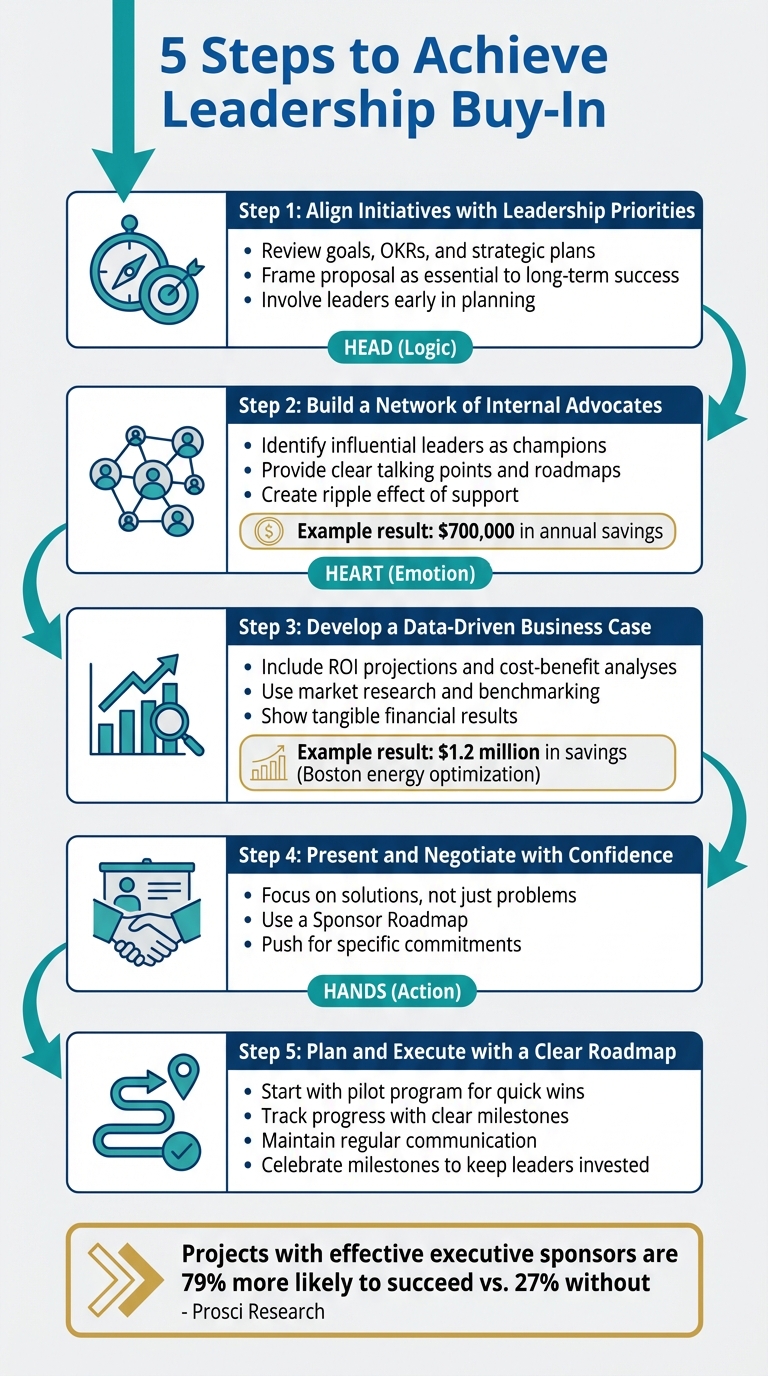
5-Step Process to Secure Leadership Buy-In
Securing leadership buy-in isn’t a matter of chance – it’s about following a thoughtful, strategic process. The "Head, Heart, and Hands" framework is central to this approach, helping you connect logic, emotion, and action. By building credibility, presenting clear data, and rallying internal support, you can create a compelling case that resonates with leadership.
Step 1: Align Initiatives with Leadership Priorities
Start by understanding what matters most to your organization’s leaders. Review goals, OKRs, and strategic plans to identify how your initiative supports their priorities, whether that’s boosting revenue, improving efficiency, or reducing risks. The stronger the alignment, the easier it is to gain their backing.
Frame your proposal as essential to the organization’s long-term success, emphasizing the risks of doing nothing. Leaders need to see both the logical business case (the "Head") and feel the urgency of the situation. As WalkMe aptly states, "Leadership buy-in is not just a nice-to-have. It’s a must-have. Without it, you risk jeopardizing the execution of your vision and the overall success of your organization".
Involve leaders early in the planning process. When they help shape the strategy, they feel a sense of ownership rather than just being asked to approve something.
Step 2: Build a Network of Internal Advocates
Once you’ve aligned your initiative with leadership priorities, focus on building internal momentum. You don’t need everyone on board right away – start by identifying influential leaders who can champion your vision. Their support creates a ripple effect, making it harder for others to dismiss your proposal.
Take the example of John Healy, an engineering manager at an energy company. Despite his General Manager’s preference for a different gas-scrubbing system, Healy believed a better option existed. He brought in a trusted bio-gas expert to validate the technology and presented a detailed analysis showing $700,000 in annual savings. This approach convinced the GM and senior leadership to reconsider.
Equip your advocates with clear talking points and actionable roadmaps. These allies can help address emotional concerns (the "Heart") and practical steps (the "Hands") that skeptical leaders might need to see.
Step 3: Develop a Data-Driven Business Case
Leadership decisions are grounded in evidence, not just enthusiasm. Build a business case that includes ROI projections, cost-benefit analyses, and market research to demonstrate the value of your proposal. Solid data makes it harder for skeptics to dismiss your ideas.
Consider using a comparison table to highlight different options, outlining costs, timelines, and outcomes. For instance, energy data optimization in Boston, Massachusetts, led to $1.2 million in savings. Concrete financial results like this shift your idea from being merely "interesting" to a strategic necessity.
As Prosci highlights, "The stronger you can make the connection between effective change management and realizing project benefits, the stronger your business case will be". Don’t just explain what you’ll do – show how it directly contributes to achieving tangible benefits and reducing risks.
| The 5 B’s of Executive Buy-In | Description |
|---|---|
| Best Practices | Use benchmarking and research to answer questions with confidence. |
| Business Case | Tie your initiative to ROI, risk reduction, and measurable benefits. |
| Be Specific | Clearly outline what you need from leadership. |
| Be Assertive | Present solutions with confidence instead of waiting for approval. |
| Bring in an Expert | Use external expertise to challenge assumptions and spark new ideas. |
Step 4: Present and Negotiate with Confidence
When it’s time to present, focus on executive communication that emphasizes solutions rather than just highlighting problems. Confidence, backed by thorough research and a clear plan, inspires trust in your proposal. Address objections with empathy while emphasizing the risks of inaction.
Keep it concise – executives are busy. A "Sponsor Roadmap" can be especially helpful, outlining exactly what you need from them and when. This approach minimizes their time commitment while ensuring their involvement is impactful.
Push for specific commitments, whether it’s resources, timelines, or decision-making authority. Vague agreements like "we’ll think about it" can lead to stalled progress when priorities shift.
Step 5: Plan and Execute with a Clear Roadmap
After securing buy-in, focus on execution. Start with a pilot program to demonstrate quick wins and track progress using clear milestones and metrics. These early successes build trust and pave the way for broader implementation.
Keep leadership engaged by regularly communicating results. Tangible improvements reinforce their commitment. As author Soren Kaplan notes, "A purely logical approach results in resistance because employees don’t feel personally connected to the change". Celebrate milestones to keep leaders emotionally invested and show how their support is driving meaningful progress.
Identify potential barriers early and provide the necessary tools and support to overcome them. The goal isn’t just to launch an initiative – it’s to sustain momentum through implementation and beyond.
How to Maintain Leadership Buy-In
Getting leadership on board at the start is just the first hurdle – keeping their support as the project evolves is where the real challenge lies. To ensure leaders stay invested, they need to feel like co-owners of the project’s vision. Emad E. Aziz, President and CEO of BRIDGES, emphasizes:
"Buy-in is dynamic, just as the project is progressively elaborated, and that stakeholder support and commitment may recede to the extent of negatively affecting the project"
Without consistent engagement, support can fade, putting the entire project at risk. That’s why regular updates and flexible strategies are essential for maintaining leadership commitment.
Regular Communication Strategies
Frequent and transparent communication is key to empowering leaders and their teams. Create a consistent rhythm for updates – monthly reports, quarterly reviews, or quick check-ins – to share progress, challenges, and next steps. The numbers back this up: projects with effective executive sponsors are 79% more likely to succeed, while those without drop to just 27%.
When obstacles arise, don’t just highlight the problems – come prepared with solutions. Tim Creasey, Chief Innovation Officer at Prosci, sums it up well:
"If it isn’t someone’s job, then it’s no one’s job"
Adapting to Changing Goals
Projects don’t exist in a vacuum, and as organizational goals shift, your approach to leadership engagement needs to shift too. If priorities change, revisit your value proposition to align with the new objectives. Update not just the logical aspects but also the emotional and actionable elements to keep leadership invested.
Pay close attention to support levels, especially during the critical midpoint of execution when projects are most vulnerable. Be proactive in addressing issues – taking ownership and being transparent during implementation builds the trust and credibility needed to navigate shifting priorities.
sbb-itb-bc03425
Resilient Power‘s Science-Based Methodologies
Building on earlier strategies to gain support, Resilient Power provides leaders with tools to drive meaningful change. Their science-based methodologies focus on improving executive communication, fostering team alignment, and ensuring quick, data-driven responses during crises. These methods expand on the "Head, Heart, and Hands" framework by emphasizing clear messaging, team resilience, and decisive action.
Executive Communication Skills
Resilient Power’s "Underscore & Explore" methodology is designed to create core messages closely tied to organizational success while encouraging structured feedback from stakeholders. Research shows this approach can double employee acceptance of change. Interestingly, while over 75% of leaders believe their communication strategies are effective, only 46% of employees agree. This disconnect is critical, as poor collaboration and communication are cited by 86% of employees as major contributors to workplace errors. Simplifying information – reducing the load by 30–40% – helps transform complex ideas into clear, engaging conversations.
Team Alignment and Resilience Strategies
Aligning teams goes beyond a single kickoff meeting. Resilient Power involves the Extended Leadership Team (ELT) in co-creating strategies through scenario planning and "challenge groups." These sessions allow leaders to practice decision-making in uncertain conditions and spot emerging market trends. This approach not only strengthens team resilience but also helps anticipate and mitigate potential risks during execution.
AI-Enhanced Tools and Incident Response
When faced with challenges, leaders need actionable insights and the ability to respond quickly. Resilient Power employs AI-enhanced tools that deliver predictive analytics and visual "What-If" scenarios. These tools make critical initiatives more compelling and easier to act on . Harvard Business School Professor Robert Simons emphasizes:
"Risks may not be pleasant to think about, but they’re inevitable if you want to push your business to innovate and remain competitive".
Additionally, real-time response capabilities ensure leaders can celebrate wins and address obstacles as they arise, maintaining momentum and commitment. This matters because organizations with highly engaged employees can achieve up to 23% higher profits.
Conclusion
Gaining leadership buy-in isn’t a one-and-done task – it’s an ongoing process that blends logic, emotion, and action. While the "Head, Heart, and Hands" framework offers a solid starting point, maintaining support requires consistent communication, data-backed insights, and the ability to adapt as business priorities evolve. Without this commitment, organizations risk facing conflicting decisions, mixed messages, and resource shortfalls that can lead to delayed projects and higher costs.
The stakes are high: companies with engaged employees report 23% higher profits and 10% greater customer loyalty. On the flip side, nearly half of organizations fail to meet key strategic objectives when leadership commitment falls short. The difference often lies in treating leaders as co-creators of the vision, rather than just approvers of plans.
Harvard Business School Professor Robert Simons highlights a common challenge: while organizations excel at sharing information vertically, they often falter when it comes to horizontal communication across teams. Breaking down these silos requires deliberate efforts to make strategy a shared mission. This reinforces the importance of clear communication and alignment across all levels of an organization.
To strengthen leadership commitment, integrating science-based methods can make a real impact. The formula is straightforward: clearly explain the "why" behind each initiative, use data to build an undeniable case, and involve leaders early to foster a sense of ownership. Combining these steps with advanced methodologies – like executive communication training, team alignment strategies, and AI-powered decision-making tools from Resilient Power – creates the foundation for meaningful change. As WalkMe aptly states:
"A vision is only as good as the team’s willingness and ability to execute it".
Kick things off with pilot programs to generate momentum. The effort to secure genuine leadership buy-in doesn’t just ensure project success – it cultivates an environment where innovation flourishes and strategic goals are achieved.
FAQs
How can I make sure my initiative aligns with leadership goals?
To ensure your initiative aligns with leadership goals, begin by diving into your organization’s strategic priorities and the metrics that executives rely on to gauge success. Familiarize yourself with the company’s vision, annual objectives, and key performance indicators (KPIs). Then, frame your project in a way that connects directly to these priorities. For instance, emphasize how your initiative could contribute to increasing revenue, cutting costs, or mitigating risks, and back it up with tangible numbers. For example, you might say, “This project could add $2.5 million in profit over the next 12 months.” This kind of data-driven connection shows that your proposal supports the company’s broader business objectives.
But numbers alone aren’t enough. Pair your data with a compelling story that highlights the human side of the initiative. Use relatable examples to show how the project could positively impact employees, customers, or even the company’s reputation. Leaders are more likely to back ideas that resonate on both a strategic and values-driven level.
Lastly, present a clear roadmap for making your idea a reality. Break down the practical steps, define key milestones, and identify who will be responsible for what. Be specific about the resources you’ll need – whether that’s a budget, tools, or executive sponsorship. Getting leadership involved early and showing that you’ve thought through the details will inspire confidence and improve your chances of approval. If you need additional guidance, Resilient Power®️ offers expert strategies and coaching to help leaders align initiatives with their strategic goals successfully.
How can I keep leadership engaged and supportive throughout a project?
To keep leadership engaged throughout a project, focus on three essential elements: clarity, connection, and collaboration.
Start by clearly defining the project’s purpose and value. Explain the business case, outline potential risks of not taking action, and show how the initiative ties into the organization’s long-term goals. Complement this with relatable stories or examples that demonstrate the project’s human impact. For instance, explain how it will improve daily operations or create benefits for employees – this helps build emotional investment.
Maintain their involvement by delivering regular, concise updates that highlight key achievements, potential risks, and progress. Encourage their active participation in critical decisions, like adjusting resources or changing the scope, to give them a sense of ownership rather than leaving them as passive observers. Set up a feedback loop to address any concerns early and celebrate milestones publicly to reinforce their commitment and recognize team efforts.
By blending logical reasoning, emotional storytelling, and consistent interaction, you can keep leadership engaged and aligned every step of the way. Resilient Power®️ specializes in coaching leaders on these approaches, ensuring organizations maintain support and achieve success in even the most complex projects.
What makes the ‘Head, Heart, and Hands’ framework so effective for leadership buy-in?
The ‘Head, Heart, and Hands’ framework works because it taps into three essential aspects of leadership engagement:
- Head (logic): This part focuses on delivering clear, rational explanations, helping leaders grasp the purpose and advantages of a given initiative.
- Heart (emotion): It builds an emotional connection, inspiring leaders to genuinely care about the outcome on a personal level.
- Hands (action): By providing practical, actionable steps, it makes it easier for leaders to understand their role and actively contribute to achieving results.
When these elements come together, leaders not only feel knowledgeable and emotionally connected but also ready to take action – key ingredients for creating lasting commitment.