
Making tough decisions under pressure doesn’t have to be chaotic. Here’s a simple framework to help your team navigate high-stakes situations effectively:
- Define the Decision: Clarify the scope, constraints (e.g., budget, deadlines), and assign a decision owner.
- Set Roles: Use the DACI framework – Driver, Approver, Contributors, and Informed – to streamline responsibilities.
- Assess Risks and Impact: Use the 4R Test (Regret, Repeal, Repercussions, Resilience) to evaluate options and risks.
- Encourage Honest Input: Establish a safe space for open discussions, challenge assumptions, and avoid groupthink.
- Evaluate Options: List all realistic choices, assess assumptions, and run a pre-mortem to identify potential failures.
- Finalize and Document: Record the decision, reasoning, and action plan, including deadlines and ownership.
- Communicate Clearly: Share the decision and its process with all stakeholders promptly.
- Review and Learn: Conduct post-decision reviews to compare outcomes against expectations and refine your process.
This structured approach ensures clarity, accountability, and better outcomes – even when you’re operating with incomplete information or tight deadlines.
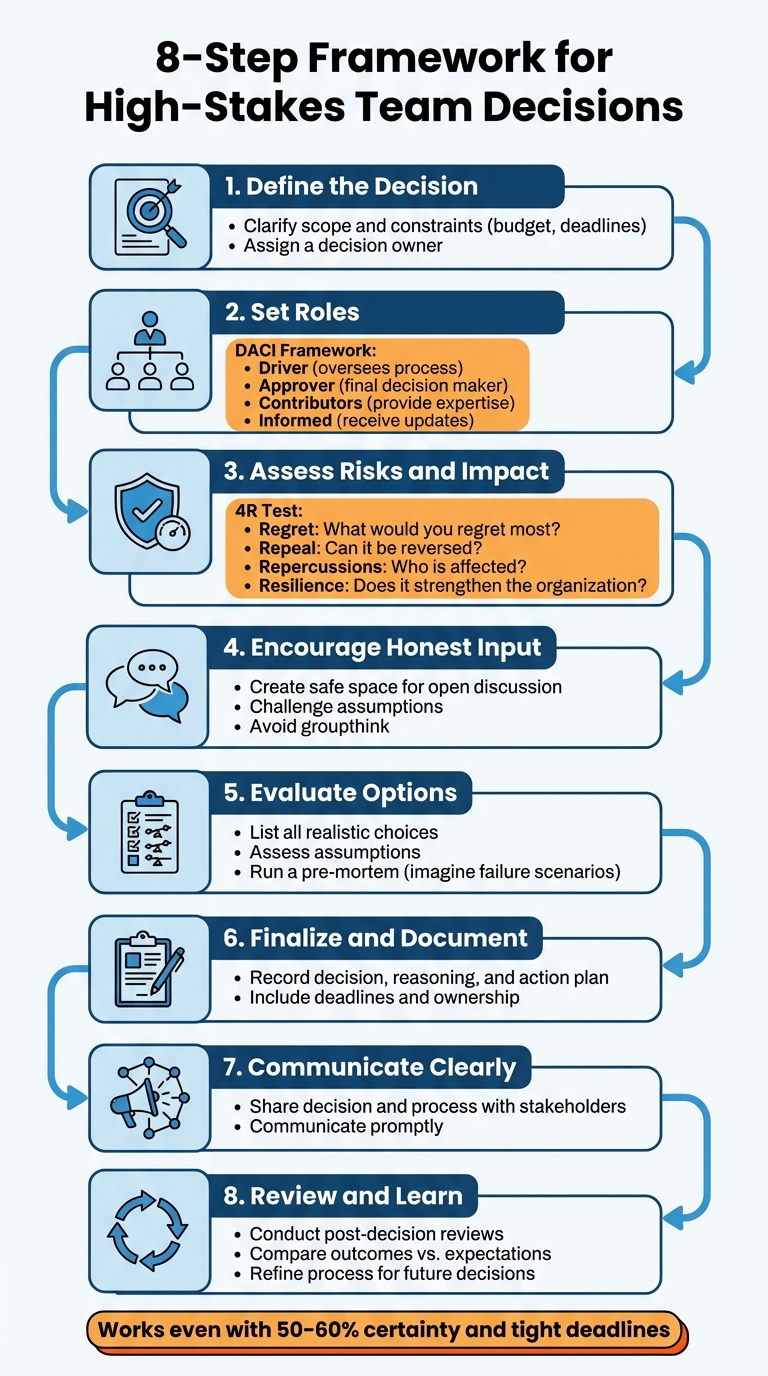
8-Step Framework for High-Stakes Team Decision Making
How to Make Good Decisions | A Framework for Leaders Under Pressure
sbb-itb-bc03425
Define the Decision, Ownership, and Impact
Before diving into discussions, it’s essential to establish a shared understanding of the decision at hand. This clarity helps avoid misunderstandings, wasted time, and decisions that fail to hold up. A strong foundation like this sets the stage for defining roles and assessing risks, which are key to making decisions that stick.
Define Decision Scope
When it comes to high-stakes decisions, nailing down the scope and boundaries is crucial. Start by summarizing the decision in a single, clear sentence that highlights what’s included and what’s not. For example: "We will select a new vendor for cloud infrastructure by March 15, 2026, with a budget limit of $250,000 annually, excluding changes to our current data center contracts." Laying out constraints like budget caps, deadlines, operational limits, or regulatory requirements ensures the team focuses on options that are actually workable.
Name the Decision Owner and Escalation Process
Appoint one decision owner – someone with the final authority to commit the organization to action. A good approach is the “consensus with fallback” model: the team works toward agreement within a set timeframe, but if that fails, a pre-assigned owner (often the team leader) makes the final call. To keep things moving, set clear escalation steps:
- 4 hours for the team to resolve internally.
- 8 hours for functional managers to step in.
- 24 hours for program directors to weigh in.
- 48 hours for steering committees to make the final decision.
Triggers for escalation might include exceeding a $10,000 budget variance or jeopardizing critical project milestones.
"The most important factor in successful decision-making is that every team member is clear about how a particular decision will be made."
– Judith Stein, MIT Human Resources
Calculate the Impact and Assess Risk
Once ownership is in place, it’s time to evaluate the potential impact and risks. Start by quantifying financial outcomes in dollars, then use the 4R Test to guide your decision-making:
- Regret: What would the team regret most if the decision is wrong or action isn’t taken?
- Repeal: How easily can the decision be reversed?
- Repercussions: Who and what will be affected by the decision?
- Resilience: Does this choice make the organization stronger?
Sometimes, decisions under pressure must be made with only 50–60% certainty. To prepare for missteps, outline the potential consequences of a wrong decision early on and plan for contingencies.
Set Up the Team for Productive Discussion
After defining the decision and assigning ownership, the next step is assembling the right team and fostering an environment where open and honest input thrives. If the group is poorly chosen or lacks psychological safety, even the best-laid plans can fall apart.
Choose Participants and Assign Roles
Carefully selecting participants is crucial. The DACI framework offers a clear structure for team roles:
- Driver: Oversees the process and ensures progress stays on track.
- Approver: Makes the final decision.
- Contributors: Provide subject-matter expertise and recommendations but don’t have a vote.
- Informed: Need to be updated on the outcome but don’t participate in discussions.
Keep the decision-making group small – ideally between 3–6 members – to maintain agility. Prioritize individuals with expertise directly relevant to the decision rather than assuming all expertise is interchangeable. Also, include voices that represent those affected by the decision to ensure a range of perspectives is considered.
"DACI turns the approver role from a passive ‘rubber stamp’ into a very active ‘decision maker’ role." – Atlassian
Once roles are assigned, set clear discussion guidelines to encourage honest and meaningful input throughout the process.
Set Discussion Rules and Create Safety for Honest Input
Start by clarifying the decision-making model: Will it follow Command (one person decides), Consult (input is gathered, but one person decides), Vote (majority rules), or Consensus (everyone agrees to support the decision)? Misunderstanding this upfront can lead to confusion and frustration later. It’s also wise to establish a fallback plan early on; for instance, if consensus isn’t reached within a set timeframe, the leader steps in to make the call.
Focus discussions on four critical areas:
- Facts: Objective data and evidence.
- Forecast: Resource requirements and potential risks.
- Experience: Visualizing success or failure scenarios.
- Ethics: How the decision impacts the broader community.
Encourage quieter team members to share their thoughts by asking for their input directly. This approach helps uncover potential blind spots and ensures diverse perspectives are represented. Document not only the final decision but also the reasoning behind it, the alternatives considered, and the participants involved. This level of transparency builds trust, especially with stakeholders who weren’t part of the discussion.
"People don’t actually feel they need to be directly involved in every decision – that’s exhausting! – but they do want to know that their concerns were considered and that the process used to reach the decision was fair." – Erik Larson, CEO, Cloverpop
Prevent Groupthink
In high-pressure situations, teams often fall into groupthink – rushing to agreement without fully exploring alternatives. Warning signs include quick consensus, a lack of alternative suggestions, or treating all expertise as equal when specialized knowledge is essential. Some groups even appoint "mind guards" who shield the team from conflicting information, which can stifle critical thinking.
To combat this, challenge assumptions and encourage healthy debate. For complex decisions, require at least three viable alternatives to avoid false choices. Before finalizing anything, conduct a pre-mortem: imagine how the decision could fail and identify risks you can address early. In situations where different departments are affected unevenly, acknowledge the tension and refocus the group on the organization’s core principles. This helps balance competing priorities while keeping the decision aligned with broader goals.
Evaluate Options Using Clear Methods
Taking a structured approach to evaluating options can help you avoid costly mistakes. Once your team is ready to dive into discussions, focus on clearly defining and assessing all available choices.
List and Record All Realistic Options
Start by identifying every realistic option, even the choice to do nothing. This ensures you don’t limit yourself to a narrow set of possibilities too early. The broader the range of perspectives you consider, the better your final decision is likely to be.
To gather ideas effectively, use structured brainstorming methods. Tools like Crawford Slip Writing allow team members to submit ideas anonymously, encouraging input from quieter participants. Similarly, Round-Robin Brainstorming ensures that everyone contributes at least one idea. Once you’ve collected options, group them into themes using Affinity Diagrams for easier evaluation.
"Generating a number of different options may seem to make your decision more complicated at first, but the act of coming up with alternatives forces you to dig deeper and to look at the problem from different angles." – Mind Tools
Review Assumptions, Risks, and Expected Results
For each option, outline the assumptions that need to hold true for it to succeed. Then, assess the risks and estimate the potential financial and operational impacts. Keep in mind that in high-stakes decisions, leaders often work with only 50% to 60% certainty – much less than the 75% to 80% certainty typical for routine decisions. Former U.S. Secretary of State Colin Powell’s 40-70 Rule underscores this: act when you have between 40% and 70% of the information you think you need.
To dig deeper, apply the 4R Test:
- Regret: What happens if no action is taken?
- Repeal: How easily can the decision be reversed?
- Repercussions: Who will be impacted?
- Resilience: Does this choice strengthen or weaken the organization?
When comparing pros and cons, add a mitigations row to your analysis. This helps identify specific steps to reduce or eliminate potential downsides.
Run a Pre-Mortem on the Top Choice
Once you’ve evaluated all options, validate your top choice with a pre-mortem. The idea is simple: imagine your decision has failed six months down the line and figure out why. This exercise helps uncover hidden risks and blind spots early. Research suggests this method can improve the accuracy of predicting outcomes by about 30%.
Take Johnson & Johnson’s response to the 1982 Tylenol crisis as an example. After several deaths in Chicago were linked to tampered Tylenol bottles, CEO James Burke ordered a nationwide recall of 31 million bottles – valued at $100 million. This bold move prioritized customer safety over immediate profits and ultimately safeguarded the brand’s long-term reputation.
To conduct an effective pre-mortem, gather your key team members and relevant stakeholders shortly after outlining your decision. Start with a clear statement: “The project has failed. What went wrong?” Each participant should independently list potential reasons for failure to avoid groupthink – a process often called the "brainstorm of doom". Then, share and rank the risks by likelihood and severity, and create strategies to address the most critical ones. Assign a note-taker to document all insights.
"A premortem… drives teams to anticipate failure, then take steps to prevent it." – Alliance for Decision Education
Make sure to record the pre-mortem findings alongside your final decision. This documentation can help counter hindsight bias when reviewing the decision later. With these steps completed, your team will be ready to finalize, document, and share the decision effectively.
Finalize, Record, and Share the Decision
After completing your evaluations and pre-mortem analysis, it’s time to finalize your decision with clarity and ensure everyone is on the same page. A lack of clear documentation or poor communication can derail even the best decisions.
Clarify How the Decision Will Be Made
Start by defining who has the authority to make the final call and how input will be handled. Is the leader making the decision solo? Does the team need to reach full consensus? Or will you aim for consensus but fall back on a predetermined plan if no agreement is reached by a set deadline?
The RAPID framework is a helpful tool here. It assigns specific roles in the decision-making process: who will Recommend, Agree, Perform, Input, and Decide. For critical decisions where team alignment is essential, consensus can be effective – but only if everyone can genuinely agree to these four statements: "I have heard your positions", "I believe you have heard my position", "The decision does not compromise my values", and "I can fully support the proposed decision and its implementation".
If consensus isn’t possible within the agreed timeframe, a fallback plan is essential. For instance, the leader might step in to make the final call after the deadline. This approach keeps the process moving and avoids getting stuck in endless deliberations.
"An okay decision made at the right moment to produce maximum benefit is better than a perfect decision made after it no longer matters." – Bridgespan Group
Write Down the Decision and Reasoning
Once a decision is made, document it thoroughly. Record what was decided, why it was chosen, and the key assumptions underlying its success. Be sure to include insights from your pre-mortem analysis to counter hindsight bias.
Your documentation should summarize the evidence, analysis, and thought process that led to the decision. Include the options you weighed, the risks identified during the pre-mortem, and the steps you’ll take to mitigate those risks. This record will serve as a reference point later when someone inevitably asks, "Why did we do it this way?"
Make this documentation easily accessible. Store it in a shared location where team members and stakeholders can review it as needed. This is especially helpful for onboarding new team members or providing context for those joining mid-project.
"People will be more motivated to get on board if they can understand why the decision’s been made, and how it will benefit them and the organization." – Mind Tools
Assign Owners, Deadlines, and Budgets
With the decision documented, the next step is to operationalize it. Assign clear responsibilities for each action item, specifying an owner, a deadline (MM/DD/YYYY), and a budget (in USD). The "Perform" role in the RAPID framework is particularly useful here, as it designates who is responsible for executing the decision.
When delegating tasks to subgroups, set clear boundaries. Define pricing limits, budget constraints, and any specific operational guidelines they must follow. For example, if you’re rolling out a new product feature, you might assign the engineering lead as the owner, set a deadline of 06/15/2026, and allocate $75,000 for development costs.
Formalize these commitments in an action plan. Data shows that only 14% of managers are satisfied with their organization’s decision-making speed, often due to unclear accountability. By establishing clear ownership, you can drive faster and more effective execution.
"No decision is complete until it has been executed. Once you’ve made a decision, hold yourself and your fellow leadership team members accountable for implementing the results." – Bridgespan
Tell Stakeholders About the Decision
Effective communication is critical once the decision is made. Identify all stakeholders impacted by the decision and tailor your communication to meet their needs. The RAPID framework can help you distinguish between "Performers", who need detailed instructions for execution, and the "Informed", who only require a high-level overview.
Customize your messaging for different groups. High-impact stakeholders may need one-on-one meetings to address concerns and align expectations. Performers might require direct briefings or project kickoff meetings with clear guidelines. For the broader organization, use tools like email updates, shared decision logs, or all-hands meetings.
When communicating, share not only the decision but also the process behind it. If the decision impacts departments unevenly, acknowledge those tensions while reinforcing the organization’s mission and priorities. Speed is crucial – communicate promptly to prevent rumors or misunderstandings from spreading.
"Proactively communicate the process and outcome of the decision to your community – once again, with special care given to those most affected by it." – Bridgespan
Stay open to feedback and be ready to address valid concerns as they arise.
Review Results and Strengthen Team Capabilities
Schedule a Post-Decision Review
Host a review session to evaluate how outcomes stack up against your initial expectations. Compare the actual financial, operational, and business effects with the assumptions you documented during planning.
Lean on the "failure benchmarks" you set earlier – specific milestones or conditions that signal when to adjust course or shut down a project. For instance, you might decide, "If we haven’t reached 5,000 active users by 09/30/2026, we’ll end the pilot program." Regularly revisiting these criteria helps avoid falling into the sunk cost fallacy and supports clear-headed decisions about whether to push forward, pivot, or pull the plug.
Pay attention to any uneven effects on staff or stakeholders. For example, if a cost-cutting initiative disproportionately impacts one department, that’s a critical insight to factor into future planning.
"Make sure that you fess up when you make a mistake. You’re never going to be perfect, but if you don’t admit when you went in the wrong direction, your team will lose faith in you." – David Walter, Master Electrician, Alcoa
These reviews are not just about accountability – they’re essential for refining decision-making processes for future projects.
Record What Was Learned
Document both successes and failures. As Annie Duke, a decision science expert, points out, "Focusing solely on failures restricts opportunities to improve decision-making".
Create a searchable record that tells the complete story behind each decision. This archive offers future teams the context they need to understand past choices without second-guessing them. Don’t just record the outcomes – capture details about the process too. Note which evaluation methods worked, where groupthink may have influenced decisions, and how team dynamics shaped the discussion.
James Everingham, Co-founder of Lightspark and former Head of Engineering at Instagram, underscores the importance of this approach:
"Decision-making is a mental muscle that teams have to build. When a problem comes up… you have to insert this step of ‘How should we think about solving this problem? And then how can we systemize that so it can be used later?’"
Apply Lessons to Leadership Training
Take the lessons you’ve recorded and turn them into tools for leadership development. Use real-life case studies – both wins and missteps – to train leaders in improving their judgment and avoiding repeat mistakes.
Incorporate these insights into your leadership competency frameworks. Review decisions every six months to refine your processes. Train leaders to distinguish between "above the waterline" decisions – those that are high-risk and demand detailed analysis – and lower-stakes decisions that can be made more quickly. This helps teams strike the right balance between speed and thoroughness.
You might also consider collaborating with Resilient Power® (https://resilientpower.global). Their science-based methodologies can help your organization turn individual lessons into systematic, team-wide strengths. With only 24% of U.S. managers strongly agreeing that their peers make well-thought-out decisions, structured decision-making training could set your organization apart in a competitive landscape.
Conclusion
Making decisions under pressure doesn’t have to feel chaotic. By following a structured approach, you can turn tense moments into opportunities for productive action. When you establish clear ownership, encourage honest discussions among your team, and evaluate options systematically, you create a framework that reduces errors and drives progress. Knowing who has the final say, fostering a culture that values thoughtful disagreement over forced agreement, and relying on organized analysis are the key ingredients that separate rushed mistakes from decisions that propel your organization forward.
This method applies to every stage of high-stakes decision-making. Managers collectively face billions of decisions each year. Treating decision-making as a deliberate process rather than a series of knee-jerk reactions allows your team to concentrate on what truly matters. It prevents wasted energy on low-priority choices and ensures that critical decisions get the attention and care they deserve.
Timing and process are crucial when it comes to decision quality. In crisis situations, you may need to act with only 50%–60% certainty instead of waiting for the usual 75%–80%. A structured checklist can help you determine the right balance between speed and thoroughness, ensuring that decisions are made effectively, even under pressure.
But the real value lies in treating every decision as a chance to grow. By scheduling reviews, documenting lessons learned, and using those insights to refine leadership training, you create a team that gets better with every challenge. This continuous cycle – from defining the problem to evaluating options and reflecting on outcomes – strengthens your organization’s ability to adapt and thrive.
To embed these practices into your company’s culture, consider tools like Resilient Power®. This approach combines science-backed methodologies with customized strategies to enhance leadership resilience and improve team decision-making across the board.
FAQs
What is the DACI framework, and how does it improve team decision-making?
The DACI framework is a method designed to assign clear roles to team members during decision-making, cutting through confusion and making the process more efficient. The acronym stands for Driver, Approver, Contributor, and Informed, with each role playing a distinct part. The Driver takes charge of leading discussions and gathering relevant information. The Approver holds the authority to make the final call. Contributors share their input and expertise, while the Informed are kept in the loop but don’t actively participate.
By clearly defining responsibilities, this framework minimizes inefficiencies like decision fatigue and miscommunication, leading to quicker and more confident outcomes. It’s especially useful in high-stakes situations, where alignment, focus, and accountability are critical. Resilient Power integrates the DACI framework into its consulting services, helping leaders establish strong, efficient decision-making systems that can perform under pressure.
What is a pre-mortem, and how can it improve team decision-making?
A pre-mortem is a forward-thinking exercise where a team envisions a project or decision as if it has already failed. The goal? To work backward and pinpoint what could have gone wrong. This approach shines a light on hidden risks, uncovers blind spots, and brings up concerns that might not be voiced otherwise.
By identifying challenges ahead of time, teams can create strategies to reduce risks, align their efforts, and boost the chances of success. It’s a method that promotes honest communication and makes sure every perspective is taken into account before proceeding.
Why is it essential to document team decisions and the reasoning behind them?
Documenting team decisions and the reasoning behind them is essential for ensuring transparency and accountability. It creates a clear record of what choices were made, the rationale behind them, and who participated in the process. This helps keep everyone on the same page and reduces the chances of misunderstandings.
Additionally, having these records serves as a useful resource for future decision-making. Teams can reflect on past experiences, identify what worked or didn’t, and make more informed adjustments moving forward. A transparent approach to decision-making not only strengthens trust but also enhances collaboration and leads to more effective results.