
When a crisis hits – like layoffs, pandemics, or sudden changes – it can shatter workplace dynamics. Employees may feel disconnected, trust in leadership often drops, and engagement plummets. Rebuilding isn’t instant, but it’s possible with a focused approach. Here’s a quick breakdown:
- Assess the Damage: Gather feedback through surveys, forums, and analytics to identify gaps in trust, communication, and engagement.
- Reaffirm Values: Revisit your organization’s core principles. Ensure they’re not just words but actions demonstrated by leadership.
- Open Communication: Create safe spaces for honest feedback and regular updates. Transparency builds trust.
- Support Wellbeing: Invest in mental health programs, flexible schedules, and recognition systems to uplift morale.
- Strengthen Leadership: Train leaders to manage stress and guide teams effectively. Form teams dedicated to driving recovery efforts.
- Track Progress: Use metrics like employee surveys, turnover rates, and feedback loops to measure and refine your efforts.
The key is consistency. Employees want to see real, lasting changes – not just temporary fixes. By addressing trust, communication, and wellbeing, you can rebuild a workplace that’s prepared for future challenges.
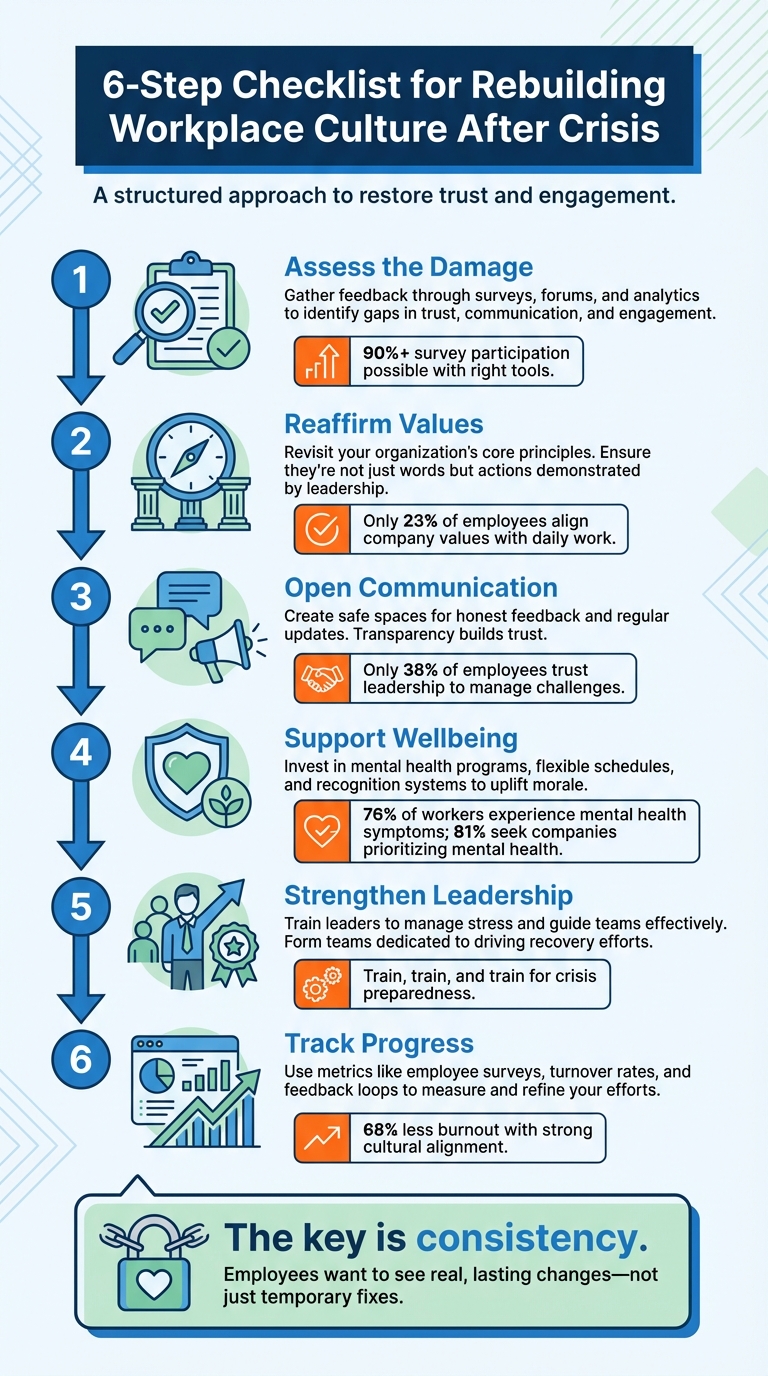
6-Step Checklist for Rebuilding Workplace Culture After Crisis
From Destruction to Construction: How Great Leaders Rebuild After Tough Times – Pete’s Points #337
sbb-itb-bc03425
Assess Your Current Workplace Culture
Start by taking a close look at your current workplace culture. This isn’t about pointing fingers or assigning blame – it’s about understanding what worked, what didn’t, and what your team needs to move forward. To do this effectively, you’ll need to examine both hard data and the emotional undercurrents that remain.
Conduct Post-Crisis Reviews
Run a thorough debrief that includes a Timeline of Events (what happened and when), a Process Review (what decisions were effective and where improvements are needed), and Action Items (key lessons for the organization). Use a trauma-informed approach to address lingering feelings of fear, guilt, or uncertainty. While these emotions won’t show up in typical performance metrics, they can quietly erode productivity and morale.
Consider the example of Neovia Logistics, which launched "Neovia Voice" in 2025 under the leadership of CHRO Michael Foss. This feedback platform empowered local leaders to act on employee input quickly. The results were impressive: over 90% survey participation and a dramatic reduction in attrition by more than half. Their success stemmed from offering multiple feedback channels – pulse surveys for real-time emotional check-ins, open forums for sharing concerns, and predictive analytics to detect subtle signs of disengagement, like declines in peer recognition or attendance.
These insights can help you uncover the specific gaps and challenges within your workplace culture.
Identify Gaps and Pain Points
After gathering feedback, analyze the data to identify trust issues, communication barriers, and drops in engagement. If your pre-crisis data already showed low alignment and engagement, it’s likely those numbers worsened during the crisis.
For instance, CORT tackled high turnover by implementing a comprehensive listening strategy, including engagement, lifecycle, pulse, and exit surveys. This approach uncovered critical needs around safety and leadership support, leading to an 84% favorable safety score and boosting survey participation from 40% to 69%. Ask diagnostic questions like, “What’s holding us back?” or “Where are we most at risk?”. Predictive analytics can also help you spot early warning signs of disengagement, such as reduced collaboration or declining recognition rates, long before employees decide to leave.
Reaffirm Core Values and Purpose
After assessing where your organizational culture stands, the next step is reconnecting with your core values. These values are more than just words – they’re the foundation of your organization’s behavior and decision-making, especially in challenging times. A crisis often reveals whether your values are genuinely upheld or merely aspirational. This moment presents an opportunity to close that gap and ensure your values are lived, not just stated.
Review and Reinforce Core Values
Start by asking yourself and your team: What values must remain central? Which ones no longer serve their purpose? What principles will shape the future? This isn’t about rewriting your values but ensuring they stay relevant and are consistently demonstrated by leadership. As Rose Gailey puts it:
Authentic cultures are not formed by values posted on the wall; they are the result of leaders being purposefully committed to living those values and willing to personally change in order to model the behaviors and actions that maintain integrity.
For example, during the early months of the pandemic in 2020, Delta CEO Ed Bastian demonstrated the company’s commitment to its values by giving up his full salary, fostering trust during a turbulent time. Similarly, LVMH pivoted quickly by converting Christian Dior and Givenchy fragrance factories to produce hand sanitizer, which they provided free to French health authorities. This action reinforced their purpose of being "engaged with society" through meaningful contributions.
Use your core values as the backbone of a "change story" that explains what has shifted, what remains unchanged, and why the future is worth pursuing. Small practices like "Candor Breaks" – pausing during meetings to encourage open, honest feedback – or "Temperature Checks", where team members rate their energy levels on a scale of 1 to 5, can reinforce the importance of values in both performance and well-being.
Once your values are firmly realigned, the focus should shift to open and transparent communication with your team.
Communicate Transparently with Employees
Reaffirming your values is just the first step – clearly articulating them to your team is equally critical. Transparency builds trust, even when uncertainties remain. Leaders who openly share their personal fears and challenges create an environment where employees feel safe to do the same. Organize town halls and team meetings to discuss how the organization is adapting and address key needs like hope, trust, compassion, and stability while empowering leaders and their teams during recovery.
Be specific about who is leading recovery efforts, the steps they’re taking, and when updates will be shared. Storytelling can be a powerful tool here – highlight employees who embodied your values during the crisis. These "quiet heroes" serve as real-life examples of your culture in action. Rituals, such as moments of silence or distributing "welcome back kits", can also help mark the transition from crisis to recovery [17, 18].
It’s worth noting that only 38% of U.S. employees feel confident in their leadership’s ability to manage emerging challenges. Transparent communication can help bridge that confidence gap and reinforce a sense of stability and direction in uncertain times.
Create Open Communication and Psychological Safety
Rebuilding workplace culture takes more than just clear communication – it demands deliberate actions to rebuild trust and foster connections. Employees need to feel they can speak openly without fear of judgment or backlash. This sense of psychological safety doesn’t appear on its own, even in workplaces that seem healthy. Leaders must actively work to create an environment where honesty, vulnerability, and candid feedback are not just encouraged but expected.
Research shows that up to 25% of employees may experience stress-related challenges following major disruptions, like those caused by the pandemic. Employees need structured ways to express their concerns. As grief expert David Kessler puts it:
What everyone has in common is that no matter how they grieve, they share a need for their grief to be witnessed.
This highlights the importance of creating spaces where feedback is not only welcomed but becomes a routine part of workplace culture.
Establish Feedback Channels
Having multiple ways for employees to share their thoughts is essential. Different tools capture different types of feedback. For example:
- Pulse surveys offer quick, real-time insights through short digital questionnaires.
- Town halls provide a space for live Q&A sessions with leadership.
- "Candor Breaks" allow team members to pause meetings to address unspoken issues.
- "Temperature Checks" at the start of meetings let participants rate their energy or stress levels, helping identify those who may need immediate support.
Real-world success stories show the impact of these strategies. Companies using AI-driven feedback platforms and empowering local leaders to act on responses have seen participation rates soar past 90%, while also reducing employee turnover. Seacoast Bank, for instance, revamped its feedback approach under Angel Birch (SVP, Director of Learning & Leadership Development). By combining lifecycle and pulse surveys with manager-led discussions, the bank achieved a 95% participation rate and reduced turnover during rapid acquisitions. Similarly, Redwire introduced "CEO hours" alongside a formal listening strategy to enhance leadership communication. Informal methods, like casual instant messaging, virtual coffee breaks, and even using emojis and gifs, helped rebuild the social connections that formal tools might overlook.
Encourage Team-Building Activities
While formal feedback channels are critical, rebuilding trust also requires interpersonal connections. Structured team-building activities can help break down barriers created during times of crisis. Instead of generic icebreakers, focus on activities that promote genuine vulnerability and support. Examples include:
- Story sharing sessions, where team members share personal highs and lows to foster authentic connections.
- Innovation sprints or shared purpose projects, which allow teams to collaborate on meaningful goals rather than just completing tasks.
For teams returning to in-person work, "welcome back kits" can ease the transition. These kits might include essential supplies, updated guidelines for office interactions, and mental health resources. Marking a specific date as the start of the "next normal" or introducing new workplace rituals can also help employees collectively process the shift from crisis to recovery.
Organizations that prioritize feedback and team-building as ongoing efforts – not just temporary crisis responses – often see improvements in employee engagement and perceptions of safety. By making these practices part of everyday operations, companies can create a culture where employees feel heard, valued, and connected.
Build Employee Support and Wellbeing Programs
In the aftermath of a crisis, prioritizing employee wellbeing isn’t just a nice-to-have – it’s critical. A staggering 76% of U.S. workers report experiencing mental health symptoms, and 84% attribute these challenges to workplace conditions. Even more striking, 81% of employees now actively look for companies that prioritize mental health support. Ignoring these needs can lead to talent loss and slow organizational recovery. On the other hand, strengthening support systems can lay the groundwork for long-term resilience.
To truly address employee wellbeing, companies need to make meaningful changes that provide workers with both autonomy and access to real support. For instance, offering flexibility and control over work schedules can help reduce stress and ease transitions. Some companies have redirected traditional office perks – like catered lunches – into direct stipends for home office setups or wellness initiatives. Others have introduced "flex hours", an extra hour during the day for outdoor activities, recreation, or exercise, giving employees a chance to recharge.
Introduce Mental Health Support Programs
Leadership plays a key role in normalizing mental health conversations. By openly sharing their own challenges, leaders can demonstrate that seeking help is a sign of strength, not weakness. Organizations should also work to remove psychological hazards in the workplace and ensure managers receive "psychological first aid" training to identify mental health struggles and connect employees with the right resources.
The Office of the Surgeon General underscores this approach:
The most important asset in any organization is its people. By choosing to center their voices, we can ensure that everyone has a platform to thrive.
Access to mental health and wellness programs isn’t equal across the board. For example, only 35% of workers in the lowest wage brackets have paid sick leave, and just 23% have access to paid family leave. Expanding these benefits can reduce lost wages by 30%. Addressing these gaps is vital, especially for groups disproportionately affected by crises, such as racial and ethnic minorities, women, and those from lower socioeconomic backgrounds. Taking these steps builds trust and sets the stage for more meaningful recognition efforts.
Recognize and Reward Employee Contributions
Acknowledging employees’ efforts is a powerful way to rebuild morale. Research shows that well-recognized employees are up to 9 times more engaged and 45% less likely to leave their jobs within two years. However, only 22% of employees feel they receive enough recognition. This disconnect is costly: 79% of employees who quit cite lack of appreciation as a key reason for leaving.
Recognition works best when it’s specific and consistent. A simple "good job" won’t cut it. Instead, highlight the actions and impact of an employee’s contributions. As Josh Rosenthal of TalentSmartEQ explains:
Recognition signals that people are valued, seen, and appreciated. When it’s done right, it fuels motivation and creates an environment where people perform their best.
Peer-to-peer recognition programs can increase employee engagement by 14%. Small, frequent rewards are also highly effective – employees who regularly receive these are 8 times more engaged than those who only get annual bonuses or raises. To foster a culture of recognition, companies can implement strategies like "Weekly Wins" meetings, where team members celebrate accomplishments and give shout-outs, or create calendars to track milestones such as work anniversaries and project completions. Additionally, using "You Said, We Did" updates to highlight how employee feedback has shaped organizational changes ensures contributors feel valued.
Strengthen Team Alignment and Leadership Resilience
Rebuilding workplace culture after a crisis isn’t just about having good intentions – it’s about having leaders who can manage their own stress while guiding their teams through uncertain times. And the challenge is undeniable: only 38% of U.S. employees trust their leaders to effectively handle new challenges. Without strong leadership and well-coordinated teams, recovery efforts can falter. The key lies in equipping leaders with resilience skills and forming focused teams with clear responsibilities.
Provide Leadership Resilience Training
Leaders need to prioritize their own resilience before they can effectively support their teams. As Tresha D. Moreland, CEO of HR C-Suite LLC, explains:
It is hard to lead teams and organizations effectively when you are fatigued, burned out, anxious or fearful.
Resilience training goes beyond basic stress management. It equips leaders with tools for self-regulation to manage their own fatigue and anxiety, emotional intelligence to recognize and address team challenges, and strategic communication that fosters genuine and transparent conversations instead of corporate jargon. Mike O’Neill, Senior Vice President for Communications at American Express, underscores the importance of preparation:
The three most important things you can do to prepare for a crisis are train, train and train.
This training isn’t just for senior leaders; front-line managers, who are critical to daily recovery efforts, need it too. Programs rooted in science – such as those offered by Resilient Power – help leaders build the skills to empower agile teams, conduct Post-Incident Reviews that focus on systemic improvements instead of blame, and use tools like "Empathy Mapping" to better understand employee needs.
Form Recovery Teams
While resilient leadership sets the tone, structured teams turn plans into action. Dedicated recovery teams bring the accountability and focus necessary to achieve cultural transformation. These teams thrive when they include diverse perspectives and clearly defined roles. The DAC Framework provides a practical blueprint: teams need Direction (shared goals), Alignment (coordinated efforts), and Commitment (prioritizing team success over individual recognition).
To keep recovery teams engaged and flexible, use tools like "Temperature Checks" at the start of meetings, where members rate their energy levels on a scale of 1 to 5 to identify anyone who might need extra support. Organize recovery efforts into six-week agile sprints to allow for adjustments along the way. Introduce "Candor Breaks", moments when any team member can pause discussions to address unspoken concerns or sensitive topics without fear of judgment. Tim Cook, CEO of Apple, highlighted the power of teamwork during challenging periods:
Even though we’re apart, it’s been obvious this year that around the company, teams and colleagues have been leaning on and counting on each other more than in normal times. I think that instinct, that resilience has been an essential part of how we have navigated this year.
Incorporating "co-elevation" into team dynamics – where members take responsibility for each other’s resilience and success – creates a strong network of peer support. This approach reduces the burden on leadership while fostering a collaborative environment. Periodically bringing in independent observers to offer unbiased assessments of team dynamics can also prevent groupthink and help recovery teams stay focused as they work to rebuild a thriving workplace culture.
Measure Progress and Embed Changes
Rebuilding workplace culture isn’t something you can check off a to-do list – it’s an ongoing process. It needs consistent measurement and adjustments to ensure the changes stick. Without clear metrics, even the best intentions risk fading into old habits. Over 90% of North American CEOs and CFOs agree that improving corporate culture positively impacts financial performance, yet many companies struggle to track their efforts effectively. To keep progress on track, establish clear metrics and feedback systems.
Use Metrics to Track Improvements
Start by measuring the Employee Net Promoter Score (eNPS) through regular pulse surveys. This gives you insight into whether employees would recommend your workplace to others – a key indicator of satisfaction and engagement. Keep a close eye on turnover rates, too. High attrition often signals cultural issues, while workplaces with strong cultural alignment see 68% less burnout and 55% lower attrition. Beyond internal surveys, gather external feedback from platforms like Glassdoor or Indeed. Behavioral signals, such as peer recognition and collaboration rates, can also reveal whether your company values are genuinely practiced or just words on a wall.
For example, a study at ExxonMobil revealed a stark difference between perception and reality. While 98.7% of employees claimed in traditional surveys to follow safety protocols, a more anonymous method found that 25% admitted to skipping procedures. This gap highlights the importance of using diverse tools to uncover the truth. AI-powered sentiment analysis can also help you process open feedback, providing real-time insights into employee morale. Additionally, monitor well-being indicators like absenteeism due to burnout or rising healthcare costs to spot early warning signs.
Refine Strategies with Lessons Learned
Once your metrics spotlight areas for improvement, act quickly. Treat culture as a dynamic process, not a fixed goal. Build feedback loops where you test ideas, evaluate outcomes, and adjust strategies as needed. A great example of this approach is the Veterans Health Administration’s Civility, Respect, and Engagement in the Workplace (CREW) program. Starting in 2005, work groups met weekly for six months to create tailored social norms. By 2022, over 1,200 work groups had participated, leading to measurable improvements in respectful behavior, trust in leadership, and reductions in burnout and absenteeism.
Tie employee lifecycle data – like exit surveys or engagement scores – to business performance metrics such as customer satisfaction or financial results. This helps identify which cultural changes make the biggest impact. After major events or crises, analyze recurring themes from surveys and organize collaborative workshops with employees and leaders to refine your company’s core values for the "new normal". Ed Schein, a leading thinker on corporate culture, once noted:
The only thing of real importance that leaders do is to create and manage culture.
Finally, share your progress openly. Highlight how cultural improvements are driving tangible benefits, like lower turnover or reduced healthcare costs. This transparency keeps leadership accountable and shows employees – and the public – that your commitment to change is more than just talk.
Conclusion
Rebuilding workplace culture after a crisis requires consistent, genuine leadership. While the checklist provided serves as a guide, the true impact lies in how leaders show up every single day. Your team is paying close attention to see if the changes you’re implementing are meaningful and lasting, rather than just temporary fixes. This demands intentional, daily actions to turn good intentions into a culture that endures.
It’s crucial to recognize the emotional strain your team has endured. Only 23% of U.S. employees strongly agree they can align their organization’s values with their daily work. That disconnect between stated values and lived experiences is where trust begins to break down. Instead of prioritizing productivity metrics, leaders need to address the fears and fatigue employees are feeling. As Team AdvantageClub.ai aptly puts it:
Post-crisis engagement doesn’t start with strategy; it starts with empathy.
Before leading others, assess your own readiness. Leaders who are overwhelmed or anxious can’t effectively guide their teams through recovery. To truly support your team, focus on meeting their four universal needs during times of disruption: hope, trust, compassion, and stability.
By embedding the steps outlined – reinforcing core values, fostering open communication, creating psychological safety, prioritizing employee well-being, and building leadership resilience – you lay the foundation for a culture that can withstand future challenges. As Chris Ihrig, CEO of FiredUp! Culture, wisely observes:
Rebuilding your organization’s culture offers as many opportunities as it does obstacles.
And as Gallup reminds us:
The question isn’t if the next crisis will come, but when.
The time to act is now. By integrating these practices, you can strengthen your organization to face whatever comes next and emerge even stronger.
FAQs
What’s the best way to measure progress when rebuilding workplace culture after a crisis?
To track progress effectively, begin by setting a baseline for employee sentiment, trust, and engagement levels before initiating any changes. Use pulse surveys to monitor shifts over time – improvements in engagement scores and retention rates often signal you’re on the right path. Including metrics like Employee Net Promoter Score (eNPS) and psychological safety ratings can offer a more complete view.
Don’t overlook the value of qualitative feedback. Regular focus groups or listening sessions can uncover deeper insights, while analyzing internal communications can highlight recurring themes or concerns. Combine these findings into a centralized dashboard that connects workplace culture metrics to business outcomes, such as productivity or customer satisfaction. To stay aligned with your goals, schedule periodic reviews – quarterly “culture health” meetings work well – to evaluate progress and refine your approach. When you see multiple indicators, like increased engagement, reduced turnover, and positive employee feedback, aligning, it’s a strong sign your efforts are paying off.
How can leaders effectively demonstrate core values in the workplace?
Leaders bring core values to life by consistently articulating them and ensuring their actions align with these principles. This means making choices that clearly mirror the organization’s values, leading by example, and weaving these values into everyday practices like policies and performance reviews.
Recognizing and celebrating team members who reflect these values is another powerful way to reinforce them. It builds a culture where accountability thrives. Offering coaching or training also helps employees grasp and apply these values, making them an integral part of the workplace environment.
How can companies foster a culture of psychological safety to encourage open communication?
Building a sense of psychological safety in the workplace starts at the top. When leaders openly admit their mistakes, show vulnerability, and handle errors with constructive feedback, it signals to the team that honesty and calculated risks are appreciated. Combine this with clear and transparent communication about decisions and their outcomes, and employees are more likely to feel comfortable voicing their opinions.
Consistency is essential. Teach managers to actively listen with respect, ask thoughtful follow-up questions, and create anonymous ways for employees to share feedback. Regular check-ins and following through on commitments show employees that their input isn’t just heard – it leads to real change.
Making these practices part of your team’s daily routines helps embed psychological safety into the workplace culture. Tools like those from Resilient Power®️ can support organizations in fostering a lasting environment where open dialogue and trust can flourish.