
When challenges arise – like economic crises or global disruptions – strong leadership resilience is what keeps organizations steady and prepared for growth. Resilient leaders don’t just react; they guide their teams through uncertainty with focus, quick decision-making, and clear communication. This mindset helps businesses maintain stability, protect revenue, and even uncover new opportunities during tough times.
Key Takeaways:
- Resilient leaders prioritize critical tasks, act swiftly, and communicate often.
- Companies with strong leadership resilience recover faster and grow revenues up to 6% quicker than peers.
- Practical steps include training employees, creating clear plans, and learning from past challenges.
The future is uncertain, but resilience ensures leaders and their teams are ready to face it head-on.
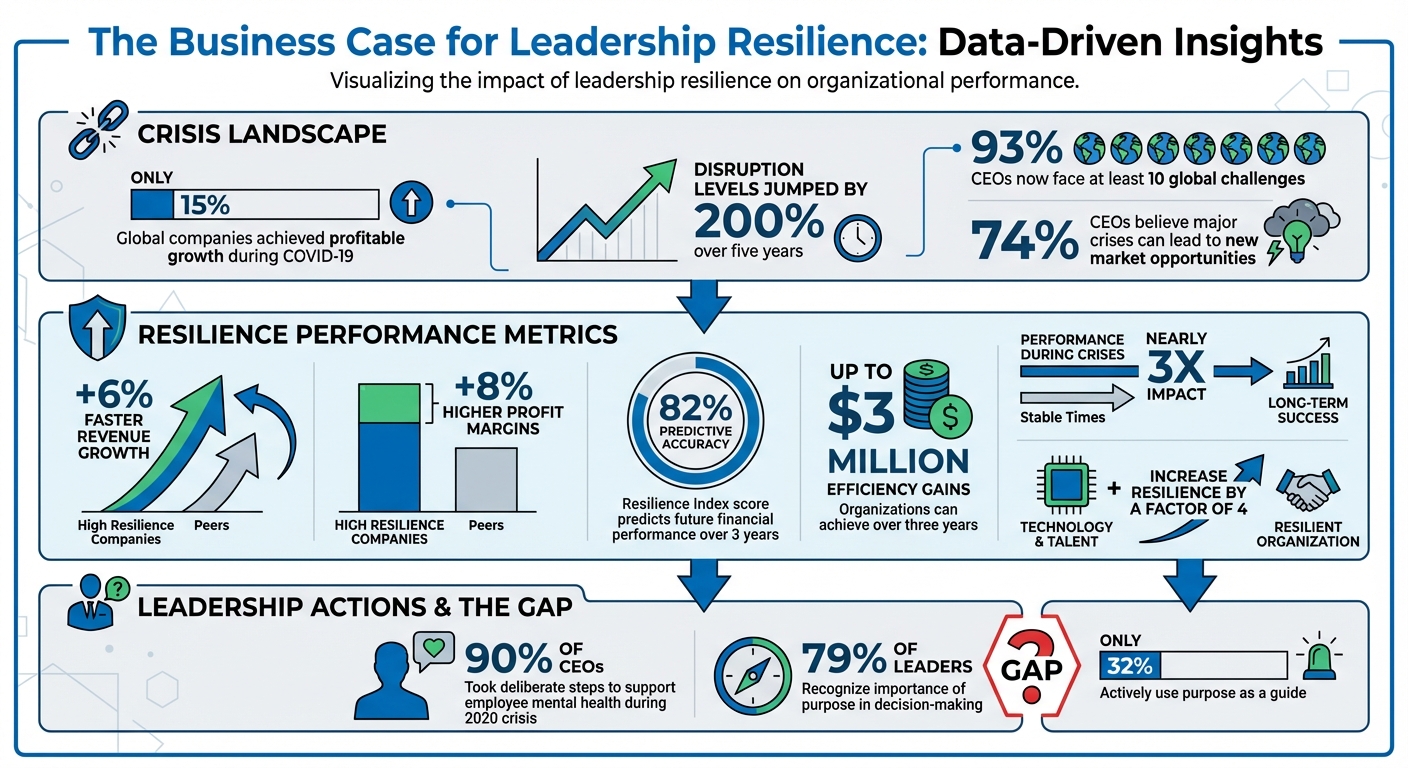
Leadership Resilience Impact on Business Performance: Key Statistics
A Leader’s Guide to Building Organizational Resilience
sbb-itb-bc03425
How Leadership Resilience Affects Business Stability
When it comes to leadership resilience, its influence on business stability is undeniable. It’s not just about surviving tough times – it’s about keeping operations running smoothly and safeguarding revenue during disruptions. The numbers paint a clear picture: only 15% of global companies achieved profitable growth during COVID-19, disruption levels jumped by 200% over five years, and 93% of CEOs now face at least 10 global challenges. These stats highlight the pressing need for leaders to act decisively when uncertainty strikes.
What separates stable organizations from those that stumble? The answer often lies in leadership response. Resilient leaders focus on swift, centralized decision-making to avoid getting bogged down by indecision. They implement "mission triage", prioritizing critical tasks that protect cash flow while postponing less urgent projects. This strategy ensures teams can continue operating effectively, even with limited resources.
Take Apple as an example during the early days of COVID-19. The company temporarily closed retail stores in affected areas but continued paying hourly employees as if operations were normal. They also transitioned their annual Worldwide Developers Conference in June 2020 to an entirely digital format, using their strong online presence to keep customers engaged. This approach showcased the power of mission triage, keeping essential functions intact and adapting quickly to new conditions.
Resilient vs. Non-Resilient Leadership: A Comparison
| Metric | Resilient Leadership | Non-Resilient Leadership |
|---|---|---|
| Decision-Making | Prioritizes speed, relying on "good enough" data to move forward | Delays action, waiting for perfect information and causing stagnation |
| Focus | Concentrates on mission-critical tasks, deferring less essential work | Gets stuck in processes, struggling to prioritize under pressure |
| Financial Strategy | Balances immediate cost reductions with long-term innovation investments | Relies heavily on deep cuts, which can slow recovery |
| Employee Impact | Builds team morale with hope, confidence, and optimism to handle stress | Focuses solely on output, risking burnout and disengagement |
| Communication | Provides clear, frequent updates to maintain trust | Communicates infrequently or inconsistently, leading to confusion and misinformation |
How Resilience Improves Crisis Management and Decision-Making
Resilient leaders possess a key advantage during crises: they act quickly, prioritizing speed over perfection. By accepting that not all data will be available, they make decisions that keep operations moving. This agility prevents paralysis and positions the organization for a faster recovery.
But the benefits of resilience go beyond immediate crisis handling. These leaders cultivate psychological resources in their teams – such as hope, confidence, and optimism – which help employees manage increased workloads. They also foster trust across multiple areas, including emotional, financial, and digital, creating a solid foundation for recovery and maintaining stakeholder confidence. For instance, UberEats adapted during the pandemic by introducing "touchless" delivery options, allowing customers to have food left at their door. This simple yet effective measure addressed safety concerns while ensuring uninterrupted service.
5 Steps to Build Leadership Resilience for Organizational Continuity
Strengthening leadership resilience is key to ensuring your organization can weather disruptions and maintain stability. These five steps provide a practical guide for leaders aiming to embed resilience into their leadership approach and organizational practices.
Step 1: Assess Crises Using Positive Leadership Resources
In times of crisis, leaders must quickly evaluate and reframe challenges by tapping into their psychological resources. Ask yourself critical questions like: "What past experiences can guide us? Where do we need to grow? What opportunities might emerge from this situation?"
Your psychological capital – self-efficacy, hope, resilience, and optimism – can serve as a buffer against the mental strain crises bring. For example, during the 2020 crisis, 90% of CEOs took deliberate steps to support their employees’ mental health.
A helpful tool here is cognitive reappraisal, which involves challenging and reframing the distorted thoughts that stress often triggers. Building trust within your team is also essential. As Stephen Covey famously said:
"Trust is the glue of life. It’s the most essential ingredient in effective communication. It’s the foundational principle that holds all relationships."
This step sets the stage for adaptive leadership and a clear vision, which are explored in Step 2.
Step 2: Develop Adaptive Leadership and a Clear Organizational Vision
Adaptive leadership is about shifting from reacting to crises to proactively shaping a "better normal." Interestingly, 74% of CEOs believe major crises can lead to new market opportunities.
This approach requires balancing leadership styles. Transformational leadership inspires with a compelling vision, while directive leadership ensures clarity and structure during chaotic periods. Together, they provide a solid foundation for navigating uncertainty.
To implement this, define your vision for the future and work backward. Use agile methods, like six-week sprints, to allow for quick adjustments as new information arises. Empower your teams by decentralizing decision-making, which fosters agility throughout the organization.
Step 3: Build a Culture of Continuous Learning and Knowledge Sharing
Resilient organizations grow stronger through challenges by fostering a culture of learning. Regularly reflect on what’s working and what needs improvement. A simple exercise like "Continue, Stop, Start" can help teams identify practices to maintain, eliminate, or introduce.
Empathy mapping is another powerful tool. By gathering diverse teams to explore the needs of stakeholders – whether customers, employees, or partners – you can enhance collective emotional intelligence and ensure the organization focuses on the right challenges. Pausing to reflect at key milestones also helps capture valuable lessons for the future.
Make knowledge sharing part of everyday operations. Use tools like digital collaboration platforms or cross-functional meetings to encourage open communication. Once this becomes routine, formal training and realistic drills can further prepare your team for future disruptions.
Step 4: Implement Employee Training and Scenario Drills
Training equips employees with the skills and confidence needed to handle crises effectively. Scenario-based drills simulate real-world challenges, helping teams build the muscle memory required to respond cohesively.
Focus on readiness by fostering an attitude of anticipation and awareness. Expand training beyond crisis response to include areas like emotional regulation, communication under pressure, and decision-making with incomplete information.
Step 5: Integrate Resilience into Planning and Decision-Making Processes
To make resilience a core part of your organization, extend short-term tactics into long-term planning. This involves incorporating resilience into both strategic and operational decision-making.
Move beyond immediate contingencies to medium- and long-term scenario planning. For example, model various economic scenarios to assess their impact on financial health over the next 18–24 months. Identify critical products, services, or customer segments that must be preserved to ensure cash flow and future growth.
Effective decision-making during crises requires balancing optimism with realism, and rationality with intuition. Bring cross-functional teams together to co-create strategies, ensuring everyone has a stake in the shared vision. This collaborative approach reduces the need for buy-in later.
As Kevin Sowers, President of Johns Hopkins Health System, put it:
"Resilience … is about how we acknowledge, respond to, and rise above chaos, and how we act on the other side of that disruption".
Using Resilient Power‘s Expertise for Resilience Building

When disruption hits, there’s no room for trial and error – organizations need proven strategies and fast action. Resilient Power has earned its reputation for providing tailored solutions to executive challenges, partnering with companies, including those in the Fortune 200, to strengthen workforce resilience. Their strategy starts at the top, focusing on leaders and their immediate teams. This creates a ripple effect of resilience that spreads naturally throughout the organization, ensuring operational stability. By identifying vulnerabilities before adversity strikes, Resilient Power positions teams for long-term success.
Implementation Strategies for Leadership and Team Alignment
Resilient Power’s approach goes beyond the surface, emphasizing science-backed techniques to align teams during high-pressure situations. Their methods focus on improving communication and self-regulation, enabling leaders to simplify complex scenarios and enhance team performance. By fostering a deeper listening mindset, leaders can boost team cohesion and retention. Treating resilience as a core business strategy aligns organizational goals with business needs, sharpening agility and competitiveness. This process ensures resources are used effectively and decisions are optimized, transforming resilience into a strategic advantage rather than just a defensive measure.
Incident Response Capabilities for Risk Mitigation and Recovery
In crisis situations, Resilient Power acts fast – often responding within hours – to guide leaders through complex challenges and restore stability. Combining AI-driven technologies with tailored remote solutions, they adapt their response to fit each organization’s unique needs. This tech-driven approach is balanced with a human-centric focus, prioritizing containment and minimizing impact.
"Resilient Power incident response capabilities are designed to address the full spectrum of human behavior, resolve incidents, and support risk management and business recovery."
Their expertise spans a wide range of scenarios, addressing the human side of crises while managing risks and driving recovery. With experience supporting Fortune 500 companies and tech startups in some of the most demanding environments, Resilient Power ensures leadership resilience remains the cornerstone of organizational continuity during critical moments. This integrated strategy provides a steady foundation when it’s needed most.
Measuring the Impact of Leadership Resilience on Continuity Outcomes
Once resilience strategies are in place, the next step is making sure they actually work. It’s not enough to focus on building leadership resilience – organizations need solid proof that these efforts lead to better results, especially during challenging times. Without measurable outcomes, resilience can feel like an abstract concept, leaving boards and stakeholders unconvinced. That’s where specific metrics and structured frameworks come into play.
Key Metrics to Evaluate Leadership Resilience
To measure resilience effectively, organizations need to examine performance from multiple angles. Key indicators include the extent of performance decline during a crisis, the speed of recovery, and whether the organization emerges stronger after the disruption.
One useful approach is the Five Capitals Framework, which evaluates resilience across five areas:
- People: Metrics like employee well-being, retention rates, and mental health support.
- Operations: Stability of products, services, and supply chains.
- Finance: Liquidity, revenue consistency, and the ability to sustain operations over 18 to 24 months.
- Reputation: Stakeholder trust and brand perception.
- Environment: Long-term sustainability practices.
The numbers tell a compelling story. Companies with high resilience grow revenues 6 percentage points faster than their peers and maintain profit margins that are 8 percentage points higher. Even more impressive, a company’s Resilience Index score can predict future financial performance with 82% accuracy over a three-year horizon. This highlights that resilience metrics aren’t just about looking back – they’re also powerful tools for forecasting.
"A resilience strategy that cannot be measured cannot be trusted." – Scott Balentine, Disaster Recovery Program Manager, Methodist Le Bonheur Healthcare
For boards and executives, financial metrics often carry the most weight. Key measurements include recovery time versus planned Recovery Time Objectives (RTO), the speed of decision-making during crises, and corrective action closure rates. These indicators ensure that resilience investments pay off. In fact, organizations that prioritize these metrics can achieve up to $3 million in efficiency gains over three years. Qualitative metrics, like manager confidence levels tracked with Green/Yellow/Red ratings, also provide important insights into leadership vulnerabilities and areas needing stronger buy-in.
Real-world examples show how these metrics translate into action.
Case Studies and Practical Examples
Take Norsk Hydro in March 2019. When the company faced a ransomware attack from LockerGoga, leadership leaned on internal measurement systems to provide transparent updates about recovery costs and corrective actions. This openness preserved trust with regulators and customers while helping the company fine-tune its future security strategies.
Contrast that with Southwest Airlines’ operational meltdown in December 2022. Their outdated scheduling system lacked performance metrics, leaving leaders unable to provide clear recovery timelines to employees or passengers. The fallout? A $140 million fine from the US Department of Transportation and significant damage to their reputation.
The difference between these two outcomes is striking. Only 15% of companies manage to sustain profitable growth during and after major disruptions. What sets those companies apart? High scores in technology and talent, which increase resilience by a factor of 4. Performance during crises has nearly 3 times the impact on long-term success compared to performance during stable times. These measurable outcomes directly affect an organization’s future, making resilience a critical investment.
Conclusion
Reflecting on adaptive leadership and forward-thinking strategies, one thing stands out: resilient leadership has the power to transform disruptions into stepping stones for growth.
The real difference between organizations that merely survive and those that thrive lies in their approach. Shifting from reactive crisis management to a proactive, opportunity-driven mindset is key. The question isn’t whether disruptions will come – they will. The real question is whether your leadership team can pivot from short-term solutions to a broader, long-term vision that embraces agility and strategic creativity.
At the heart of resilience is trust. When organizations focus on psychological safety, open communication, and purpose-driven choices, they foster an environment where teams can adapt and excel under pressure. However, there’s a gap: while 79% of leaders recognize the importance of purpose in decision-making, only 32% actively use it as a guide.
Building leadership resilience turns challenges into opportunities for lasting growth. By embedding these practices, your organization can achieve more than just survival – it can secure a competitive edge in an unpredictable world.
FAQs
What does “mission triage” mean in a crisis?
In times of crisis, "mission triage" refers to the process of organizing tasks or responses by their level of urgency and importance. This approach ensures that the most pressing issues are tackled first, allowing organizations to stay stable and continue operating effectively during difficult circumstances.
How can we measure leadership resilience in business results?
Leadership resilience shows itself in measurable ways, often tied to both predictive indicators and performance outcomes. For example, metrics such as revenue growth, profit margins, and long-term profitability are solid benchmarks for gauging how well leaders handle disruptions while keeping their organizations stable. Resilient organizations tend to excel in these areas, often surpassing their competitors in financial performance.
To get a full picture of resilience’s influence on business outcomes, it’s important to pair these hard numbers with qualitative insights. Observing how leaders adapt to challenges or the behaviors they exhibit under pressure adds depth to the analysis, creating a more rounded understanding of resilience in action.
What’s the fastest way to build resilience across leaders and teams?
Building resilience quickly comes down to incorporating proven practices that boost your physical, mental, emotional, and social health. Small, consistent habits like getting enough sleep, staying active, practicing mindfulness, expressing gratitude, and nurturing social connections can make a big difference – and they’re easy to weave into your daily routine.
For organizations, resilience grows when there’s a focus on creating psychological safety, encouraging adaptive leadership, and promoting open communication. These strategies empower both leaders and teams to identify weaknesses early and tackle challenges with confidence.