
Psychological safety is the belief that you can share ideas, ask questions, or admit mistakes at work without fear of embarrassment or punishment. Research, including Google’s Project Aristotle, shows it’s a key factor in high-performing teams. Yet, a 2019 Gallup poll found only 30% of employees strongly feel their opinions matter at work.
Leaders play a critical role in creating this environment by focusing on trust, open communication, and learning. Timothy R. Clark outlines four stages to build psychological safety: Inclusion (feeling valued), Learner (safe to ask questions), Contributor (using skills), and Challenger (questioning norms). Each stage builds on the last, requiring intentional effort.
Key leadership behaviors to support psychological safety include:
- Consultative Leadership: Involve the team in decision-making and ask for input.
- Supportive Leadership: Show genuine care for team members’ well-being.
- Challenging Leadership: Encourage accountability and push boundaries once trust is established.
Practical steps include framing work as a learning opportunity, inviting feedback, and responding constructively to mistakes. Tools like anonymous surveys and feedback sessions help measure and maintain psychological safety over time. Leaders who prioritize these practices can build resilient, engaged teams while reducing turnover and improving performance.
How Leaders Build Psychological Safety in Teams
sbb-itb-bc03425
The 4 Stages of Psychological Safety
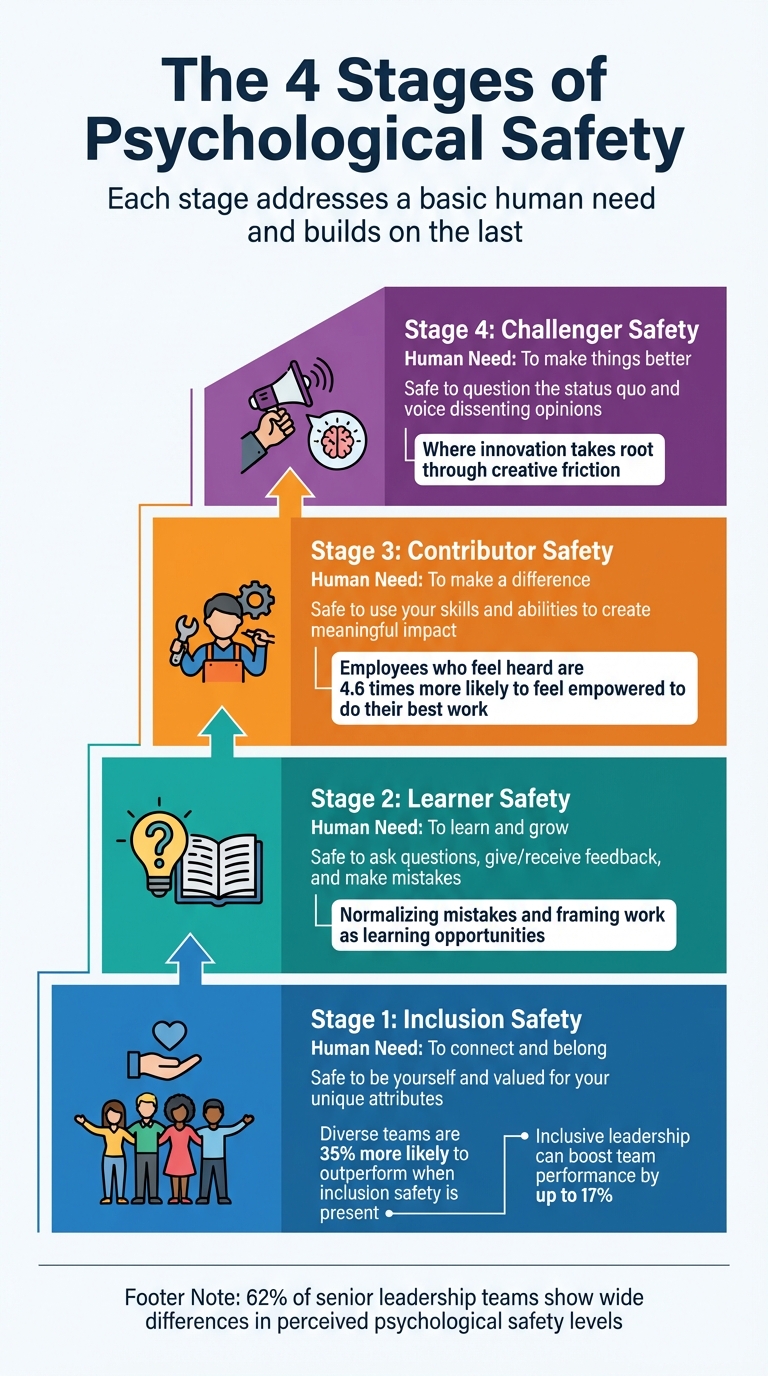
The 4 Stages of Psychological Safety in Teams
Timothy R. Clark, CEO of LeaderFactor, describes psychological safety as "a culture where vulnerability is rewarded". This kind of culture doesn’t just appear out of nowhere – it develops gradually through four distinct stages, each addressing a basic human need. These stages range from fostering a sense of belonging to empowering individuals to challenge ideas without fear of backlash.
By understanding these stages, leaders can pinpoint where their teams currently stand and take targeted steps to improve. Research reveals that 62% of senior leadership teams show wide differences in perceived psychological safety levels. It’s important to note that teams can’t skip stages – employees won’t feel comfortable challenging norms if they don’t first feel they belong. Each stage builds on the last, creating a solid foundation for a psychologically safe environment.
| Stage | Human Need Satisfied | Key Characteristic |
|---|---|---|
| 1. Inclusion | To connect and belong | Safe to be yourself and valued for your unique attributes. |
| 2. Learner | To learn and grow | Safe to ask questions, give/receive feedback, and make mistakes. |
| 3. Contributor | To make a difference | Safe to use your skills and abilities to create meaningful impact. |
| 4. Challenger | To make things better | Safe to question the status quo and voice dissenting opinions. |
Let’s break down each stage and explore how leaders can take practical steps to bring them to life.
Stage 1: Inclusion Safety
Inclusion Safety lays the groundwork for psychological safety. At this stage, team members feel accepted and valued for who they are, regardless of their background or experience. A sense of belonging is essential before deeper engagement can occur.
Leaders can nurture Inclusion Safety by celebrating each team member’s unique contributions and ensuring everyone feels they have a place. For instance, starting meetings with a round of appreciation – where team members highlight each other’s contributions – can help foster this sense of belonging. The goal is to make everyone feel genuinely included, not just tolerated.
The benefits of getting this right are clear: diverse teams are 35% more likely to outperform less diverse ones when inclusion safety is present. Additionally, inclusive leadership can boost team performance by up to 17%. But these benefits only come when individuals feel truly welcomed.
Stage 2: Learner Safety
Once inclusion is established, the focus shifts to creating a space where growth is encouraged. Learner Safety ensures that asking questions, seeking feedback, and making mistakes are viewed as natural parts of the learning process – not as signs of failure.
Leaders can promote Learner Safety by normalizing mistakes. For example, holding structured debrief sessions after projects helps teams reflect on what worked and what didn’t. Framing tasks as opportunities for growth, rather than just execution, also reinforces this mindset. When leaders openly admit their own mistakes and ask for help, they signal that vulnerability is not just accepted – it’s valued.
Without Learner Safety, perfectionism can take over. In such environments, people hide errors and avoid asking questions out of fear of judgment. In contrast, teams with strong Learner Safety focus on solutions instead of blame, creating a healthier and more productive dynamic.
Stage 3: Contributor Safety
Contributor Safety is about empowering team members to use their skills and abilities to make meaningful contributions. At this stage, individuals feel confident taking ownership of their work and solving problems proactively, rather than waiting for instructions.
Leaders can build Contributor Safety by balancing autonomy with accountability. This means setting clear expectations, providing the necessary resources, and then stepping back to let team members take charge. Recognizing individual contributions and creating formal opportunities for team input further reinforces this stage.
The impact is significant: employees who feel heard are 4.6 times more likely to feel empowered to do their best work. When team members move from simply completing tasks to actively shaping outcomes, engagement and creativity thrive.
Stage 4: Challenger Safety
The final stage, Challenger Safety, allows team members to question the status quo, propose bold ideas, and raise concerns without fear of retaliation. This stage is where innovation truly takes root, as healthy disagreements – often referred to as “creative friction” – can spark new solutions.
To cultivate Challenger Safety, leaders must actively invite dissent and address tough issues head-on. They should also publicly support thoughtful risk-taking, even when the outcomes aren’t perfect. A simple way to gauge this is to observe whether team members feel comfortable sharing unpolished ideas.
Robert Sutton, an organizational psychologist at Stanford University, offers a practical test:
"A good test is, who are the stars in your workplace? Are they the people who stifle, frighten, and blame their colleagues? Or do they promote learning and drive out fear by talking openly about their own mistakes…?"
Leadership Behaviors That Build Psychological Safety
Turning the concept of psychological safety into a reality requires leaders to translate the four stages of safety into daily actions. With only 43% of employees reporting a positive team climate, it’s clear that leaders need to go beyond formal meetings and reviews. By adopting consultative, supportive, and challenging leadership styles, they can create an environment where psychological safety thrives. After all, a positive team climate is the most important driver of psychological safety.
Consultative Leadership
Consultative leadership is all about involving the team in decision-making. Rather than simply presenting a plan, this style encourages open dialogue with questions like, “What do you think?” This approach not only makes team members feel valued but also directly boosts psychological safety. Research shows it has a standardized regression coefficient of 0.54 in its relationship with safety levels.
Amy Edmondson, a leadership expert and professor at Harvard Business School, explains:
"By asking good questions, you’re saying, ‘I value your voice.’"
Leaders can embrace this style by consistently seeking input and asking open-ended questions. Admitting when you don’t have all the answers is another powerful way to demonstrate humility. Yet, despite its importance, only 36% of organizations include this skill in their leadership training programs.
Supportive Leadership
Supportive leadership focuses on showing genuine care for team members as individuals. This means paying attention to their well-being, addressing personal needs, and fostering a sense of mutual support. While supportive behaviors don’t directly create psychological safety, they lay the groundwork for it to flourish.
To excel in this area, leaders need empathy, active listening, and emotional intelligence. It’s not just about hearing words – it’s about understanding the emotions and values behind them. One-on-one meetings, often referred to as individuation, can help leaders connect with team members on a deeper level and recognize their unique needs. The payoff? Employees in organizations that prioritize leadership development are 64% more likely to view their leaders as inclusive.
Supportive leadership isn’t about avoiding tough conversations. Instead, it builds the trust necessary to make those discussions meaningful and productive.
Challenging Leadership
Once consultative and supportive practices are firmly in place, leaders can introduce challenging behaviors to encourage growth. Challenging leadership involves holding teams accountable and encouraging them to question assumptions and push their boundaries. However, this approach only works when trust is already established. Without trust, challenges may come across as criticism rather than opportunities for growth.
| Leadership Style | Primary Focus | Impact on Psychological Safety |
|---|---|---|
| Consultative | Gathering input and team perspectives | Directly and indirectly boosts psychological safety; strengthens team climate |
| Supportive | Caring for individual well-being | Indirectly contributes by fostering a positive team climate |
| Challenging | Encouraging accountability and growth | Positive impact only when trust and a positive climate are already present |
| Authoritative | Command-and-control | Detrimental to psychological safety |
The order matters. Leaders must first establish supportive and consultative behaviors before introducing challenging ones. Amy Edmondson emphasizes this:
"You no longer have the option of leading through fear or managing through fear. In an uncertain, interdependent world, it doesn’t work – either as a motivator or as an enabler of high performance."
Once trust is solid, challenging leadership can inspire team members to push beyond their perceived limits and achieve professional growth. These behaviors aren’t one-time efforts – they require consistent, intentional practice to maintain a climate of safety.
At Resilient Power®️, we incorporate these evidence-based leadership techniques into our methodologies, helping leaders create safer, more empowered teams that reach their full potential.
How to Implement Psychological Safety
Creating psychological safety begins with small, consistent actions that affirm your team’s contributions and encourage growth. Below are practical strategies to integrate the principles of psychological safety into your daily leadership practices.
Frame Work as a Learning Opportunity
The way you communicate as an executive about challenges shapes your team’s willingness to take risks and innovate. Instead of framing obstacles as pass-or-fail scenarios, present them as opportunities to learn. Show vulnerability by sharing your own challenges openly. For example, say, "I need help figuring this out." This kind of transparency normalizes behaviors like admitting uncertainty or asking questions – key drivers of high performance.
Make it clear that reasonable risks won’t result in punishment. Align psychological safety with goals your team values, such as innovation, inclusion, or customer satisfaction. Explain how fostering a learning environment directly supports these objectives. To reinforce this mindset, regularly seek your team’s input with open-ended questions.
Invite Input and Feedback
Once a learning culture is in place, actively encourage input and feedback. Instead of presenting fully formed plans, ask questions like, "What do you think?" or "Do you have any ideas?" A compelling example of this approach comes from a late 2021 study conducted by Sandoz, a division of Novartis. This randomized controlled trial involved over 1,000 teams and 7,000 individuals worldwide. Led by Chris Rider and Antoine Ferrère, the study introduced a six-week intervention where managers held one-on-one meetings tailored to each employee’s unique needs. The results? Increased psychological safety and a higher likelihood of employees reporting ethical concerns or misconduct.
This method works because it treats employees as individuals, not just resources. Regular one-on-one meetings help uncover each person’s needs, concerns, and goals, fostering the trust necessary for open dialogue. In hybrid or remote setups, active listening during video calls and encouraging written input through chat functions can help ensure everyone’s voice is heard.
Also, pay attention to who speaks up and who stays silent. Research shows that 62% of senior leadership teams experience significant differences in perceived psychological safety levels.
Respond Productively to Failures
Your reaction to mistakes and setbacks sets the tone for honesty within your team. As Amy Edmondson, a leadership expert at Harvard Business School, advises:
"Don’t shoot the messenger. Don’t get angry when you hear a dissenting view or bad news. In a volatile, uncertain, complex world, there will always be bad news. If there’s no bad news, remind yourself: It’s not that it’s not there. It’s that you’re not hearing about it."
When errors happen, thank the person who brought them to your attention and focus on finding solutions instead of assigning blame. Reward the courage it takes to admit mistakes and explore alternatives. Incorporate "lessons learned" sessions into project reviews to discuss missteps and identify areas for improvement. Sharing your own past mistakes and the lessons they taught you can further reduce fear and encourage a culture of learning.
Robert Sutton, a Stanford professor and organizational psychologist, offers this thought-provoking question:
"A good test is, who are the stars in your workplace? Are they the people who stifle, frighten, and blame their colleagues? Or do they promote learning and drive out fear by talking openly about their own mistakes and gently but candidly pointing out others’ failures and mistakes, and talking about what we can all learn together from such troubles?"
Measuring and Maintaining Psychological Safety
Assessing Psychological Safety in Teams
Broad surveys often fall short when it comes to understanding the complexities of team dynamics. Many organizations simplify psychological safety to a single-question survey, which is far too basic to capture the full picture. To truly gauge a team’s psychological safety, more specialized tools and approaches are necessary.
A reliable method involves assessing psychological safety across four key stages: Inclusion Safety (feeling accepted within the group), Learner Safety (feeling comfortable asking questions and making mistakes), Contributor Safety (feeling empowered to share skills and ideas), and Challenger Safety (feeling free to challenge the status quo). Tools like the Psychological Safety Index (PSI) are designed to measure these dimensions, offering both numerical scores and anonymous feedback to identify areas for improvement.
Interestingly, a team’s overall safety is often defined by its least safe member. A study involving nearly 300 leaders over 2.5 years revealed that 62% of senior leadership teams experienced significant differences in perceived psychological safety levels. This highlights the importance of looking beyond average scores to uncover patterns that might indicate if certain individuals or subgroups feel less secure.
To dig deeper, anonymous surveys with targeted questions like, "If you make a mistake on this team, will it be held against you?" can provide valuable insights. Pair these surveys with open-ended feedback sessions using prompts such as, "What is one thing that prevents you from feeling safe to learn on your team?". This approach not only identifies problem areas but also lays the groundwork for actionable improvements to strengthen team resilience.
Maintaining Psychological Safety Through Resilience-Building
Sustaining psychological safety requires ongoing effort to prevent teams from slipping back into environments that stifle innovation and inclusivity.
A strong maintenance plan combines regular assessments with continuous feedback. Tools like pulse surveys and direct feedback loops allow leaders to keep a finger on the pulse of team dynamics. Additionally, "lessons learned" debriefs after key milestones can foster open conversations about mistakes and opportunities for growth. As Amy Edmondson, a Harvard Business School professor, emphasizes:
"Leaders must prioritize a culture of learning and innovation for team members to be comfortable speaking up, taking risks, and sharing information. This does not happen by default. It emerges with effort and curiosity and care".
In 2021, Sandoz, part of Novartis, conducted a randomized controlled trial with over 1,000 teams and 7,000 participants. The study found that personalized manager support significantly improved psychological safety and encouraged employees to report ethical concerns.
Organizations like Resilient Power provide practical strategies to help leaders build resilience and foster long-term cultural shifts. Their evidence-based methods go beyond theoretical concepts, equipping teams to maintain psychological safety even during challenging times.
To keep safety intact, leaders should monitor variations in team dynamics, openly acknowledge those who challenge conventional ideas, and work to reduce hierarchical barriers that hinder honest communication. By staying proactive and fostering resilience, leaders can create an environment where psychological safety thrives.
Conclusion: The Leader’s Role in Psychological Safety
Leaders shape the environment in which their teams operate, and their actions determine whether employees feel secure enough to take risks and speak up. Leadership isn’t about sidestepping conflict – it’s about encouraging openness, constructive discussions, and a mindset of continuous improvement.
The impact of psychological safety is undeniable. Teams that feel safe are rated as effective twice as often by management and experience much lower turnover rates. Despite this, many teams still struggle with engagement and open communication. These gaps represent missed chances for fresh ideas and growth – opportunities no leader should overlook.
Creating a culture of psychological safety requires consistent effort. As W. Edwards Deming wisely said:
"Drive out fear, so that everyone may work effectively for the company".
Leaders can set the tone by showing humility – admitting mistakes and appreciating those who challenge their perspectives. When someone delivers tough feedback or questions your approach, publicly thank them to demonstrate that honesty is valued more than superficial agreement.
Making this shift takes ongoing dedication. Use blameless post-mortems to review projects without finger-pointing, encourage quieter team members to share their thoughts through structured participation methods, and consistently check in to gauge how safe team members feel.
Striking the right balance between high expectations and trust creates what researchers call the "Learning Zone", an environment where innovation can flourish. Drawing from proven strategies, organizations like Resilient Power offer frameworks to help leaders nurture these skills and drive lasting cultural change. Prioritizing psychological safety isn’t just a good idea – it’s a necessity for effective leadership.
FAQs
What’s the best way for leaders to measure psychological safety in their teams?
Leaders can gauge psychological safety effectively by leveraging tools specifically designed to evaluate its core aspects, such as inclusion, learning, and personal growth. Surveys tailored to measure psychological safety break the concept into clear, actionable components, providing data that can be tracked and analyzed over time.
Beyond surveys, observing real-time team dynamics can offer valuable insights. For instance, how often do team members share ideas, admit mistakes, or seek feedback? Combining these observations with anonymous suggestions or open-ended feedback gives a more comprehensive understanding. Regularly comparing these findings to team outcomes, like innovation levels or employee retention rates, ensures ongoing progress.
Resilient Power®️ provides tailored tools and strategies to help leaders implement these measurement systems, translating data into actionable steps that strengthen team alignment and drive measurable results.
What practical steps can leaders take to build psychological safety at every stage?
To encourage inclusion, make sure every team member feels appreciated and part of the group. Set clear expectations, actively seek input from diverse perspectives, and share personal experiences or admit mistakes to build trust. Regularly check in with team members, gather their feedback, and make adjustments to strengthen their sense of belonging.
For learning, create an environment where curiosity thrives. Treat mistakes as opportunities to grow, and celebrate thoughtful questions. Dedicate time in meetings for team members to share challenges and insights, fostering a space where it’s safe to ask for help and explore new ideas.
When it comes to contribution, assign tasks that tap into individual strengths and recognize achievements publicly. Encourage team members to suggest improvements, and when good ideas are implemented, it shows that everyone’s input has value.
At the challenge stage, invite open and constructive feedback by asking questions like, “What could we do better?” or offering anonymous ways to share concerns. Reward respectful disagreements and creative ideas, showing that speaking up drives progress and is an essential part of growth.
Why is it important for leaders to balance being supportive with providing challenges?
Balancing support with challenge is essential for creating a team that feels safe yet driven to perform at its best. Leaders who prioritize trust, empathy, and open communication foster an atmosphere where team members feel comfortable sharing ideas, owning up to mistakes, and taking risks without fear of backlash. This kind of environment naturally promotes teamwork, creativity, and personal development.
But leaning too much on support alone can lead to stagnation. To truly thrive, leaders need to challenge their teams as well – by setting clear goals, holding people accountable, and encouraging them to step outside their comfort zones. This combination not only drives growth but also helps individuals build resilience and question the status quo, skills that are essential in today’s fast-moving business world.
Resilient Power®️ provides leaders with proven strategies to strike this balance, helping teams feel empowered and inspired to reach new heights.