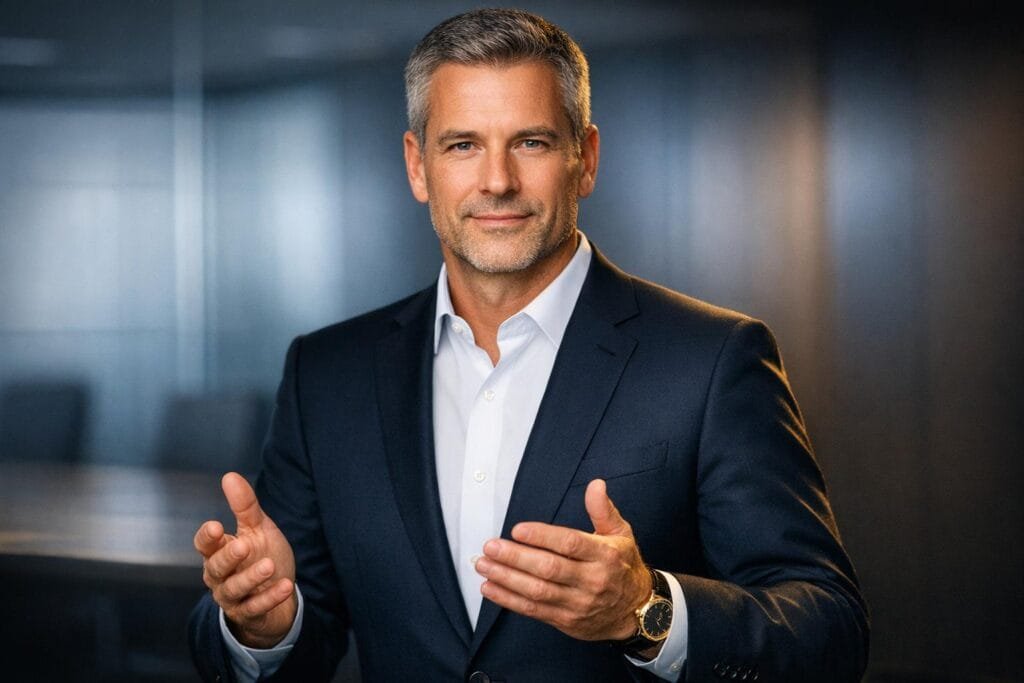
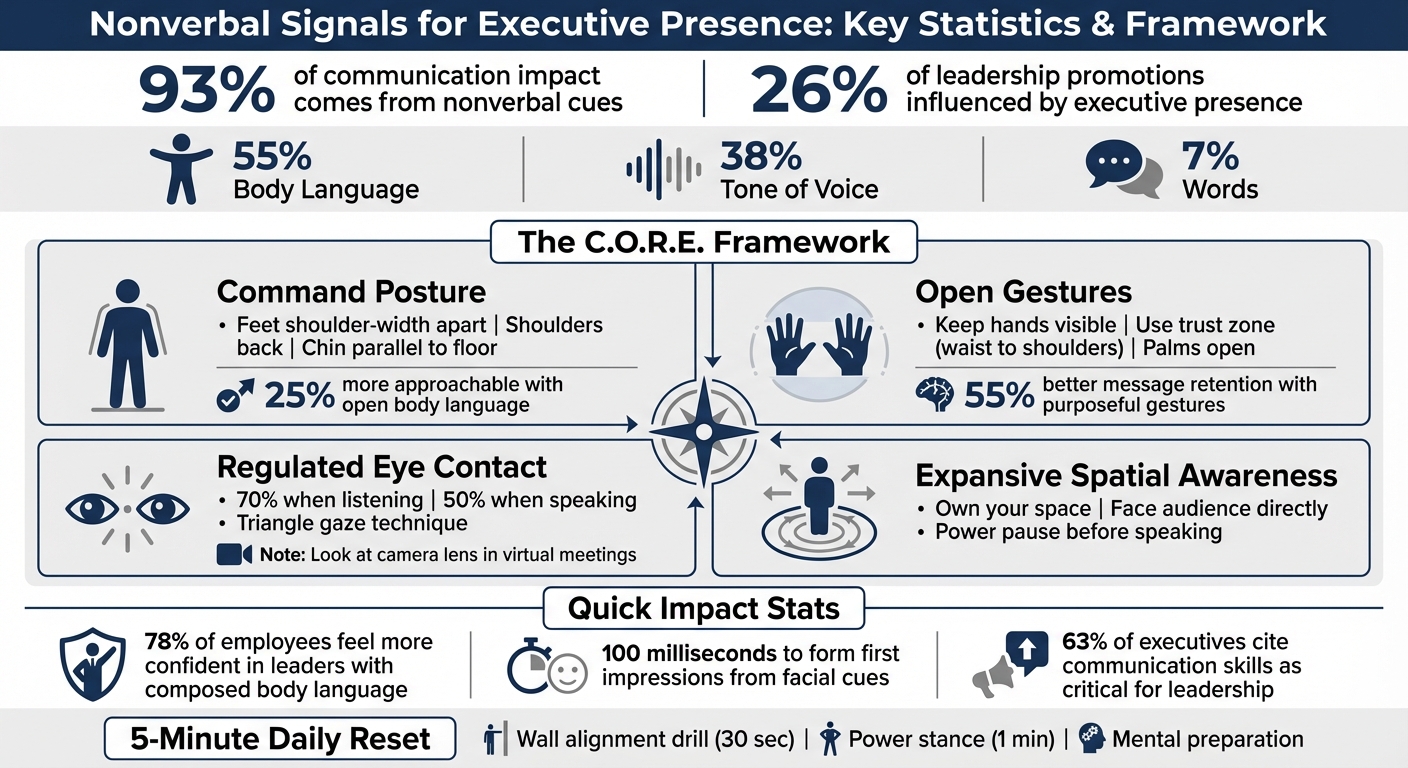
Nonverbal communication is a key factor in how others perceive your leadership abilities. Research shows that 93% of communication impact comes from nonverbal cues, including posture, gestures, eye contact, and facial expressions. These signals shape your executive presence, which influences 26% of leadership promotions.
Here’s what you need to know to improve your nonverbal communication:
- Posture: Stand tall with a balanced stance to project confidence and control.
- Eye Contact: Maintain steady, intentional eye contact to build trust and authority.
- Gestures: Use purposeful hand movements within the "trust zone" (waist to shoulders) to reinforce your message.
- Facial Expressions: Keep a neutral-calm expression to convey composure and credibility, especially in high-pressure situations.
Executive Presence: Nonverbal Communication Impact Statistics and Key Techniques
The Power of Neutral Body Language for Executive Presence
sbb-itb-bc03425
Posture: Building Authority and Confidence
Your posture is the cornerstone of your physical presence. Before you even speak, people are already sizing up your body language, deciding if you’re someone worth paying attention to. how you carry yourself can either enhance your executive communication or quietly chip away at it.
Command posture is the go-to stance for projecting leadership. Stand with your feet shoulder-width apart, distribute your weight evenly, and keep your spine elongated. Relax your shoulders while keeping them back, and hold your chin parallel to the floor. This posture communicates stability, readiness, and control – qualities that instantly signal leadership. In fact, research shows that leaders who adopt open, confident body language are seen as 25% more approachable than those who don’t.
Posture doesn’t just affect how others see you – it impacts how you feel about yourself. Studies reveal that adopting expansive, "high-power" postures can spark hormonal changes, increasing testosterone (linked to confidence) and reducing cortisol (the stress hormone). Standing tall doesn’t just make you look confident – it can actually make you feel more capable. Let’s take a closer look at specific postures that can elevate your executive presence.
Key Postures for Executive Presence
Different scenarios call for slightly different postures, but the underlying principle is simple: own your space with intention. When standing, stick to the command posture mentioned earlier. When seated, sit all the way back in your chair, keep both feet flat on the floor, and rest your hands visibly on the table or armrests. This signals engagement and authority.
For added impact, try the engagement lean – lean forward about 10 degrees when making an important point – or the power pause – plant your feet firmly and take a 2–3 second pause to scan the room before speaking. Both techniques convey confidence and control. If you ever feel your posture slipping, reset with the wall alignment drill: stand against a wall with your heels, hips, shoulders, and head touching the surface for 30 seconds. This exercise helps recalibrate your posture and reinforces your baseline stance.
Picture a swan gliding across a pond – graceful and composed on the surface, but paddling furiously beneath the water. When you’re in control, you let others see only the calm, not the effort behind it.
Common Posture Mistakes and How to Fix Them
Even seasoned leaders can fall into posture habits that work against them. Recognizing and correcting these is key to maintaining authority.
One common misstep is the "apologetic lean", where your shoulders round forward and your chin tucks down, making you appear unsure. To fix this, roll your shoulders back and lift your chin to realign with your command posture.
Another trap is the "retreat step", where you instinctively step backward when faced with a challenge. This can signal hesitation. Instead, focus on grounding yourself – feel your feet firmly planted on the floor. This helps you stay steady and reduces nervous habits like foot tapping or leg bouncing.
Finally, avoid the "laptop shield" – hiding behind your screen during meetings creates a physical and emotional barrier, making you seem disengaged. Keep your body open, avoid crossing your arms or legs, and stay present. Remember, 78% of employees feel more confident in leaders who maintain composed body language, especially under pressure. Your team is always watching, and how you carry yourself during tough moments speaks volumes about your leadership.
Eye Contact: Building Trust and Connection
Eye contact is a powerful nonverbal tool that can instantly establish trust and connection. It’s one of the most effective ways to convey sincerity and confidence without uttering a single word. Research even suggests that eye contact is the number one nonverbal cue influencing how people perceive confidence, trustworthiness, and authority. Maintaining steady eye contact signals calmness and control, while too little can come across as insecure, and too much may feel intimidating. Striking the right balance is key.
Leaders who regulate their eye contact effectively are often seen as more competent and trustworthy than those who avoid or overdo it. In challenging conversations, steady eye contact helps maintain professionalism and rapport, even when tensions run high. On the other hand, glancing sideways can signal distraction, and looking downward might imply submission or a lack of confidence.
Techniques for Effective Eye Contact
So, how can you master the art of regulated eye contact? Start with the 70/30 Rule: aim to maintain eye contact about 70% of the time while listening and 50% while speaking. This balance fosters connection without overwhelming the other person. For one-on-one interactions, try the Triangle Gaze – let your gaze shift gently between the person’s left eye, right eye, and forehead in a triangular motion. This prevents the discomfort of prolonged staring.
In group settings, the Lighthouse Technique is especially useful. Slowly sweep your gaze across the room, pausing for 3–5 seconds on each person to make everyone feel included. For large audiences, focus on 3–4 anchor people positioned in different parts of the room. Deliver one complete thought to each anchor to create the illusion of personal connection with the entire audience. Additionally, hold eye contact for the duration of a specific thought before shifting your gaze to avoid appearing distracted.
It’s also important to consider cultural differences. In Western business settings, steady eye contact is a sign of confidence and global resilience in leadership, but in some cultures, it can be interpreted as confrontational. Always tailor your approach to the audience, ensuring your eye contact feels intentional and builds trust. When working in virtual environments, these principles need slight adjustments to suit the medium.
Eye Contact in Virtual Meetings
Virtual meetings present unique challenges for maintaining effective eye contact. Since your face fills the screen, even small nonverbal cues like eye movements or expressions are magnified. One common issue is that looking at participants’ faces on the screen can make it seem like you’re looking away or down.
The fix is straightforward but takes practice: look directly into the camera lens to simulate direct eye contact. To make this feel natural, position your camera at eye level. While you don’t need to stare into the camera for the entire meeting, aligning your gaze with key points in the discussion can greatly enhance how others perceive your engagement and authority.
"Eye contact is a primary way to create connection with others while communicating." – Angie (Min Ah) Park, The Humphrey Group
Gestures: Reinforcing Your Message
Hand gestures do more than accompany your words – they help your message stick. Research from UCLA reveals that nonverbal signals make up 55% of communication impact. When your gestures align with your words, they create a sense of consistency that strengthens your professional credibility. On the flip side, when verbal and nonverbal cues clash, people are more likely to trust what they see over what they hear.
"Nonverbal cues are either supporting your message or detracting from it." – Vanessa Van Edwards, Author of Cues: Small Signals, Incredible Impact
To maximize the effectiveness of your gestures, keep them within the "trust zone" – the area between your waist and shoulders. Gestures in this zone convey honesty and engagement. Open gestures with visible palms signal transparency and confidence, while crossed arms or hidden hands can suggest defensiveness or unease. In virtual meetings, this becomes even more important since your upper body is the primary focus. Keep your hands visible in the camera frame to project the same authority you’d have in person.
Effective Gestures for Leadership Impact
Certain gestures can elevate your presence as a leader. These deliberate movements, when paired with strong posture and eye contact, enhance how others perceive you.
- The steeple gesture – pressing fingertips together with palms apart – exudes confidence and expertise. It’s particularly impactful when making decisive statements or expressing firm positions.
- For conclusions or directives, try palms-down pressing. Whether pressing your hands flat on a table or gesturing downward, this movement anchors authority and conveys finality.
- Illustrative gestures make complex ideas easier to understand. Use your hands to outline a timeline, show scale, or count off points. These controlled movements not only project confidence but also help your audience retain information. In fact, research shows that listeners remember up to 55% more of a leader’s message when supported by purposeful gestures.
The key is to ensure each gesture serves a purpose, reinforcing your words rather than becoming a distraction.
Balancing Gestures for Professionalism
While purposeful gestures can amplify your message, overdoing it or using uncontrolled movements can have the opposite effect. Avoid self-soothing gestures like touching your face, fidgeting with objects, or wringing your hands – these actions signal nervousness and self-doubt. Similarly, the "fig leaf" position, where hands clasp in front of your body, can appear vulnerable. Instead, aim for an open, neutral stance with your hands at your sides.
Frantic or abrupt movements can also undermine your authority, and pointing directly at someone may come across as hostile. Open body language, on the other hand, makes leaders appear 25% more approachable. Before starting a presentation, practice the "power pause" – stand still for 2–3 seconds with your hands in a neutral position. This signals control and sets the stage for deliberate gestures. If you’re prone to fidgeting, record yourself speaking and watch on mute to identify any unconscious habits. Replace these with neutral positions, like resting your hands flat on a table.
Facial Expressions: Showing Poise and Approachability
Your facial expressions, much like posture and eye contact, play a key role in shaping the nonverbal signals that define executive presence. They can immediately set the tone for leadership. Studies reveal that people form opinions about competence and trustworthiness in just 100 milliseconds based on facial cues.
The trick for leaders is finding the right balance between warmth and authority. Staying composed under pressure can boost employee confidence by an impressive 78%. However, small, unconscious reactions – like a tight-lipped smile or a frozen expression – can unintentionally broadcast anxiety or defensiveness. Your facial expressions should always match the seriousness of your message.
The Power of Calm Expressions
One of the most impactful tools in a leader’s arsenal is the "neutral-calm" expression. This involves a relaxed brow, an unclenched jaw, and a soft, natural mouth. This look exudes self-control and authority. In tough situations, pairing this with "interested neutrality" – attentive eyes and a slight nod – can project calm determination.
Be mindful of the "Smile Override." Smiling at the wrong time, especially during serious moments, can undermine your authority. Instead of signaling strength, it may come across as an attempt to pacify. For moments like delivering tough feedback or making firm decisions, a calm and neutral expression is far more effective.
When stress starts to creep in, try the "name it to tame it" approach. Acknowledge what you’re feeling – like saying to yourself, "my face feels tense" – to help reduce the physical signs of stress. Another helpful trick is to slow your exhale, which activates the parasympathetic nervous system and naturally eases facial tension. Once you’ve regained composure, subtle mirroring can help build a stronger connection with others.
Mirroring to Build Rapport
Facial expressions, just like gestures and eye contact, can strengthen trust and reinforce your presence as a leader. Subtle mirroring – matching someone else’s expressions and pace – can create a subconscious sense of connection and alignment. Timing is critical here. Wait about 3–5 seconds before mirroring someone’s posture or expression to keep the interaction natural. For instance, if a colleague leans forward with interest, pause briefly before leaning in yourself. If they adopt a serious expression during a challenging discussion, let your own expression reflect that seriousness after a short delay. This technique works particularly well in one-on-one settings, such as meetings or negotiations, where rapport is essential.
Combining Nonverbal Signals for Executive Presence
Once you’ve mastered posture, eye contact, gestures, and facial expressions individually, the real challenge lies in weaving them together into a cohesive presence. This alignment is what creates a strong executive presence. While each nonverbal cue plays its part, their power comes from working in harmony to support your message. When your body language and words contradict each other, people instinctively trust what they see over what they hear.
"When verbal and nonverbal messages conflict, people believe the body." – Confidence Playbook
Great leaders strike a balance between warmth and competence. Lean too far into competence without approachability, and you risk coming off as unrelatable. On the other hand, too much warmth without demonstrating capability might make you seem less credible. The earlier-mentioned C.O.R.E. Framework – Command Posture, Open Gestures, Regulated Eye Contact, and Expansive Spatial Awareness – brings these elements together. When aligned with your verbal communication, this framework can significantly boost your executive presence. In fact, executive presence is estimated to influence about 26% of career advancement into leadership roles.
Aligning Nonverbal and Verbal Communication
Mixed signals between what you say and how you act can erode trust. For example, confidently sharing quarterly results while nervously fidgeting or avoiding eye contact sends a message of uncertainty instead of confidence. Research shows that up to 93% of communication is nonverbal – 55% comes from body language and 38% from tone of voice. This means your audience is paying more attention to how you present yourself than to the words you’re saying.
To stay aligned, consider using the 5-Point Self-Scan. Every 15 minutes, check that your feet are firmly planted, your hands are steady and visible, your shoulders are back, your facial expressions match your tone, and your eyes are engaged with your audience. Before starting a presentation, try the Power Pause: walk to the front, plant your feet, and take 2–3 seconds to scan the room. This moment of stillness signals confidence and draws attention.
Body alignment also plays a key role. Facing your audience directly – head, torso, and feet – shows full engagement. When answering tough questions, pivot your entire body toward the speaker instead of just turning your head. This kind of purposeful alignment enhances both approachability and retention. Studies reveal that leaders using open body language are seen as 25% more approachable, and audiences remember up to 55% more when gestures are used effectively.
Practicing and Improving Nonverbal Skills
Improving your nonverbal communication takes practice and intention. A helpful technique is the Video Review on Mute. Record yourself during a meeting or presentation, then watch without sound to spot distracting habits like fidgeting, slouching, or mismatched expressions.
"Under duress, we do not rise to our expectations; we fall to the level of our training." – Bruce Lee (quoted by Brooke Vuckovic, Kellogg School of Management)
Start practicing in low-pressure situations to build confidence. Work on your power posture while waiting in line or during casual conversations. Before important meetings, try the Wall Alignment Drill: stand with your heels, hips, shoulders, and head against a wall for 30 seconds to reset your posture. To ground yourself and prevent fidgeting, focus on the sensation of your feet on the floor.
Feedback from peers can also be invaluable. Ask for observations about your facial expressions, eye contact, and any repetitive movements during high-pressure moments. For vocal variety, try reading children’s books out loud to play with pitch and tone – this helps avoid a monotone delivery. By practicing these techniques consistently in low-stakes environments, you’ll build the muscle memory needed to project calm authority and polish your executive presence. These small but deliberate steps can have a lasting impact on your leadership style.
Resilient Power‘s Approach to Nonverbal Communication

Resilient Power focuses on sharpening executive presence by fine-tuning nonverbal communication in less than 100 milliseconds. Backed by "thin slice" research, their training demonstrates how quick, silent glimpses of nonverbal behavior can create consistent impressions. This method integrates key elements like posture, eye contact, and gestures into comprehensive executive training.
Science-Based Training for Executive Presence
At the heart of Resilient Power’s strategy is the C.O.R.E. Framework: Command Posture, Open Gestures, Regulated Eye Contact, and Expansive Spatial Awareness. This structured system is designed to help leaders build authority and foster connection. The training also triggers hormonal changes – boosting testosterone while lowering cortisol – to help leaders stay composed under pressure. Notably, 63% of senior executives believe communication skills are critical to shaping perceptions of executive presence.
Through tools like video reviews and personalized feedback, leaders can uncover and address blind spots in their communication. The program emphasizes the alignment of verbal and nonverbal signals, as audiences tend to trust what they see when messages are consistent.
Customized Solutions for Leadership Success
Resilient Power takes it a step further with tailored coaching to refine each leader’s unique style. Using the Resilience Assessment, they establish a data-driven baseline to evaluate a leader’s current presence and identify areas for improvement. One-on-one coaching hones "body awareness", teaching leaders to monitor their breathing, heart rate, and posture so they can respond thoughtfully instead of reacting impulsively in high-pressure scenarios.
Postural assessments, guided by expert input, help correct common habits like slouching or holding tension. These evaluations lead to actionable strategies that build muscle memory through practice, enabling leaders to project calm authority naturally – even in the face of challenges.
Conclusion: Using Nonverbal Signals for Leadership Impact
Nonverbal cues are incredibly powerful, forming impressions within the first 100 milliseconds and accounting for up to 55% of your communication impact. When your body language doesn’t align with your words, people tend to trust what they see over what they hear.
To harness this, consider using the C.O.R.E. Framework – Command Posture, Open Gestures, Regulated Eye Contact, and Expansive Spatial Awareness. Start your day with a simple 5-Minute Morning Reset: stand against a wall to correct your posture, hold a power stance for one minute, and mentally prepare for key interactions. During meetings, dedicate 15 minutes to a Self-Scan, checking that your posture, gestures, and facial expressions are consistent with your message.
"Executive presence is the ability to inspire confidence – in your subordinates that you’re the leader they want to follow, in your peers that you’re capable and reliable, and in senior leaders that you have the potential for great achievements."
- Forbes (cited by Richard Reid)
Executive presence plays a major role in leadership success, influencing 26% of leadership promotions. Additionally, 63% of executives highlight communication skills as a critical factor in effective leadership. This makes mastering nonverbal communication a key step toward advancing your career.
If you’re looking to refine these skills, Resilient Power offers personalized, science-backed training. Their approach includes video analysis and tailored feedback, giving you a clear, actionable plan to strengthen your executive presence – whether you’re gearing up for a big presentation or guiding your team through challenging situations.
FAQs
How can I look confident without seeming arrogant?
To project confidence without seeming arrogant, aim for neutral confidence. This means using body language that conveys capability while remaining genuine and approachable. Steer clear of overly aggressive gestures or rigid stances. Instead, stand tall with good posture, maintain appropriate eye contact, and incorporate relaxed, open gestures into your movements. Incorporating power poses – open, expansive postures – can also enhance your confidence while keeping your demeanor friendly and welcoming.
What should I do with my hands when I’m nervous?
To look confident even when you’re feeling nervous, try to avoid fidgeting or clenching your hands – these actions can give away your anxiety. Instead, focus on keeping your hands relaxed and open. You can rest them in your lap, place them on a podium, or use deliberate, natural gestures to underline your points. Recording yourself and practicing self-awareness can also help you spot and minimize nervous habits, making it easier to convey calmness and control.
How do I show eye contact on Zoom without staring?
To keep eye contact on Zoom without seeming overly intense, aim to look into the camera lens about 70–80% of the time, particularly when emphasizing important points. Shift your gaze between the camera and the person’s image to maintain a natural feel. Studies indicate that glancing slightly below the camera (around 2°) can make you appear attentive while preventing any awkwardness. With practice, this balance can help you project both confidence and a sense of connection.