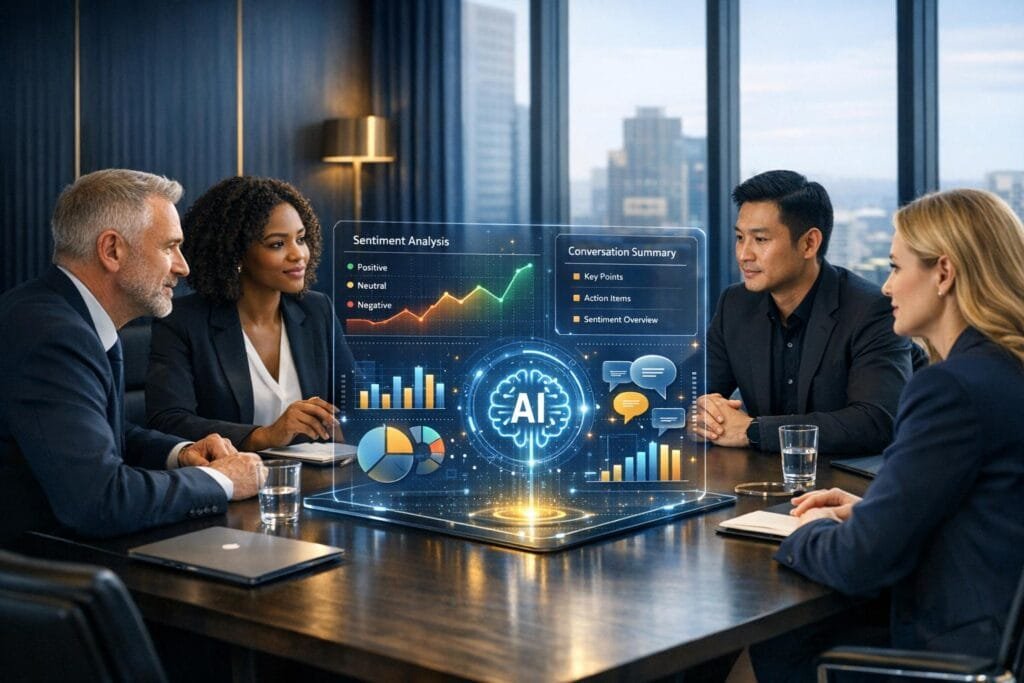
AI is transforming how businesses handle stakeholder conversations. Here’s what you need to know:
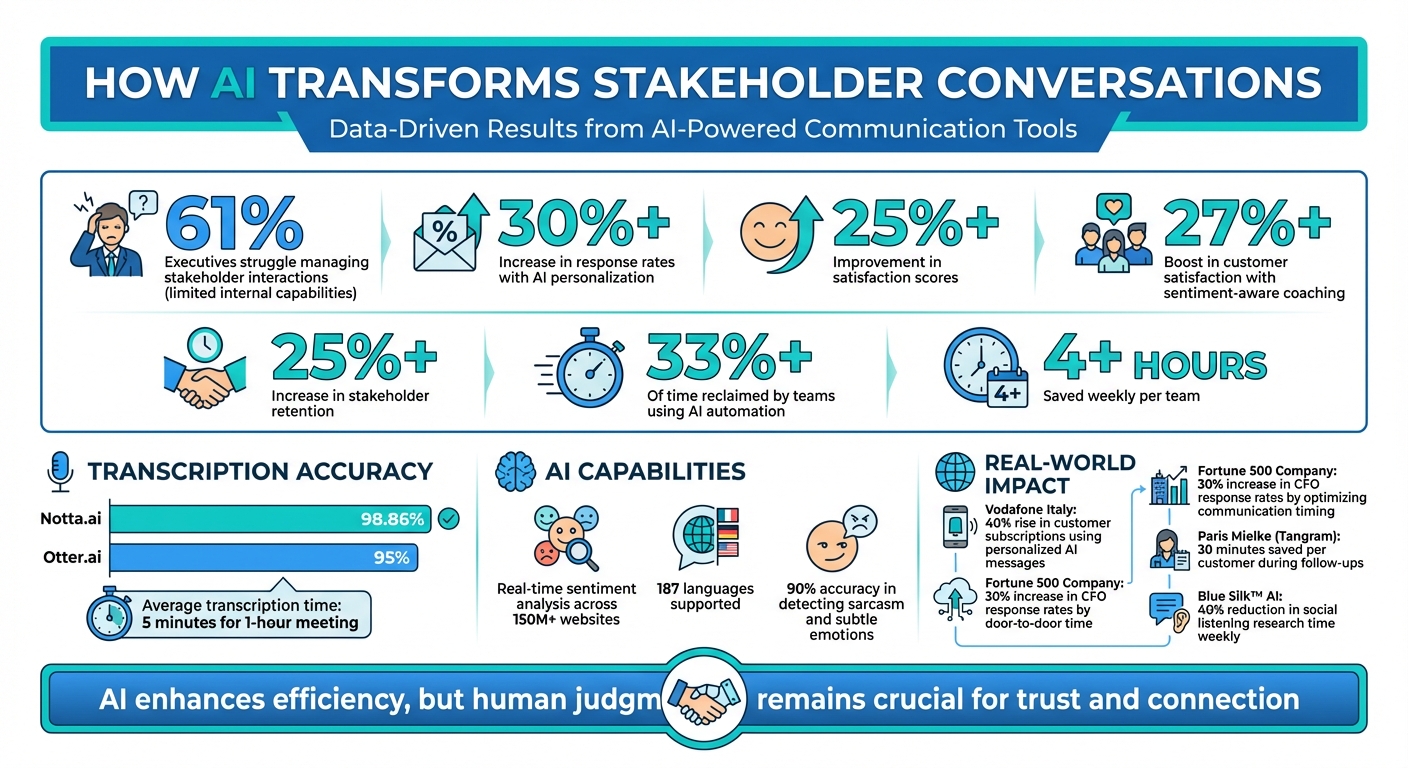
- Why it matters: 61% of executives struggle with managing stakeholder interactions due to limited internal capabilities. AI tools bridge this gap by providing real-time insights, increasing response rates by 30%, and improving satisfaction scores by 25%.
- What AI does: It analyzes emotions, detects sentiment shifts, and identifies potential conflicts early. Tools like IBM Watson Tone Analyzer and MonkeyLearn go beyond simple sentiment analysis to uncover deeper emotional cues.
- Key features: AI-powered tools like Otter.ai and Notta.ai simplify meeting transcriptions, generate summaries in minutes, and organize follow-ups seamlessly. These tools save time and boost efficiency.
- Personalized communication: AI helps craft tailored responses by analyzing past interactions, ensuring messages address specific stakeholder concerns. Companies using AI for personalization report a 30% increase in response rates.
- Real-time feedback: Platforms like Talkwalker and Sprinklr provide live sentiment tracking, helping businesses adjust strategies instantly. This proactive approach prevents issues from escalating.
The takeaway: AI boosts efficiency in stakeholder communication, but human judgment remains crucial for maintaining trust and connection.
AI Impact on Stakeholder Communication: Key Statistics and Benefits
09 AI for Communication & Stakeholder Management | How PMs Build Trust Under Pressure
AI for Emotional and Sentiment Analysis
Understanding stakeholder emotions early can stop small problems from spiraling into bigger ones. AI tools excel at analyzing emotions across various formats – text, voice, and even visual cues. From dissecting emails and meeting transcripts to interpreting vocal tones and body language during virtual calls, these tools provide insights far beyond what intuition can offer.
While sentiment analysis categorizes communication as positive, negative, or neutral, it often misses the finer details. Emotion detection goes deeper, identifying specific feelings like frustration, gratitude, or worry. For instance, a phrase like "I appreciate the update" might seem positive in a sentiment analysis, but emotion detection could uncover underlying concerns.
Reading Stakeholder Sentiments with AI
AI tools such as IBM Watson Tone Analyzer break down communication into distinct tones. These include emotional tones like anger or cheerfulness, social tones like openness or agreeableness, and even writing tones such as analytical or tentative. Similarly, MonkeyLearn offers a simple drag-and-drop interface, making it easy to analyze sentiment patterns in meeting transcripts or email threads.
Aspect-based analysis takes this a step further by highlighting specific strengths and weaknesses in stakeholder feedback. Instead of labeling an entire interaction as negative, this method reveals nuanced insights – for example, stakeholders might appreciate a team’s responsiveness but feel frustrated with pricing or deadlines.
Some advanced platforms even provide real-time coaching during live conversations. Tools like Balto display on-screen prompts when signs of rising tension are detected, encouraging users to adjust their tone or show more empathy to de-escalate situations. Companies using such sentiment-aware coaching have seen a 27% boost in customer satisfaction and a 25% increase in stakeholder retention.
Identifying Conflicts Early
The true power of AI sentiment analysis lies in its ability to spot potential problems before they escalate. For example, subtle changes in language – like a stakeholder shifting from collaborative terms like "we" to distancing phrases like "you" and "your organization" – can signal growing dissatisfaction.
"Emotion-aware AI should act more like a mirror than a mask. It is about reflecting human emotion, not impersonating it." – Aniket Bera, Associate Professor, Purdue University
Natural Language Understanding (NLU) adds another layer by uncovering the intent behind stakeholder comments. For instance, a seemingly neutral question like "Can you clarify the timeline again?" might actually carry frustration. By analyzing phrasing, punctuation, and context, AI can detect these subtle emotional cues, helping leaders navigate complex executive communication with greater confidence.
Making these insights actionable is key. AI systems can be programmed to trigger alerts when sentiment scores fall below certain thresholds. This allows leaders to address minor concerns within 48 hours while escalating more serious issues to senior leadership immediately. Such a tiered approach ensures timely intervention, preserving relationships before they suffer lasting damage.
These capabilities not only help in resolving conflicts but also pave the way for AI-driven meeting summaries, streamlining post-meeting follow-ups and action planning.
AI-Powered Meeting Summarization for Stakeholder Conversations
Keeping track of discussions during stakeholder meetings can eliminate the hassle of manual note-taking. Tools like Otter.ai and Notta.ai use AI to transcribe speech into text in real time, identifying speakers and context through natural language processing. These tools don’t just stop at transcription – they refine the text for clarity and organize lengthy conversations into chapters with descriptive headings. This paves the way for smoother post-meeting workflows.
Automated Transcriptions and Summaries
AI’s capabilities extend beyond real-time sentiment detection to advanced meeting summarization, ensuring every stakeholder interaction is both productive and actionable. Tools like Notta.ai boast a transcription accuracy of 98.86%, while Otter.ai achieves 95%. They condense lengthy meetings into structured summaries, highlighting key decisions, concerns, and action points. Impressively, transcribing a one-hour meeting takes just five minutes on average.
These tools also offer features like source citations, enabling users to jump directly to specific moments in the transcript or audio. This functionality ensures clarity and prevents misinterpretation of stakeholder input. For example, Paris Mielke, Co-founder and CEO of Tangram, relies on Notta to record daily sales calls, saving at least 30 minutes per customer during follow-ups.
Managing Post-Meeting Actions
Beyond summarization, AI tools simplify post-meeting workflows by capturing insights and assigning action items with deadlines. This ensures no task is overlooked. Integration with platforms like Salesforce, HubSpot, Jira, and Asana seamlessly incorporates meeting insights into existing workflows, creating an easily searchable institutional memory.
"I just love the ability of Notta to record meetings, transcribe notes and then be able to go back to that and remember what I committed to." – Dave Barclay, VP and Partner, MindWire
Automation is a major time-saver, with teams reclaiming up to 33% of their time and saving over four hours weekly. For instance, Dr. Tavish Nanda, a vitreoretinal surgeon at Retina Consultants, P.C., reduced patient door-to-door time by nearly 50% by using Notta to transcribe consultations. Sharing AI-generated recaps immediately after meetings via Slack or email helps sustain momentum while the discussions are still fresh.
Personalized Stakeholder Communication with AI
With the help of real-time sentiment analysis and efficient meeting summaries, personalized stakeholder communication is transforming how organizations engage. Gone are the days when generic messages could suffice. AI tools now analyze emails, transcripts, and project briefs to uncover what matters most to stakeholders – whether it’s budget concerns, quality expectations, or timeline risks. This allows leaders to craft responses that directly address these priorities instead of relying on generic updates. The result? More meaningful interactions and better-timed communication.
Writing Tailored Responses
Tools like ChatGPT and Microsoft 365 Copilot make creating customized messages easier by tapping into your organization’s actual communication history. For example, Microsoft 365 Copilot uses "grounding" via the Microsoft Graph, pulling from real emails, chats, and documents to ensure responses align with the specific context of a relationship. Leaders can guide these tools with prompts like: “Reframe this message for [audience type]. It was originally written for [context]. Adjust the tone, word choice, and style to fit the intended audience”.
The results speak for themselves. Organizations that integrate AI into their communication workflows report a 30% increase in response rates and a 25% boost in stakeholder satisfaction. A standout example comes from Vodafone Italy, which used customer profile data alongside a custom language generator to create personalized promotional messages for 5G launches and plan upgrades. This effort led to a 40% rise in customer subscriptions.
Using Stakeholder Interaction Histories
AI doesn’t stop at crafting tailored responses – it also refines communication strategies by analyzing how stakeholders interact over time. It doesn’t just consider what stakeholders say but also how they prefer to communicate. By studying response patterns, AI can determine whether someone engages more with Slack messages or formal emails, and even identify the best times to reach out. For instance, a Fortune 500 company discovered their CFO was more likely to respond to morning Slack messages than afternoon emails. By adjusting their approach, they increased response rates by 30%.
Additionally, AI tools can create dynamic audience segments that evolve in real time based on changes in behavior and engagement history. This means your communication strategy adapts automatically as relationships grow, ensuring your messages stay relevant without requiring constant manual updates.
sbb-itb-bc03425
Real-Time Analytics for Stakeholder Conversations
AI meeting summaries make follow-ups easier, but real-time analytics take things further by improving interactions as they happen. With the help of AI, leaders can now measure live sentiment during meetings, emails, and even on social media. This instant feedback allows them to tweak their strategies in the moment, creating more flexible and responsive stakeholder engagement.
Tracking Stakeholder Sentiments in Real-Time
Today’s AI tools can analyze stakeholder sentiment in mere seconds. Take Talkwalker, for instance – it monitors conversations across 150 million websites and over 30 social media platforms in 187 languages. Its Blue Silk™ AI goes beyond surface-level analysis, detecting sarcasm, slang, and subtle emotions with 90% accuracy across 127+ languages. This level of detail helps leaders understand not just what stakeholders are saying but what they truly mean.
Sprinklr’s platform is another powerhouse, making over 10 billion predictions daily with more than 80% accuracy in identifying sentiment and emotions. Nexis Newsdesk, on the other hand, adds millions of social media posts and news articles to its database every day, enabling leaders to spot potential issues before they escalate.
For example, in June 2025, a mid-sized investment firm used Talkwalker’s sentiment analysis to monitor investor discussions on Reddit and X. They picked up on negative chatter about a government proposal affecting subsidies for "RenewableCo", an energy stock. Acting on this insight, the firm reduced its holdings before the stock dropped 8%.
"Sentiment is now part of the decision stack. Marketers use it to inform messaging. Comms teams track it to manage risk… It’s not a line on a chart… It’s a lens for business strategy."
- Michael Brito, Global Head of Data + Intelligence, Zeno Group
AI doesn’t stop at text – it can analyze images, videos, and audio on platforms like TikTok and YouTube. This is crucial, especially as TikTok posts now average 66 comments each – a 73% increase year-over-year – making it essential to differentiate between positive and negative engagement.
Adjusting Strategies Based on Live Feedback
Real-time sentiment tracking doesn’t just provide data; it empowers leaders to act on that data immediately. Tools like Smart Alerts notify teams about sudden sentiment shifts or keyword trends, helping them address potential PR issues before they grow. Automated notifications can also highlight significant changes, allowing teams to respond quickly and effectively.
A great example of this is McDonald’s “Grimace’s Birthday” campaign in 2025. The company used real-time social listening to tap into a viral TikTok trend. By engaging with a humorous meme in the moment, McDonald’s boosted engagement and earned free publicity, contributing to strong Q2 earnings. Similarly, Netflix monitored the #SaveLucifer hashtag in July 2025. Seeing the surge in fan demand, they decided to revive the show, which then became one of their most-watched series.
To fully understand the impact of sentiment, leaders should pair it with metrics like reach and engagement. This combined view helps distinguish between isolated complaints and broader trends that require immediate action.
"Real-time insights facilitate proactive communication, addressing issues before they escalate."
- Bella Williams, Insight7
Leaders can also refine their messaging on the fly by using live feedback to adjust tone or content, ensuring their responses align with stakeholders’ emotions. Tools like Blue Silk™ AI save up to 40% of social listening research time each week, giving leaders more time to act on the insights rather than just collect them.
Resilient Power‘s Custom AI Solutions for Leaders
While off-the-shelf AI tools can provide useful insights, leaders often face challenges that demand more tailored solutions, especially when managing complex stakeholder interactions. Resilient Power steps in to address this need by combining science-backed leadership strategies with customized AI technologies. These solutions are designed to enhance stakeholder conversations by blending real-time AI insights with proven methods for building leadership resilience. Let’s explore how Resilient Power makes this approach unique.
Science-Based Methods for Leadership Resilience
At the heart of Resilient Power’s approach is the integration of Emotional Intelligence (EQ) with advanced AI tools. Instead of replacing human judgment, their methods ensure that AI serves as a complement – boosting efficiency and insight while leaving empathy and diplomacy firmly in the hands of leaders. This balance allows leaders to make informed decisions while navigating the subtle dynamics of stakeholder relationships.
Using Natural Language Processing (NLP), their systems analyze communications for changes in tone and emotional patterns within a leader’s specific stakeholder network. This enables early detection of potential issues like frustration, confusion, or disengagement. Leaders can then adjust their strategies before these challenges escalate. By combining these insights with their leadership resilience expertise, Resilient Power creates a strong foundation for effective stakeholder engagement.
Custom AI Technologies for Stakeholder Engagement
Resilient Power takes their solutions a step further with custom AI tools that do more than just monitor interactions. One standout feature is their immersive AI simulations, which allow executives to practice stakeholder conversations, test messaging, and receive real-time feedback. These voice-enabled simulations provide a safe environment for rehearsing delicate discussions, whether it’s addressing performance concerns or handling resistance to hybrid work arrangements.
Additionally, Resilient Power offers AI-driven stakeholder mapping and segmentation tools. By leveraging geospatial analysis and predictive behavior modeling, they help leaders craft highly targeted engagement strategies. Automated tools analyze emails, meeting notes, and project documents to identify key stakeholder interests and communication patterns. To further streamline efforts, their Power vs. Interest matrices automatically categorize stakeholders based on their influence and interest levels, enabling leaders to prioritize their focus effectively.
Conclusion: How AI Transforms Stakeholder Conversations
AI has reshaped how leaders interact with stakeholders by moving from occasional problem-solving to a model of continuous engagement. Instead of relying solely on periodic updates, AI tools now offer ongoing sentiment analysis across emails, meetings, and social platforms. This real-time insight helps leaders spot potential concerns – like frustration over project delays or confusion about strategic goals – before they escalate. It’s a shift that highlights AI’s growing importance in strategic leadership.
Organizations that weave AI into their communication processes often see notable improvements in performance. By automating repetitive tasks and fine-tuning communication tone and timing, AI allows leaders to dedicate more energy to building trust and exercising sound judgment.
However, AI is not a substitute for human leadership – it’s a tool to enhance it. As Harvard Business Review aptly puts it, "AI won’t replace humans, but humans with AI will replace humans without AI". The ideal approach is to treat AI as a collaborative partner that provides insights and flags risks, while leaving critical decisions and sensitive communications to human oversight. Striking this balance is increasingly important as stakeholders demand greater transparency about the role AI plays in decision-making. Leaders who integrate AI thoughtfully into their strategies can meet these expectations while staying effective.
For example, Resilient Power combines AI-driven solutions with science-backed leadership practices. Their approach strengthens emotional intelligence and strategic thinking, equipping leaders to manage complex relationships while maintaining the authenticity that fosters trust.
The impact is undeniable: AI doesn’t just streamline stakeholder conversations – it makes them more strategic, tailored, and effective in aligning teams and achieving business goals.
FAQs
How can AI tools help leaders improve conversations with stakeholders?
AI tools bring a new dimension to stakeholder conversations by delivering data-backed insights, sentiment analysis, and customized messaging. This ensures that discussions are not only clear but also meaningful and engaging. With such tools, leaders can gain a deeper understanding of stakeholder concerns, allowing them to fine-tune their communication to meet specific needs more effectively.
On top of that, AI-driven coaching plays a key role in helping leaders sharpen their communication skills. This makes their interactions more impactful and builds trust along the way. By tapping into these technologies, leaders can handle tough conversations with greater confidence and work toward stronger alignment with stakeholders.
How does emotion detection enhance AI-driven stakeholder communication?
AI’s ability to detect emotions enables it to pick up on cues like stress, frustration, or disengagement. This insight empowers leaders to adjust their messaging, tackle concerns proactively, and foster conversations that feel more genuine and productive for everyone involved.
When leaders grasp the emotional context of a situation, they can predict potential conflicts, build deeper connections, and ensure their communication resonates on a more personal level. This skill becomes especially crucial during high-pressure discussions where empathy and tone can significantly influence the outcome.
How can AI summarization improve post-meeting productivity?
AI-driven meeting summarization tools create quick and clear summaries of discussions, highlighting key decisions, action items, deadlines, and who is responsible for what. This means no more scrambling to take notes manually, making it easier for everyone to stay aligned and move forward efficiently.
These tools simplify follow-up tasks and deliver instant clarity, saving time and improving team coordination. Leaders can then concentrate on achieving goals instead of getting bogged down by administrative tasks.