
Employee turnover is costly – replacing a single employee can cost 30% to 400% of their annual salary. Yet, 78% of the reasons employees quit are avoidable. AI is transforming how companies address retention by predicting resignations, identifying disengagement, and offering tailored development plans before issues escalate. Tools like IBM’s predictive attrition program have saved millions by spotting patterns traditional methods miss, such as workload imbalances and career stagnation.
Key takeaways:
- Turnover costs: $5,000 per hourly worker; up to 2x salary for salaried roles.
- AI accuracy: Predicts departures with up to 95% accuracy.
- Solutions: Real-time analytics, sentiment tracking, and personalized growth plans.
AI-driven strategies help empower leaders to act early, improve engagement, and reduce costly disruptions, benefiting both employees and businesses.
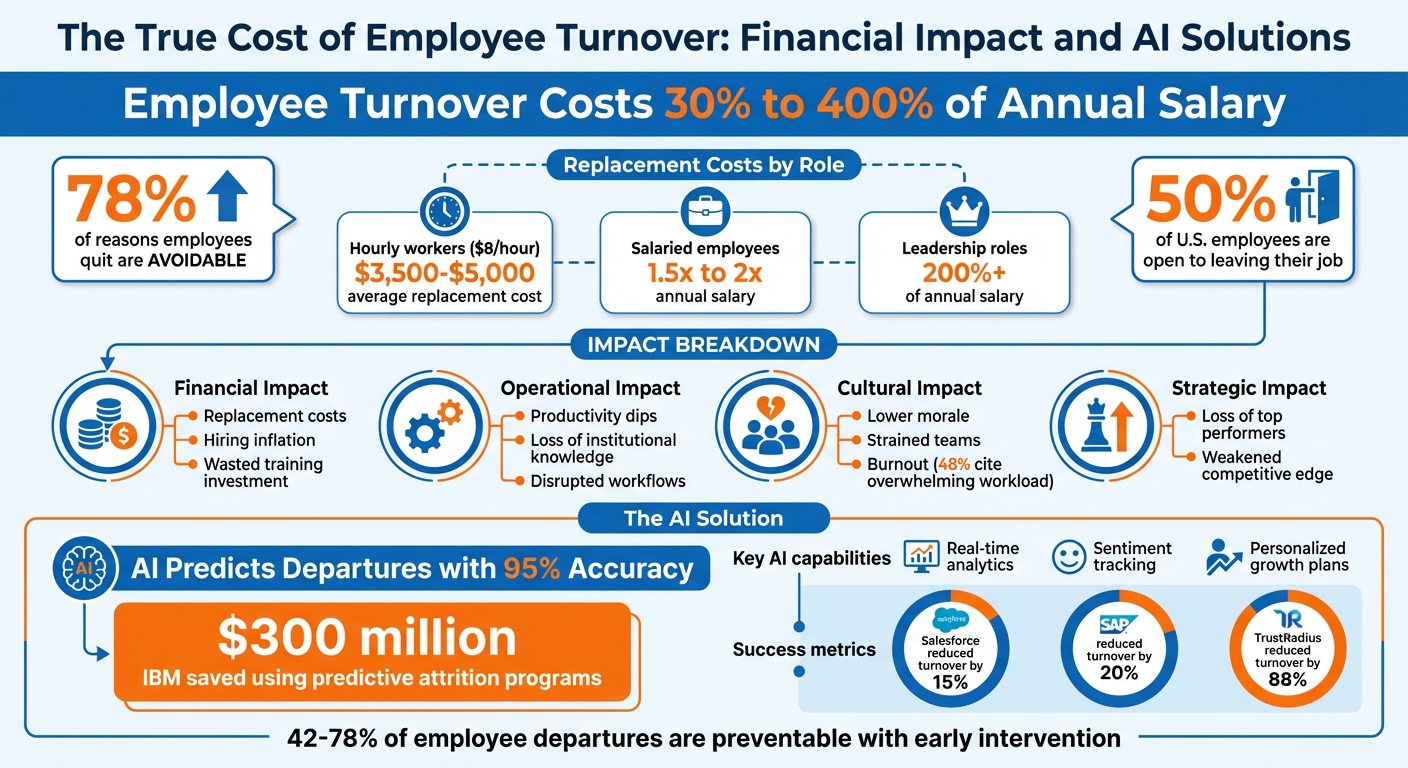
The True Cost of Employee Turnover: Financial Impact and AI Solutions
How AI Can Help You Stop Employee Turnover in Your Business
The Financial Impact of Employee Turnover
The numbers don’t lie – employee turnover is expensive. Replacing a salaried employee can cost anywhere from 1.5 to 2 times their annual salary, and for leadership roles, that figure can soar past 200% of annual salary. Even for hourly workers making just $8 per hour, replacement costs average around $3,500. With half of U.S. employees reportedly open to leaving their job, the financial risk to organizations is staggering.
When someone leaves, the direct costs – like recruitment, onboarding, and training – are only part of the equation. The hidden costs, such as lost productivity and the erosion of institutional knowledge, often hit even harder. For instance, it can take over six months to recoup the investment in a mid-level manager, and during that time, the remaining team members often pick up the slack. This added workload isn’t just inconvenient – it’s dangerous. Nearly half of workers (48%) cite overwhelming workloads as the top cause of burnout, which can trigger even more resignations.
The damage doesn’t stop there. When employees leave, they take their skills and expertise with them, which can lead to mistakes and operational hiccups. Customer relationships may also take a hit, especially if departing employees had strong client connections – sometimes even prompting customers to follow them to competitors. On top of that, high turnover can tarnish a company’s reputation, making it harder to attract new talent and raising red flags for investors concerned about stability.
Here’s a breakdown of how turnover impacts organizations:
| Impact Category | Specific Consequences |
|---|---|
| Financial | Replacement costs (30–400% of salary), hiring inflation, wasted investment in training |
| Operational | Productivity dips, loss of institutional knowledge, disrupted workflows |
| Cultural | Lower morale, strained team dynamics, burnout among remaining employees |
| Strategic | Loss of top performers, weakened competitive edge |
These challenges only grow when leaders fail to recognize the early signs of employee disengagement.
Why Leaders Miss Early Warning Signs of Attrition
Many leaders rely on outdated tools like annual reviews and exit interviews to gauge employee satisfaction, but these methods are reactive – they only uncover problems after the damage is done. By the time someone sits down for an exit interview, their disengagement may have been brewing for months.
One particularly tricky challenge is identifying "Silent Superstars" – high-performing employees who quietly disengage without raising concerns. These individuals often demonstrate the limitations of traditional feedback systems. Leaders who depend on gut instinct or wait for employees to vocalize issues may miss subtle but telling signs, such as lower engagement scores, slower responses in project tools, or a shift in language from "we" to "they".
"Turnover rarely starts with a resignation. It starts with trends leaders don’t always see (or want to see) – engagement and productivity dips, uneven workloads, shifts in communication tone."
– Rob Hosking, Executive Director, Robert Half
Standard tracking systems also fail to catch critical warning signs. For example, employees working more than 15 hours of overtime per week are significantly more likely to quit, yet many organizations don’t actively monitor workload distribution. Another overlooked factor is peer promotion disparity – when employees see their colleagues advancing while they remain stagnant, resentment can quietly build. These issues rarely show up in annual surveys but can be identified through real-time data.
The stakes couldn’t be higher. Studies show that 42% to 78% of the reasons employees quit are preventable. Yet, these warning signs are often ignored until it’s too late, leaving companies scrambling to fill gaps and repair the damage.
Using AI Predictive Analytics to Reduce Turnover
AI predictive analytics dives deep into performance metrics, engagement surveys, communication patterns, and factors like long commutes or excessive overtime. By incorporating Natural Language Processing (NLP), it can even analyze the tone of surveys, emails, and executive communication and internal messaging. This combination helps identify early warning signs of dissatisfaction or disengagement – well before an employee decides to leave. With these insights, leaders can take quick, targeted action to address potential issues.
AI doesn’t just predict if someone might leave – it also forecasts when. Using survival analysis models, it estimates turnover risks over specific timeframes, such as 30, 60, or 90 days. This allows companies to act strategically, whether it’s through mentoring opportunities, adjusted workloads, new challenges, or even compensation reviews.
"Predicting employee turnover doesn’t mean reading minds. It means spotting patterns. It means analyzing thousands of micro-signals." – PeopleSpheres
Shifting from Reactive to Preventive Leadership
The shift from reactive to preventive leadership is a game-changer. Traditional approaches, like exit interviews, often uncover issues after it’s too late. In contrast, AI provides real-time insights that enable leaders to address problems before they escalate.
Another advantage of AI is its ability to remove bias from decision-making. Historically, managers relied on subjective assessments, which can be clouded by personal judgment. IBM’s CEO Ginni Rometty highlighted this issue, stating, "Managers are subjective in ratings. We can infer and be more accurate from data." With AI, decisions are backed by objective data, such as task performance and behavioral signals, offering a clearer picture of employee engagement. Modern AI tools, like engagement dashboards, continuously monitor metrics like workload and sentiment trends, giving managers a real-time pulse on their teams. For example, if a top-performing employee starts showing signs of burnout, AI can suggest specific actions to re-engage them.
Transparency is key to making this approach work. Research shows that 92% of employees are comfortable with their data being tracked – provided they know it’s being used to support their growth. Clearly communicating what data is collected and how it’s used fosters trust, which is critical for the success of these initiatives. Companies that have embraced this data-driven approach are already seeing tangible improvements in retention.
Companies That Reduced Turnover with AI
Several organizations have demonstrated how AI can transform retention efforts. IBM, for instance, rolled out a Watson-based predictive attrition program between 2012 and 2019. By analyzing thousands of data points – excluding private emails and social media – the system achieved a 95% accuracy rate in predicting flight risks, identifying employees likely to leave within six months. In one case, the program flagged a software engineer who felt stagnant in her role. Her manager intervened with mentoring opportunities, contributing to an estimated $300 million in retention savings.
KPMG also saw success with AI-powered analytics, predicting two-thirds of employees at risk of leaving. By offering tailored retention solutions, such as career development discussions and workload adjustments, the firm managed to retain 10% to 20% of those employees.
Other companies have seen similar benefits. Salesforce reduced turnover by 15% using predictive modeling, while SAP reported a 20% drop in attrition rates. Smaller businesses have also reaped rewards: TrustRadius achieved an 88% reduction in turnover with AI engagement tools, and Kreg Tool saw a 20% decrease in attrition through predictive impact models.
These examples highlight how AI-driven strategies not only improve retention but also deliver measurable financial benefits. By transforming turnover into a proactive opportunity, businesses can strengthen their workforce and reduce costly disruptions.
Improving Employee Engagement with AI Sentiment Analysis
AI sentiment analysis gives leaders a real-time pulse on team morale by analyzing workplace communications and survey responses. It scans emails, Slack messages, Zoom transcripts, and chat logs to pick up on tone and emotional cues. This isn’t just about counting words – it’s about detecting subtle changes in how people communicate. For example, shorter messages, a drop in collaborative language, or reduced interaction frequency can signal disengagement. When these patterns emerge, AI flags them as potential concerns.
Adding to this, behavioral analytics track digital habits. A sudden slowdown in response times could indicate disengagement. AI also identifies stress indicators, such as frequent late-night notifications or signs of message fatigue, helping predict burnout before it escalates. A study conducted in June 2025 by researchers Jayakani and Meenakshi found that using AI tools boosted engagement scores from 3.2 to 4.1 and reduced turnover intention from 35% to 20%.
Companies like Test Prep Insight and Microsoft have used behavioral analytics to spot burnout signals early and adjust work policies, enabling proactive interventions.
The shift toward always-on feedback mechanisms is replacing outdated quarterly surveys. AI-powered chatbots now allow employees to share feedback instantly, giving leaders a continuous stream of insights instead of waiting months for formal reviews. This ongoing feedback helps address issues before they escalate, fostering a more engaged workforce and building trust through prompt leadership responses.
Building Trust Through Timely Feedback
Timely responses from leadership are essential for turning insights into trust. Trust grows when leaders act quickly on concerns identified through AI sentiment analysis. The key lies in closing the feedback loop – transforming insights into visible actions. Currently, only 43% of individual contributors report seeing positive changes based on their feedback, which highlights a significant gap that can erode trust over time. AI helps bridge this gap by automatically directing negative sentiments or complaints to the right HR contact for immediate attention. Quick action not only resolves issues but also strengthens employee retention.
Transparency plays a critical role in this process. Ingrid Fulmer, Associate Dean and Professor at Rutgers University, emphasizes:
"When AI appears designed to catch employees doing wrong… the more likely it is to be perceived as intrusive and viewed negatively or with resentment".
Leaders must clearly communicate that AI monitoring is meant to enhance productivity and well-being, not to surveil or punish. When organizations are open about the purpose of data collection, employees are much more comfortable with the process.
AI also ensures privacy while encouraging honest feedback. In small teams, where open-text survey responses could reveal individual identities, AI can summarize feedback while keeping contributors anonymous. This creates a safer space for employees to voice concerns without fear of being singled out. Research shows that 90% of employees are willing to let employers collect and use their data if it directly benefits them. By fostering this trust, employees feel more comfortable sharing genuine feedback, and leaders can use these insights to create a better work environment.
sbb-itb-bc03425
Designing Personalized Development Plans with AI
AI is reshaping leadership development by diving deep into diverse data streams. Using natural language processing (NLP), it can analyze skills, backgrounds, and experiences far beyond traditional static reviews. It doesn’t stop there – AI tracks progress in real time, observes digital behaviors, and incorporates feedback from peers and managers to identify skill gaps with precision.
With AI-powered recommendation engines, employees receive tailored suggestions for learning materials, certifications, or project opportunities that align with their career goals. These platforms also consider career aspirations and personality traits to provide customized coaching or match employees with internal projects. For instance, in 2019, Workday introduced a career hub allowing employees to dedicate 15% of their time to short-term projects. By 2025, this expanded to 50% for projects lasting up to six months, with 95% of participants reporting notable skill growth.
IBM’s "Career Coach" platform takes it a step further by using machine learning to predict optimal internal career moves based on individual skills and goals. This strategy has saved IBM over $100 million by reducing turnover and boosting employee engagement. Similarly, Spotify’s "Echo" platform, an AI-powered internal talent marketplace, analyzes employee skill sets to recommend internal job opportunities, enhancing internal mobility and cutting turnover rates.
AI also supports adaptive learning. AI-driven Learning Management Systems dynamically adjust training content to suit each individual’s learning style and progress. The results speak volumes: these AI-enhanced learning tools have been shown to improve operational efficiency by up to 15% and increase productivity by up to 20%.
"Personalized career development is one of the most impactful ways to improve retention. AI-powered career pathing and internal gig marketplaces help employees see a future within the company." – Jim Link, CHRO at SHRM
By aligning career growth with organizational goals, these personalized strategies create a clear pathway for employee development, directly influencing retention.
How Personalized Growth Affects Retention
The data is clear: personalized growth is a game-changer for retention. AI’s ability to predict turnover and assess sentiment helps create development plans that foster long-term engagement and loyalty. Employees who believe they can advance their careers within their current organization are 3.4 times more likely to stay engaged. Additionally, workers who feel their workplace technology supports productivity are 61% more likely to remain at their company for over three years. Research also highlights a strong link between employee engagement and retention (r = 0.75), with a moderate positive connection (r = 0.60) specifically between learning opportunities and staying power.
The stakes are high for leaders who overlook personalized career development. A lack of tailored growth opportunities can accelerate disengagement: 71% of employees say they would leave if their efforts go unrecognized. Moreover, 71% of people now expect companies to deliver personalized interactions, and 76% report frustration when this expectation isn’t met.
"Shouldn’t the place where we spend so much of our time and energy understand us better than any brand out there?" – Andy Biladeau, Chief Transformation Officer at SHRM
One key focus for leaders is what Jim Link refers to as "time-to-intervention." By using AI to monitor when an employee’s engagement with learning platforms drops, leaders can take action months before a top performer considers leaving. However, implementing these systems requires careful consideration.
"AI can be a powerful tool for personalizing the employee experience, but it must be implemented with clear boundaries. Employees should feel empowered, not monitored." – Jim Link, CHRO at SHRM
To avoid unintended consequences, regular audits of AI-driven career pathing tools are essential. These reviews ensure that algorithms do not perpetuate historical biases in promotions or development opportunities.
Improving Team Alignment with AI-Driven Leadership
AI is reshaping how teams operate by addressing one of the biggest challenges in the workplace: alignment. When employees feel disconnected from their roles or team goals, they’re more likely to leave. But AI offers a solution by matching employees with internal opportunities that fit their skills and interests, creating a more cohesive and engaged workforce. Instead of relying on outdated annual reviews, leaders can now leverage AI to monitor workload imbalances in real time and assign tasks based on individual strengths, ensuring that everyone is working where they excel.
Take Spotify, for example. Their AI-powered talent marketplace has improved internal mobility by helping employees discover new opportunities within the company. Similarly, Cigna has implemented an AI-driven HR platform that acts like a recommendation engine, showcasing open roles to employees based on their data. This helps solve a common problem: many workers are unaware of growth opportunities within their own organizations.
AI is also shedding light on team dynamics through tools like Organizational Network Analysis (ONA). This technology identifies key "cultural influencers" within teams – individuals whose behaviors can serve as models for training and mentorship. By leveraging these insights, leaders can strengthen team alignment and foster a more collaborative culture. The impact is clear: 83% of employees in strong workplace cultures report being highly motivated to deliver quality work, compared to just 45% in weaker environments.
"People stick around longer when they have opportunities for career growth." – Janet Clarey, Director of HR Research and Advisory Services, McLean & Company
The numbers back this up. Employees who feel they have career advancement opportunities within their current organization are 3.4 times more likely to stay engaged. AI helps create this sense of alignment by promoting what researchers call "Person-Organization Fit." This involves aligning employees’ personal goals and skills with the company’s broader objectives, creating a workplace that feels both supportive and forward-thinking.
Resilient Power‘s Approach to AI-Enhanced Team Alignment
Resilient Power®️ has taken this concept to the next level with its data-driven strategies. By combining predictive analytics with practical solutions tailored to specific organizational needs, they’ve developed a method to improve team alignment and reduce turnover. Their approach identifies skill gaps, cultural friction, and potential flight risks before they become major issues, enabling leaders to act proactively rather than reactively.
Their solutions focus on early detection of misalignment, creating balanced workloads, and offering personalized development plans that connect individual growth with the company’s goals. By integrating AI insights into leadership strategies, Resilient Power helps leaders make faster, more informed decisions while maintaining the human connection that builds trust.
With experience spanning Fortune 500 companies and tech startups, Resilient Power has shown how AI can transform team alignment. Their methods ensure employees feel valued, challenged, and aligned with their organization’s mission, ultimately reducing turnover and fostering long-term success.
Measuring the ROI of AI-Powered Retention Strategies
To measure the ROI of AI-driven retention strategies, focus on three main metrics: lower turnover rates, cost savings, and higher employee engagement. The financial benefits are hard to ignore. Replacing an employee can cost anywhere from 1.5 to 2 times their annual salary, factoring in recruiting, onboarding, lost productivity, and training costs. Reducing voluntary turnover by just 20% could save a company the equivalent of one to two years’ salary for each retained employee.
It’s important to differentiate between types of turnover. Leaders should separate voluntary exits (when employees choose to leave) from involuntary exits (such as layoffs) and focus on "regrettable" turnover – cases where key performers leave versus natural attrition. AI can help here by generating flight risk scores based on factors like tenure, engagement survey results, and behavioral patterns, flagging employees who might leave within six months. For example, IBM used predictive attrition models to save significantly by prioritizing retention efforts for top talent with in-demand skills.
Beyond financial metrics, organizations should track engagement and sentiment trends using AI tools like pulse surveys and sentiment analysis. These tools can identify early signs of burnout or disengagement – such as excessive overtime or after-hours work. Research shows that 94% of employees are more likely to stay with a company that invests in their personal growth. By monitoring these indicators, companies can take proactive steps to improve retention.
Using AI Dashboards for Real-Time Insights
Once you’ve defined your key ROI metrics, AI dashboards can provide real-time insights to guide decision-making. These dashboards consolidate data from multiple sources into a single, easy-to-navigate platform. With updates as frequent as every 30 seconds, leaders gain instant visibility into everything from executive-level KPIs to team-specific metrics, enabling timely interventions.
One of the standout features of these dashboards is their ability to send automated alerts. For instance, if an employee’s collaboration metrics drop or their survey responses show declining satisfaction, the system immediately flags these changes. Natural Language Processing (NLP) tools add another layer by analyzing the emotional tone in emails, Slack messages, and surveys, detecting shifts from optimism to frustration before they escalate into resignations. Additionally, these tools allow organizations to benchmark their retention and compensation metrics against industry standards, ensuring they remain competitive.
"The future of HR isn’t just about managing people – it’s about making data-driven decisions that drive business impact." – Alex Alonso, Chief Data & Analytics Officer, SHRM
Resilient Power’s Role in Implementing Scalable AI Solutions
Resilient Power®️ takes these strategies further by integrating AI tools into retention initiatives tailored to each company’s unique goals and workforce challenges. Whether working with Fortune 500 firms or startups, their approach combines predictive analytics with customized solutions that align with leadership priorities and industry-specific needs.
Their process involves embedding AI tools into existing HR systems, creating unified dashboards that track a wide range of retention indicators. These include flight risk scores, engagement trends, workload patterns, and development opportunities. Resilient Power also emphasizes measuring outcomes through clear before-and-after comparisons, enabling companies to track improvements in turnover rates, cost savings, and engagement scores. By establishing baseline metrics and implementing continuous monitoring, they help organizations demonstrate ROI to stakeholders while fine-tuning strategies in real time based on actionable data insights.
Conclusion
Employee retention is no longer just a challenge – it’s a leadership priority that calls for proactive, data-driven solutions. With tools like AI, leaders can now identify flight risks, spot burnout, and create personalized development plans before valuable employees decide to leave. Considering research shows that 78% of employee turnover can be avoided, the real question isn’t whether to use AI-powered strategies but how quickly they can be put into action.
But let’s be clear: technology alone isn’t the answer. Preventing turnover requires more than just data; it demands a balance of analytics and human connection. As Janet Clarey wisely puts it:
"It is the combination of data and human intuition that leads to successfully reducing turnover".
AI provides the insights, but leaders must follow through with actions that matter – like having honest conversations, redistributing workloads, and prioritizing employee development.
This is where Resilient Power®️ steps in, offering scalable AI solutions tailored to the unique challenges of any workforce. By combining predictive analytics with leadership resilience training and team alignment strategies, Resilient Power ensures that data-driven insights lead to real, lasting change. Their approach focuses on people, workplace dynamics, and effective change management, helping organizations turn insights into stronger, more engaged teams.
Whether you’re running a global corporation or a small business, the tools to reduce turnover and build a more committed workforce are already here. High-profile case studies and real-world examples prove that AI-powered retention strategies work – and partnering with experts who understand both the technology and leadership needs can make all the difference.
At its core, AI equips leaders to move beyond reactive measures, enabling them to create workplaces where employees feel valued, stay engaged, and grow alongside the organization.
FAQs
How does AI help leaders predict which employees might leave?
AI leverages machine learning models to sift through extensive HR data, including employee demographics, performance reviews, compensation records, survey responses, and even sentiment insights from workplace communication. By spotting trends and early indicators, AI can pinpoint employees who might be considering leaving – sometimes months ahead – with impressive precision.
This forward-thinking method gives leaders the chance to tackle potential challenges early, boost employee engagement, and develop strategies to retain key talent. The result? A stronger, more dedicated workforce.
How can AI enhance employee development plans to improve retention?
AI enables leaders to craft customized development plans by pinpointing skill gaps, recommending specific training programs, and proposing career paths that evolve with individual strengths and aspirations. This ensures employees are offered growth opportunities that not only match their personal goals but also align with the organization’s objectives.
With the ability to provide real-time feedback and adjust plans based on performance data, AI keeps development strategies flexible and engaging. This dynamic approach enhances employee satisfaction, improves productivity, and plays a key role in retaining top talent.
How does AI sentiment analysis help leaders improve employee engagement and reduce burnout?
AI sentiment analysis leverages tools to interpret unstructured data – think emails, chats, and surveys – to give leaders real-time insights into how employees are feeling. This allows leaders to respond promptly to concerns, provide tailored support, and strengthen trust within their teams.
By spotting early signs of stress or dissatisfaction, leaders can take actionable steps to improve engagement and help prevent burnout. Many organizations using AI-powered sentiment analysis report better employee satisfaction and lower turnover, making it an effective way to nurture a healthier workplace environment.