
Scenario planning is a tool that helps leaders prepare for a range of possible futures instead of relying on single-outcome predictions. It’s especially useful in today’s world of uncertainty, where events like sudden economic shifts or geopolitical crises can disrupt traditional forecasting methods. By crafting multiple scenarios, leaders can identify risks, seize opportunities, and make informed decisions.
Key points:
- What it is: A method to explore various future outcomes, not predict them.
- Why it matters: Traditional forecasting struggles with unprecedented events.
- How it helps: Improves decision-making, strengthens executive communication, and prepares organizations for unexpected changes.
For example, Shell used scenario planning in the 1970s to navigate the oil crisis, and companies today use similar methods to manage supply chains, detect early market signals, and adjust strategies effectively.
Steps to implement scenario planning:
- Define objectives and identify key uncertainties.
- Analyze driving forces and trends.
- Develop plausible scenarios.
- Formulate strategies based on these scenarios.
- Monitor indicators and update plans as needed.
Modern tools like AI and Monte Carlo simulations make this process faster and more precise, enabling leaders to respond dynamically to change. Whether you’re navigating economic turbulence or planning for long-term goals, scenario planning equips you to manage risks and lead confidently.
Scenario Planning: 5-Step Process to See the Future
sbb-itb-bc03425
Benefits of Scenario Planning for Leaders
Scenario planning provides leaders with tools to navigate uncertain futures, turning unpredictability into a strategic advantage in today’s complex world.
Improving Decision-Making Under Uncertainty
Scenario planning pushes leaders to question assumptions and refine strategies by examining a variety of potential futures. This approach goes beyond traditional forecasting by incorporating qualitative insights that expose emerging trends.
Take the Defense Logistics Agency (DLA) as an example. They implemented a "strategic radar" system that tracked nearly 100 weak signals of change across five categories. Each quarter, leadership reviewed and narrowed these signals to the 20–30 most relevant indicators. This process allowed the agency to detect early signs of a slowdown in commercial RFID deployments and adjust its global logistics strategies accordingly.
Deloitte researchers emphasize the importance of this process:
"The biggest enemies of good decision-making in times of crisis are neither uncertainty nor ambiguity; they are, rather, over-confidence, procrastination, and incomplete or biased data".
By exploring multiple scenarios, leaders can identify "no-regret" moves – actions that are beneficial regardless of the outcome – and "call options", which are flexible investments that allow for strategic pivots without overcommitting resources. This structured approach empowers leaders to make sharper decisions and prepares them to lead with confidence.
Building Resilient Leadership Practices
Scenario planning doesn’t just improve decision-making – it also strengthens leadership by fostering resilience. Preparing for a range of possible futures helps leaders remain adaptable and inspire confidence even in uncertain times. This practice encourages "organizational vigilance", where leaders learn to monitor weak signals and embrace ambiguity.
For instance, in 2011, chemical producer Alchemy applied scenario planning to its Asia-Pacific supply chain strategy, spanning 18 business units across 13 countries. They developed four distinct scenarios and stress-tested their initiatives. By mid-2014, they identified projects that performed well across multiple scenarios and paused those that only worked under specific conditions. This approach enabled Alchemy to weather an economic slowdown in China without falling into outdated decision-making patterns.
Former Intel CEO Andy Grove captured this mindset perfectly:
"Give me a turbulent world as compared with a stable world and I’ll want the turbulent world".
Additionally, scenario planning helps leaders identify leading indicators – like the Purchasing Managers’ Index or trends in patent filings – that reveal shifts in the external environment earlier than traditional metrics. This forward-thinking mindset transforms leaders into proactive strategists rather than reactive problem-solvers.
Scenario Planning vs. Traditional Forecasting
While scenario planning enhances decision-making and builds resilience, it also stands apart from traditional forecasting in key ways. Forecasting relies on past trends to predict stable uncertainties, such as inflation, whereas scenario planning prepares leaders for dramatic changes driven by political, economic, or technological disruptions.
Here’s a breakdown of the differences:
| Feature | Traditional Forecasting | Scenario Planning |
|---|---|---|
| Core Assumption | Future continues current trends | Future may differ significantly from today |
| Data Focus | Quantitative historical data and models | Mix of qualitative narratives and quantitative factors |
| Risk Handling | Best for stable, predictable risks (e.g., inflation) | Best for novel, unexpected events like "Black Swans" |
| Leadership Impact | Optimizes current strategies | Encourages flexibility and adaptability |
| Outcome | Single "most likely" prediction | Multiple plausible and diverse futures |
Traditional forecasting often reinforces existing assumptions, which can limit strategic thinking. Scenario planning, on the other hand, actively challenges these assumptions. A great example of this is Royal Dutch Shell in the 1970s. Their scenario planning team predicted a tripling of oil prices following the 1973 Arab-Israeli War – something traditional forecasting methods failed to foresee. Although initially met with skepticism, this insight led Shell to overhaul its business planning process, enabling senior leaders to act on these predictions.
While traditional forecasting remains useful for routine tasks like budgeting or short-term planning, scenario planning is essential for managing today’s unpredictable world, where events like pandemics or geopolitical upheavals can arise without precedent.
How to Implement Scenario Planning: A Step-by-Step Guide
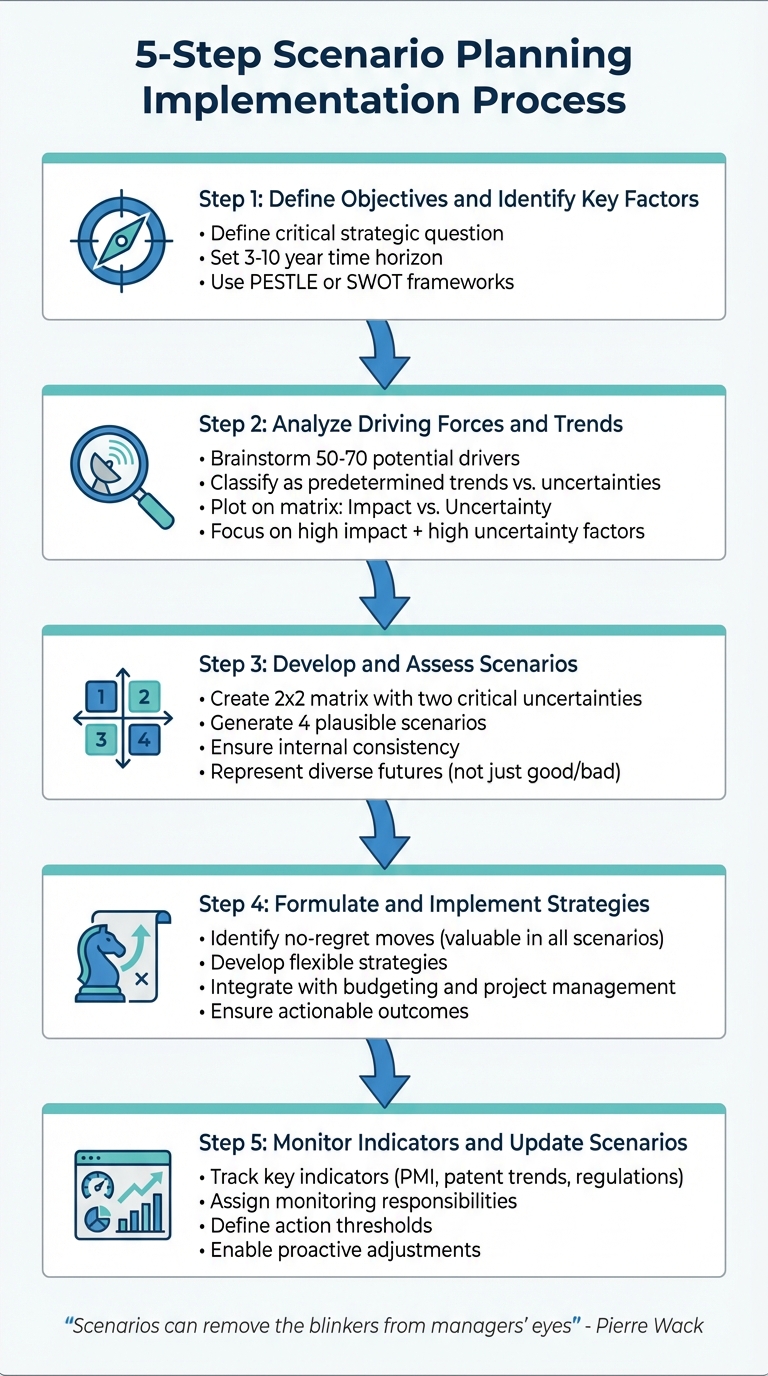
5-Step Scenario Planning Implementation Process for Leaders
Turning potential scenarios into actionable strategies requires a structured approach. By following a series of clear steps, leaders can move from identifying uncertainties to making informed decisions. Here’s a breakdown of the process into five key steps.
Step 1: Define Objectives and Identify Key Factors
Start by defining a critical strategic question – something uncertain yet impactful, like future industry trends or upcoming regulations. The question should directly affect your organization’s direction and have significant stakes.
Set a time horizon of 3 to 10 years to allow for meaningful changes while staying relevant. Use frameworks like PESTLE (Political, Economic, Social, Technological, Legal, Environmental) or SWOT to map out internal strengths and external forces that could shape outcomes.
Step 2: Analyze Driving Forces and Trends
Examine your environment to identify the key forces driving change. This could include shifts in regulations, technological advancements, demographic changes, or evolving societal attitudes. Begin with a broad list – experts suggest brainstorming 50 to 70 potential drivers before narrowing them down.
Classify these drivers into two categories: predetermined trends (like an aging population or planned infrastructure projects) and uncertainties (such as geopolitical changes or emerging technologies). Plot these factors on a matrix with "Level of Impact" and "Level of Uncertainty" as axes. Focus on those that are both highly impactful and highly uncertain – these will become the cornerstone of your scenarios.
Step 3: Develop and Assess Scenarios
Select two critical uncertainties to create a 2×2 matrix, generating four plausible scenarios. These aren’t just "good" or "bad" outcomes but represent fundamentally different futures based on how those uncertainties could evolve.
Pierre Wack, a pioneer in scenario planning, highlighted the value of this approach:
"If managers operate within defined confines, they no longer tend to see solutions outside their own view of the world. Scenarios can remove the blinkers from managers’ eyes and show them alternative windows on the world".
Each scenario should be internally consistent and grounded in real possibilities, providing a diverse range of potential futures to consider.
Step 4: Formulate and Implement Strategies
Identify no-regret moves – actions that will deliver value regardless of how the future unfolds, such as improving efficiency or strengthening partnerships. Then, pinpoint flexible strategies that can adapt to different scenarios, helping you seize future opportunities without overcommitting.
To ensure scenario planning influences real decisions, tie it directly to your budgeting and project management processes. Without this connection, the exercise risks becoming theoretical rather than practical.
Step 5: Monitor Indicators and Update Scenarios
Establish clear indicators to track which scenario is unfolding. These could include metrics like the Purchasing Managers’ Index, patent filing trends, or shifts in regulatory policies. Assign specific team members to monitor these signals and report regularly.
Define thresholds that trigger specific actions. For example, "If more than 50% of major donors are non-committal by June" could prompt a targeted response. This approach ensures monitoring leads to proactive strategic adjustments, not just passive observation.
Tools and Techniques for Leadership Scenario Planning
Core Tools for Scenario Planning
The 2×2 scenario matrix is a go-to method for aligning executives during strategic discussions. By identifying two key uncertainties and plotting them on perpendicular axes, leaders can create four distinct future scenarios. These narratives are not only easy to visualize but are also effective for quickly testing strategies in short workshops.
Another essential tool is PESTLE analysis (Political, Economic, Social, Technological, Legal, Environmental), which helps leaders scan the external landscape to uncover key driving forces. For long-term goals, backcasting is particularly useful. This technique starts with a defined future objective – like achieving net-zero emissions by 2050 – and works backward to outline the actions needed today.
Organizations like the Defense Logistics Agency use the strategic radar process to detect risks early, showcasing its value in proactive decision-making.
Using AI and Advanced Technologies
Modern technologies are reshaping scenario planning, making it faster and more dynamic. Generative AI has revolutionized the process, reducing planning timelines from months to just days. Daniel J. Finkenstadt, a U.S. military officer and researcher, emphasizes its importance:
"Firms must embrace generative AI to rapidly adapt contingency plans and build resilience in the face of shifting risks".
Large Language Models (LLMs) play a significant role here, organizing concerns, pinpointing driving forces, and predicting trends like the rise of electric vehicles or automation. These insights form the groundwork for scenario development.
The speed this technology offers is crucial. For example, extreme weather events often disrupt supply chains within a 6-day timeframe, making traditional 2-to-5-year planning horizons feel outdated. AI-enhanced tools allow leaders to react to changes almost in real time.
Monte Carlo simulations bring a numerical edge to scenario planning, forecasting the likelihood and financial impact of risks using historical data. Meanwhile, AI-powered chatbots make complex risk management systems more accessible, enabling leaders to ask plain-English questions and receive actionable insights instantly. It’s no surprise that 69% of CFOs consider AI a cornerstone of their financial transformation strategies.
Companies like Resilient Power®️ integrate these advanced tools with practical strategies, helping leaders make swift, data-driven decisions without sacrificing the depth of analysis. These technologies, while varied in their focus, collectively enhance leadership capabilities by offering both speed and precision.
Tool Comparison for Leadership Effectiveness
| Tool/Technique | Key Use | Leadership Benefit | Implementation Requirement |
|---|---|---|---|
| Generative AI (GenAI) | Rapid scenario generation and idea evaluation | Speeds up planning; reduces bias | Access to LLMs and custom GPT frameworks |
| Monte Carlo Simulation | Financial risk and probabilistic forecasting | Adds numerical precision to qualitative insights | High-quality historical data and modeling skills |
| Strategic Radar | Detecting "weak signals" in the periphery | Early warnings of macro-level changes | Tailored metrics and expert review panels |
| 2×2 Matrix | Executive alignment and strategy stress-testing | Quick, visual, and easy to communicate | Identifying two critical uncertainties |
| Backcasting | Long-term policy or sustainability goals | Clear pathways from future goals to present actions | Defined target future (e.g., 2050 net-zero) |
Each tool offers distinct advantages, depending on the context. For instance, the 2×2 matrix is ideal for fast alignment among executives, while Monte Carlo simulations provide the detailed financial insights needed for high-stakes decisions. AI-powered tools, on the other hand, make scenario planning accessible to organizations that might lack the resources to employ large teams of risk analysts.
Connecting Scenario Planning with Resilient Leadership
Applying Scenario Planning to Leadership Challenges
Scenario planning isn’t just about preparing for unpredictable futures – it also improves how teams communicate, align goals, and handle crises. It offers a framework that helps leaders notice early signs of change and respond thoughtfully instead of scrambling under pressure.
One common leadership hurdle is communication breakdown during critical decision-making moments. Scenario planning helps bridge this gap by creating a shared language within the organization. As Paul J.H. Schoemaker and Shardul Phadnis note:
"Offering managers a common, richer vocabulary will lead to better discussions about future possibilities, warning signs, and strategic choices the business faces".
This shared language gives teams the tools to act decisively when early warning signs appear. Take Alchemy, a chemical producer, as an example: between 2011 and 2014, the company used scenario planning for its Asia-Pacific supply chain strategy. Leaders from 18 business units across 13 countries collaborated, aligning around shared goals. By mid-2014, this approach allowed the company to pivot during China’s economic slowdown, shelving projects tied to a single outcome while advancing strategies that worked across multiple scenarios.
Scenario planning also helps teams address misalignment caused by differing views on risk. Structured processes allow teams to identify "trigger points" and adjust strategies quickly. Leaders who focus on these signals shift from reactive to proactive decision-making. They serve as stabilizers during crises, helping their teams interpret events and tolerate uncertainty.
Resilient Power‘s Role in Leadership Risk Management
Resilient Power®️ builds on the strengths of scenario planning, tailoring its methods to tackle real-world leadership challenges. By weaving scenario planning into its science-based approach, the company strengthens leadership resilience and sharpens executive communication skills. This is critical, especially since only about 25% of funders openly discuss impact risks with grantees. Effective risk management, however, demands structured and transparent conversations about uncertainty.
Resilient Power®️ also excels in translating scenario planning into action during complex events. Research shows that decision-making becomes particularly tough when moral values heavily influence stakeholder behavior. Resilient Power®️ combines rapid sensemaking with personalized solutions, helping leaders navigate these values-driven decisions and turn scenario insights into concrete strategies. By integrating scenario planning with tools like those offered by Resilient Power®️, leaders are better equipped to anticipate challenges and manage risks with confidence.
Conclusion: Building Resilient Leadership Through Scenario Planning
Scenario planning equips organizations to handle a range of possible outcomes, creating a mental framework that helps leaders identify early signs of change. For instance, during the second week of April 2025, when the S&P 500 saw a dramatic 9.5% rise one day and a 3.5% drop the next, companies with scenario plans were better prepared to respond effectively.
One of the biggest strengths of scenario planning is its ability to differentiate between manageable risks and extreme uncertainty. Traditional forecasting often struggles when historical data falls short, leaving leaders unprepared for sudden shifts. By factoring in even the most unlikely events, scenario planning empowers decision-makers to handle uncertainty with greater confidence. Time and again, it’s been shown that this approach enables leaders to thrive in chaotic environments rather than simply endure them.
However, successful scenario planning involves more than just imagining alternative futures. It demands active leadership involvement, not delegation to specialized teams. Leaders must also establish clear decision triggers – specific signs that indicate when to implement a plan. Additionally, linking scenario planning to organizational agility allows teams to react quickly through decentralized decision-making. These strategies form the backbone of a leader’s ability to adapt effectively during volatile times.
Key Takeaways for Leaders
Focus on "no-regret" actions and adaptable "call options" that provide value across different scenarios. Develop a strategic system to track weak signals, much like the Defense Logistics Agency did when it noticed a slowdown in commercial RFID deployments. Lastly, build resilience by ensuring your organization can operate for at least three months, even with a 50% drop in revenue. This isn’t about pessimism – it’s about being prepared. As Louis Pasteur famously said:
"Chance favors the prepared mind".
Resilient Power®️ combines these scenario planning principles with science-based practices to help leaders strengthen their resilience, improve communication, and align their teams to succeed in unpredictable conditions.
FAQs
How is scenario planning different from forecasting?
Scenario planning involves crafting several potential future scenarios to examine how unpredictable events could interplay, rather than attempting to forecast one definitive outcome based on assumed conditions. This method equips leaders to prepare for various possibilities, moving beyond a sole reliance on projections.
What indicators should we track to know which scenario is unfolding?
Tracking key indicators helps you stay ahead of potential scenarios. Pay attention to warning signs from external factors, shifts in critical drivers or assumptions, and trigger points that hint at significant changes. Keeping an eye on these elements allows for timely action and strategic adjustments, ensuring risks are managed effectively.
How do we turn scenarios into decisions and budget actions?
To turn scenarios into actionable decisions and budget strategies, start by creating clear action plans for each scenario. Define specific triggers that signal when to implement these plans. Finally, integrate insights from your scenarios into your broader strategic decision-making. This method helps maintain flexibility, stay prepared, and keep your actions aligned with your organization’s objectives.