
Teams that can handle challenges and bounce forward are crucial for long-term success. Resilient teams thrive on open communication, trust, shared goals, and a mindset that views obstacles as opportunities for growth. Leaders play a key role in creating this environment by focusing on:
- Psychological Safety: Encourage open dialogue without fear of judgment.
- Emotional Intelligence: Build self-awareness, empathy, and trust.
- Clear Goals & Purpose: Align team efforts with meaningful objectives.
- Growth Mindset & Stress Management: Reframe setbacks as learning opportunities and balance stress effectively.
- Recognition & Empowerment: Highlight resilient behaviors and delegate decision-making.
These practices help reduce turnover, boost engagement, and improve team performance even in uncertain times. By prioritizing resilience, leaders ensure their teams are prepared to navigate challenges and achieve sustainable success.
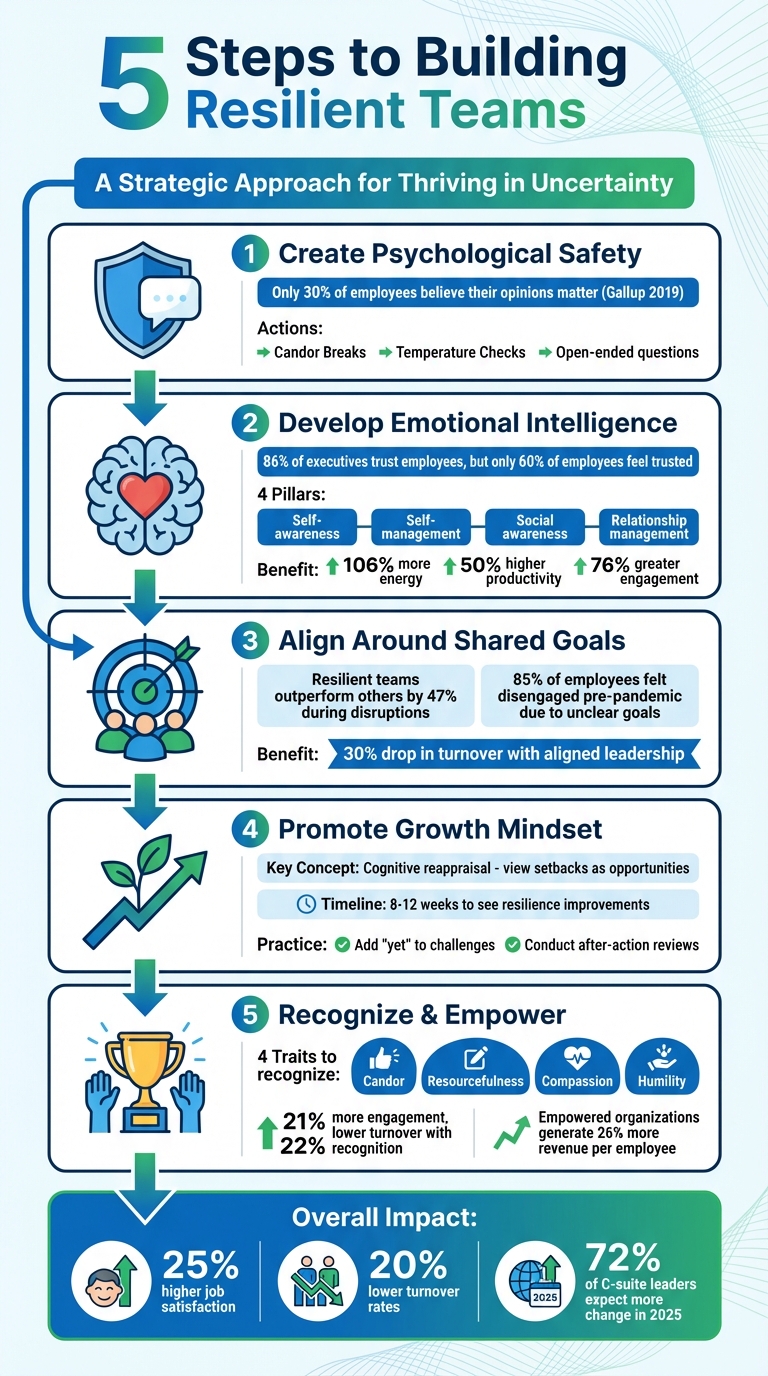
5 Steps Leaders Use to Build Resilient Teams
Step 1: Create Psychological Safety and Open Communication
Build a Culture of Openness
Psychological safety is the cornerstone of resilient teams. It’s about creating an environment where people feel safe to take risks, share ideas, and voice concerns without fear of judgment or backlash. Back in 2012, Google’s "Project Aristotle" uncovered a key insight: the most effective teams weren’t defined by individual brilliance but by the presence of psychological safety. Teams that fostered this environment consistently outperformed those where members felt the need to hold back.
Still, many workplaces struggle with this. A 2019 Gallup poll revealed that only 3 in 10 employees strongly believe their opinions matter at work. Even among senior leadership, 62% report uneven levels of safety when it comes to speaking up. To bridge this gap, small practices like "Candor Breaks" can make a big difference. These are moments during meetings where anyone can voice thoughts or concerns. Similarly, starting meetings with a simple "Temperature Check" – asking everyone to rate their energy or mood on a scale of 1 to 5 – can help identify colleagues who might need extra support.
Listening is just as important as speaking. Pay attention not just to what’s being said but also to the emotions behind it. Use open-ended questions like, "What do you think?" or "What might we be overlooking?" to encourage diverse perspectives and avoid groupthink. Once this culture of openness is in place, it naturally sets the stage for the next step: building trust through vulnerability.
Use Vulnerability to Build Trust
Trust deepens when leaders are willing to show vulnerability. A 2021 study by Sandoz, part of Novartis, tested this idea with over 1,000 teams and 7,000 individuals worldwide. In one-on-one meetings, managers asked employees about their needs and priorities, which led to measurable improvements in psychological safety and ethical behavior.
Leaders can take the first step by sharing their own mistakes and framing failures as learning opportunities. This signals that solving complex problems is a shared responsibility. Practices like "Story Sharing", where team members share personal highs and lows, can foster empathy and understanding within the group. Harvard Business School Professor Amy C. Edmondson underscores this shift in leadership:
"You no longer have the option of leading through fear or managing through fear. In an uncertain, interdependent world, it doesn’t work – either as a motivator or as an enabler of high performance".
When someone brings forward bad news or a differing opinion, respond with gratitude instead of frustration. This approach not only strengthens trust but also reinforces the idea that every voice matters.
At Resilient Power, we’ve embraced these methods to create an environment where communication flows freely, and teams feel empowered to excel. Psychological safety isn’t just a concept – it’s a practice that transforms how teams work together.
sbb-itb-bc03425
Step 2: Develop Emotional Intelligence and Trust
Improve Self-Awareness and Empathy
Emotional and Social Intelligence (ESI) refers to a leader’s ability to manage their own emotions and understand the emotions of others. This skill is essential for fostering strong team relationships and maintaining resilience. Instead of suppressing emotions, effective leaders learn to acknowledge and respond to them constructively. ESI is built on four main pillars: self-awareness, self-management, social awareness, and relationship management.
A leader’s emotional state can directly influence their team – a phenomenon known as "emotional contagion." For example, if a leader appears stressed, that tension can spread to the team. On the other hand, a calm and focused leader can inspire a more positive and productive atmosphere. Reflection exercises, such as the "continue–stop–start" method, can help leaders improve their emotional awareness and refine their work practices.
Active listening is another critical skill. During one-on-one meetings, prioritizing personal check-ins and focusing solely on listening can help build trust on a deeper emotional level. When leaders consistently show empathy, they create a safe space where team members feel comfortable being themselves.
Build Trust Through Consistency
Once self-awareness and empathy are in place, consistent actions become the foundation for trust. While vulnerability may open the door to trust, reliability is what keeps it intact. Interestingly, research shows a disconnect: 86% of executives believe they trust their employees, but only 60% of employees feel that trust is mutual. This gap often arises from inconsistent behavior or a lack of transparency.
Cognitive trust, which is based on competence and reliability, grows when leaders follow through on even the smallest commitments. For instance, if a leader promises to send a file by Friday, meeting that commitment helps establish dependability. At the same time, socioemotional trust – rooted in emotional connection – flourishes when leaders explain the reasoning behind their decisions. Providing context not only reduces anxiety but also helps team members see how their efforts contribute to broader goals.
The benefits of a high-trust workplace are hard to ignore. Companies with strong trust cultures report 106% more energy, 50% higher productivity, and 76% greater employee engagement. A great example of this is Satya Nadella’s leadership at Microsoft. When he became CEO in 2014, his emphasis on rebuilding trust through empathy and human connection transformed the company’s internal culture. This shift played a significant role in Microsoft’s market value skyrocketing by over 1,000% during his tenure.
At Resilient Power®️ (https://resilientpower.global), we stress that consistent, transparent actions paired with genuine empathy are the foundation of resilient and trustworthy teams.
Jacob Goldstein, Executive Director of The Leadership Laboratory, sums it up perfectly:
"Trust isn’t just a nice-to-have in leadership – it’s the foundation that determines whether your team thrives or merely survives".
Consistency is non-negotiable. When mistakes happen, addressing them with curiosity rather than judgment sends a powerful message to the team. By focusing on system improvements instead of assigning blame, leaders create an environment where calculated risks are not only accepted but encouraged. This mindset is essential for building teams that can adapt and grow under pressure.
Step 3: Align Teams Around Shared Goals and Purpose
Set Clear Goals and Expectations
Once trust and open communication are established, the next step is aligning the team around clear goals. This alignment strengthens a team’s ability to navigate challenges effectively. When everyone understands the objectives and feels connected to them, it creates a shared focus that helps teams stay on course, even during uncertain times.
Purpose acts as a stabilizer when things get chaotic, offering teams a sense of direction. Without it, teams may become overly reactive, addressing immediate issues without considering the bigger picture. Research shows that resilient teams outperform others by 47% during disruptions. However, before the pandemic, a staggering 85% of employees reported feeling disengaged, often because they didn’t understand their goals or why those goals mattered. When leaders clarify objectives and explain how individual roles contribute to the broader mission, engagement levels improve significantly.
Ashley Cardini, a leadership expert formerly with TD Ameritrade, introduced quarterly leadership offsites to help teams align their understanding of company goals. She called these sessions "collective sense-making", where leaders could step back, evaluate their direction, and ensure everyone was on the same page. This approach also included setting shared mental models – agreements on how decisions would be made during high-pressure situations and what compromises were acceptable. Reflective practices, like asking critical questions about priorities and assumptions, help teams focus on what truly matters during disruptions.
Consistent communication plays a big role here. Using multiple channels – like emails, team meetings, and one-on-one check-ins – helps prevent misunderstandings and keeps everyone aligned. A structured schedule, such as starting the week with a motivational message, holding midweek one-on-ones, and ending with a team check-in, can maintain alignment without overwhelming anyone.
Create a Sense of Shared Purpose
While clear goals set the direction, a sense of purpose is what drives teams forward, especially when things get tough. Purpose gives meaning to the work, motivating people to push through challenges. Bobby Parmar, a professor at UVA’s Darden School of Business, explains:
"In anchoring ourselves to purpose and to meaning, we are better equipped to meet fresh challenges head on and find opportunities to learn and improve."
Purpose isn’t just about lofty mission statements. It’s about showing team members how their work directly benefits others – whether it’s helping customers, supporting coworkers, or solving pressing problems. This understanding creates a deeper level of commitment that goes beyond financial rewards.
In January 2021, Apple CEO Tim Cook highlighted this connection between purpose and performance. He credited the company’s Q4 success – exceeding Wall Street expectations despite pandemic challenges – to resilient teams that relied on each other more than ever. This peer support, he noted, was crucial to their financial achievements.
Fostering shared purpose also involves reframing obstacles as opportunities to grow. Using tools like the "4 Ls" retrospective – where teams reflect on what they Loved, Longed for, Lacked, and Learned – can turn setbacks into valuable lessons that keep the team moving forward.
Finally, empowering teams to act within clear guidelines strengthens their sense of ownership. When people are trusted to make decisions aligned with the mission, they feel more invested in the outcome. Organizations with aligned, purpose-driven leadership teams experience a 30% drop in turnover, proving that a strong sense of purpose not only boosts performance but also retains top talent.
Step 4: Promote Growth Mindset and Stress Management
Reframe Challenges as Learning Opportunities
Resilient teams thrive by viewing setbacks not as failures but as opportunities to improve. This shift in perspective – known as cognitive reappraisal – helps reduce unproductive thinking and fosters healthier, more constructive beliefs.
One simple yet effective way to encourage this mindset is by adding the word "yet" when discussing challenges. For instance, saying, "I haven’t mastered this yet" opens the door to growth and reduces stress. Leaders can amplify this approach by conducting structured after-action reviews to identify lessons from challenges and apply them to future efforts.
Take the story of Suneera Madhani, who co-founded Stax in 2014. After her initial pitch was rejected, she leaned into a growth mindset, refusing to let the setback define her. Her perseverance paid off – Stax eventually reached unicorn status, achieving a valuation of over $1 billion. Madhani now champions workplaces that embrace diverse perspectives and resilient thinking. Research shows that with focused effort, workplace resilience can see noticeable improvements in as little as 8 to 12 weeks.
Organizational psychologist David Burkus puts it this way:
"Resilience isn’t about continuing to take punches. It’s not about bouncing back. It’s about the ability to bounce forward."
In addition to fostering a growth mindset, regularly assessing team sentiment can help leaders identify and address challenges early on. Partnering this mindset with effective stress management practices ensures resilience is both sustained and actionable.
Add Stress Management Practices
While a growth mindset transforms obstacles into opportunities, managing stress ensures teams maintain the energy to act on those opportunities. Think of resilience as a battery – it needs consistent recharging. The goal isn’t to eliminate stress entirely but to strike the right balance. Too little challenge leads to disengagement, while too much can overwhelm. The sweet spot, often referred to as "eustress", is where challenges align with the team’s skills and capacity for growth.
Leaders play a critical role in modeling stress management. Taking vacations, practicing mindfulness, and prioritizing recovery sends a powerful message that recharging isn’t optional – it’s essential. Even simple habits like getting 7–8 hours of sleep can significantly boost leadership resilience.
Stress management also involves embedding well-being into the team’s routine. Treat well-being as a non-negotiable priority, scheduling it alongside work commitments. Encouraging cross-functional activities can help build mental agility, while practices like "savoring" – prolonging and celebrating positive moments – counteract the brain’s tendency to focus on negatives.
Consider Sheila Mikhail’s experience as CEO of AskBio in 2021. Facing the collapse of a $240 million funding deal with only six weeks of cash flow left, she resisted panic by focusing on her company’s long-term purpose. This focus allowed her to renegotiate the deal successfully, securing the company’s future. Her story highlights how stress management paired with purpose-driven thinking can create resilience during high-stakes moments.
For more actionable strategies on incorporating these practices into your leadership approach, explore the science-backed tools available at Resilient Power®️ (https://resilientpower.global).
Building Resilience in Your Team: 5 Leadership Techniques That Work
Step 5: Recognize Resilient Behaviors and Empower Teams
Once trust is established and goals are clear, the next step is to identify resilience in action and empower teams to make decisions independently.
Celebrate Resilience and Small Wins
Resilience often shows up in small, everyday moments – like when someone finds a clever workaround for a technical issue or reaches out for help instead of struggling solo. Recognizing these actions reinforces behaviors that strengthen a team’s overall resilience.
To spot resilience, look for four key traits: Candor (open discussions about challenges), Resourcefulness (creative problem-solving during setbacks), Compassion (genuine care for teammates), and Humility (the courage to ask for help). When you see these qualities in action, acknowledge them right away. One way to do this is by holding "Resilience Spotlight" sessions during team meetings, where members share stories about overcoming obstacles. This not only highlights resilience but also normalizes it as part of the team culture.
Even small gestures of recognition can have a big impact. Quick check-ins to assess energy levels or small rewards like extra time off can show appreciation for hard work. Research backs this up: teams that experience regular recognition are 21% more engaged and have 22% lower turnover rates.
After completing a tough project, try the "4 Ls Retrospective" to reflect on resilient actions and identify areas for growth. Ask the team what they Loved (what boosted morale), Longed for (what they wished had been in place), Lacked (what strategies fell short), and Learned (key takeaways for the future). You can find more leadership articles on our blog. This approach shifts the focus from setbacks to growth, while celebrating the resilience shown throughout the process.
When resilient behaviors are consistently recognized, teams are better prepared to take ownership of their decisions, paving the way for sustained innovation.
Empower Teams to Make Decisions
Recognition becomes even more powerful when paired with trust. Empowering teams to make their own decisions shows confidence in their judgment and ability to handle challenges, reinforcing the trust built earlier.
Empowerment rests on four elements: Authority (clear decision-making rights), Capacity (skills and resources), Context (understanding the bigger picture), and Desire (motivation in a safe environment). Start by clarifying “who has the D” – clearly defining who holds decision-making authority in specific situations. This prevents unnecessary delays caused by approvals. Push decision-making to the individuals closest to the issue or customer, as they often have the most relevant insights.
The advantages are clear. Empowered organizations generate 26% more revenue per employee, and teams with decision-making authority are 3.5 times more likely to innovate. During the 2009 economic downturn, companies that empowered their teams saw EBITDA rise by 10%, while competitors experienced nearly a 15% decline.
However, empowerment works best with clear guardrails – consistent guidelines that allow team members to act with confidence. Align individual tasks with the organization’s mission so that decisions naturally support broader goals. When team members take risks responsibly, recognize their efforts publicly, even if the outcome isn’t perfect. This helps shift the narrative around failure and encourages ongoing experimentation.
By celebrating small wins and empowering decision-making, resilience becomes a daily practice, allowing teams to thrive even in challenging situations.
For actionable frameworks on building resilient, empowered teams, check out Resilient Power®️ at https://resilientpower.global.
Conclusion: Building Resilient Teams for Long-Term Success
Developing resilient teams isn’t a one-time effort – it requires steady, deliberate leadership. Think of resilience as a battery that needs regular recharging through psychological safety, emotional intelligence, shared purpose, a growth mindset, and empowerment. By focusing on these areas, leaders can build teams that recover from setbacks, adapt to shifting markets, and stay united during stressful times. In fact, these practices can turn challenges into opportunities.
The impact is clear: resilient teams experience 25% higher job satisfaction and 20% lower turnover rates. With 72% of C-suite leaders anticipating even more organizational change in 2025 compared to 2024, the ability to handle uncertainty isn’t just helpful – it’s essential for staying competitive.
Long-term success depends on managing human energy as carefully as financial resources. Leaders who emphasize stress management and self-care can help prevent burnout, ensuring their teams remain productive and motivated. Tools like temperature checks, candor breaks, and retrospective frameworks are practical ways to keep this balance in check.
When teams consistently embody and celebrate traits like candor, resourcefulness, compassion, and humility, resilience becomes second nature. Over time, these values become ingrained in the team’s identity, creating a culture where resilience thrives.
FAQs
How do I build psychological safety fast?
To establish psychological safety quickly, start by encouraging team members to connect on a personal level. This could mean sharing personal values, experiences, or meaningful stories. Create an environment where open dialogue is welcomed, making it clear that speaking up won’t lead to judgment or rejection. Additionally, prioritize inclusion by recognizing and valuing individual contributions from the beginning. These actions help build trust, foster understanding, and lay the groundwork for a supportive team dynamic, even in high-pressure situations.
What should I do when trust is low on my team?
When trust takes a hit, the key to rebuilding it lies in taking clear, intentional steps that show both genuine care (warmth) and reliability (credibility). Start by openly admitting mistakes – this demonstrates accountability. Pair that with transparent communication to keep everyone on the same page. Finally, make sure to consistently deliver on promises. These actions create a safe space for honest dialogue and help mend relationships, laying the groundwork for a stronger, more trusting team dynamic.
How can I empower decisions without losing control?
Decentralizing decision-making can help teams take ownership and act with greater confidence, but it’s important to maintain a balance. By clearly defining boundaries, leaders can delegate authority while ensuring decisions align with overall objectives. This approach not only boosts autonomy but also encourages motivation within the team.
Transparency and open communication play a key role here. When people feel safe to share ideas and concerns, it builds trust and creates a sense of psychological safety. By combining autonomy with clear oversight, teams are better equipped to make informed choices, respond to challenges, and stay in tune with leadership’s vision.