
AI is transforming scenario planning, making it faster, more accurate, and better equipped to handle complex risks. Here’s what you need to know:
- AI tools like machine learning, generative AI, and predictive analytics help businesses identify risks, create diverse scenarios, and forecast outcomes.
- Companies using AI report a 20–50% improvement in forecasting accuracy, a 30–65% reduction in supply chain errors, and an ROI of 180%.
- AI-driven planning cuts response times by 50% and reduces investment payback periods to just 6–12 months.
- Frameworks like the 3C-AI Framework guide organizations through risk identification, scenario creation, prioritization, testing, and refinement.
The Role of AI in Scenario Planning and Risk Forecasting
sbb-itb-bc03425
AI Technologies Changing Scenario Planning
Three AI technologies are reshaping how organizations approach scenario planning: machine learning for spotting risk patterns, generative AI for crafting diverse scenarios, and predictive analytics for forecasting outcomes. These tools work together to create a more dynamic, integrated system that enables proactive risk management.
Machine Learning for Risk Pattern Detection
Machine learning dives into historical data to uncover patterns and establish baseline scenarios that guide effective planning. This method cuts through common human biases – like tunnel vision and overconfidence – that often undermine traditional approaches.
What sets AI apart is its speed and ability to scale. For instance, Natural Language Processing (NLP) tools can extract risk models from sources like books, reports, and articles, automating what used to be a slow, manual task. Additionally, machine learning systems can monitor media and group risk drivers into "storylines", creating a clearer picture of potential threats.
Daniel J. Finkenstadt, a U.S. military officer and researcher, emphasizes the importance of this adaptability:
Firms must learn how to anticipate anomalies by engaging with their environments early and often. And they have to be able to react quickly to shifts in environments.
The urgency is real. Data from Resilinc’s Event Watch platform reveals that extreme weather events disrupting supply chains often occur less than six days apart. Traditional methods simply can’t keep up. Machine learning’s ability to detect patterns early allows leaders to address risks before they escalate into crises.
Generative AI for Creating Multiple Scenarios
While machine learning identifies risks, generative AI broadens the scope by creating diverse "what-if" scenarios. This technology excels at simulating unexpected events and edge cases, cutting planning time from months to just days – a critical advantage in emergencies.
Generative AI builds on learned patterns to produce detailed narratives for each scenario, sidestepping the biases that often skew human predictions. This is particularly beneficial for smaller organizations that may lack dedicated risk management teams.
Take IBM’s Scenario Planning Advisor, for example. It generates numerous scenarios in seconds by analyzing dozens of influencing factors. Shirin Sohrabi from IBM T.J. Watson Research Center highlights this capability:
Applying AI planning techniques to devise possible scenarios provides a unique advantage for scenario planning.
By generating scenarios quickly, leaders can evaluate multiple strategies at once, improving their ability to handle uncertainty effectively.
Predictive Analytics for Forecasting Outcomes
Predictive analytics takes the diverse scenarios from other AI tools and projects possible outcomes, giving leaders actionable insights. These systems combine neural networks with symbolic AI – known as neuro-symbolic integration – to enhance both the logic and clarity of their forecasts.
AI systems process thousands of variables in seconds, identifying rare but high-impact outcomes that manual methods might miss. Real-time monitoring platforms also use predictive analytics to track external factors, such as severe weather or geopolitical conflicts, flagging anomalies before they disrupt operations.
These forecasts form the backbone of AI-driven risk management frameworks like the 3C-AI framework. By treating forecasts as starting points for refinement, organizations can uncover strategic gaps – such as preparing for one scenario at the expense of another – and develop the flexibility needed to adapt as new information emerges. This equips leaders to make proactive decisions that safeguard their resilience in leadership.
The 3C-AI Framework for Risk Management
The 3C-AI Framework provides a dynamic, ongoing approach to managing AI-related risks through five interconnected steps: Characterization, Construction, Clustering, Assessing, and Iteration. Unlike traditional methods that focus on fixed technical attributes, this framework evolves alongside the rapidly changing landscape of AI technologies.
By combining systematic risk identification with continuous refinement, the framework addresses gaps in traditional AI oversight. It sheds light on the opaque decision-making processes of deep learning models while fostering organizational flexibility through diverse scenario planning instead of relying on rigid, single-point predictions. This approach not only identifies emerging risks but also equips leaders to make quick, informed decisions.
Rather than being a one-and-done task, the framework functions as an "engine for organizational learning". Each cycle deepens an organization’s understanding of risks across operational, ethical, legal, financial, and security dimensions. For instance, when Air Canada faced legal repercussions in February 2024 due to its chatbot providing incorrect bereavement fare information, the company was held financially liable for the AI’s errors. This example illustrates how the framework bridges traditional risk management with the complexities of AI-driven decision-making.
Framework Steps and AI Integration
Here’s how each step in the framework uses AI to improve scenario planning and risk mitigation:
| Framework Step | Purpose | AI Support Mechanisms | Benefits for Risk Mitigation |
|---|---|---|---|
| Characterization | Map the risk landscape across domains. | NLP and pattern detection to analyze "near misses" and failures. | Develops a detailed inventory of potential threats. |
| Construction | Build diverse, plausible future scenarios. | Generative AI (GenAI) to create trend-based narratives. | Reduces bias and expands the range of possible outcomes. |
| Clustering | Prioritize scenarios for resource focus. | Automated ranking based on impact, likelihood, and speed. | Focuses attention on high-priority, fast-developing risks. |
| Assessing | Test strategies and identify warning signs. | Predictive analytics to track early indicators. | Exposes vulnerabilities and enables proactive action. |
| Iteration | Refine processes through continuous learning. | Feedback loops to update models with new data. | Strengthens adaptability and long-term resilience. |
The Characterization phase plays a critical role by scanning news, social media, and industry reports to uncover risk drivers that human analysts might miss. During Construction, multiple scenarios are created simultaneously to challenge existing assumptions. The Clustering step then groups related trends and prioritizes scenarios based on their "velocity", or how quickly they might develop.
In the Assessing phase, organizations identify "signposts" – early indicators that suggest a scenario is starting to unfold. These signals enable preemptive action before risks escalate. For example, when McDonald’s discontinued its AI-powered voice assistant pilot in June 2024 after repeated order misinterpretations (such as recording one beverage as nine), it highlighted the importance of recognizing and responding to such signposts early.
The final step, Iteration, ensures the entire process remains dynamic. Feedback loops continuously refine risk models, turning the framework into a cycle of learning and improvement. As Larry Summers, President Emeritus of Harvard University, emphasized, organizations must stay vigilant as AI capabilities – and the risks they pose – continue to grow. This iterative process helps organizations adapt to new challenges while building resilience for the future.
Manual vs AI-Driven Scenario Planning
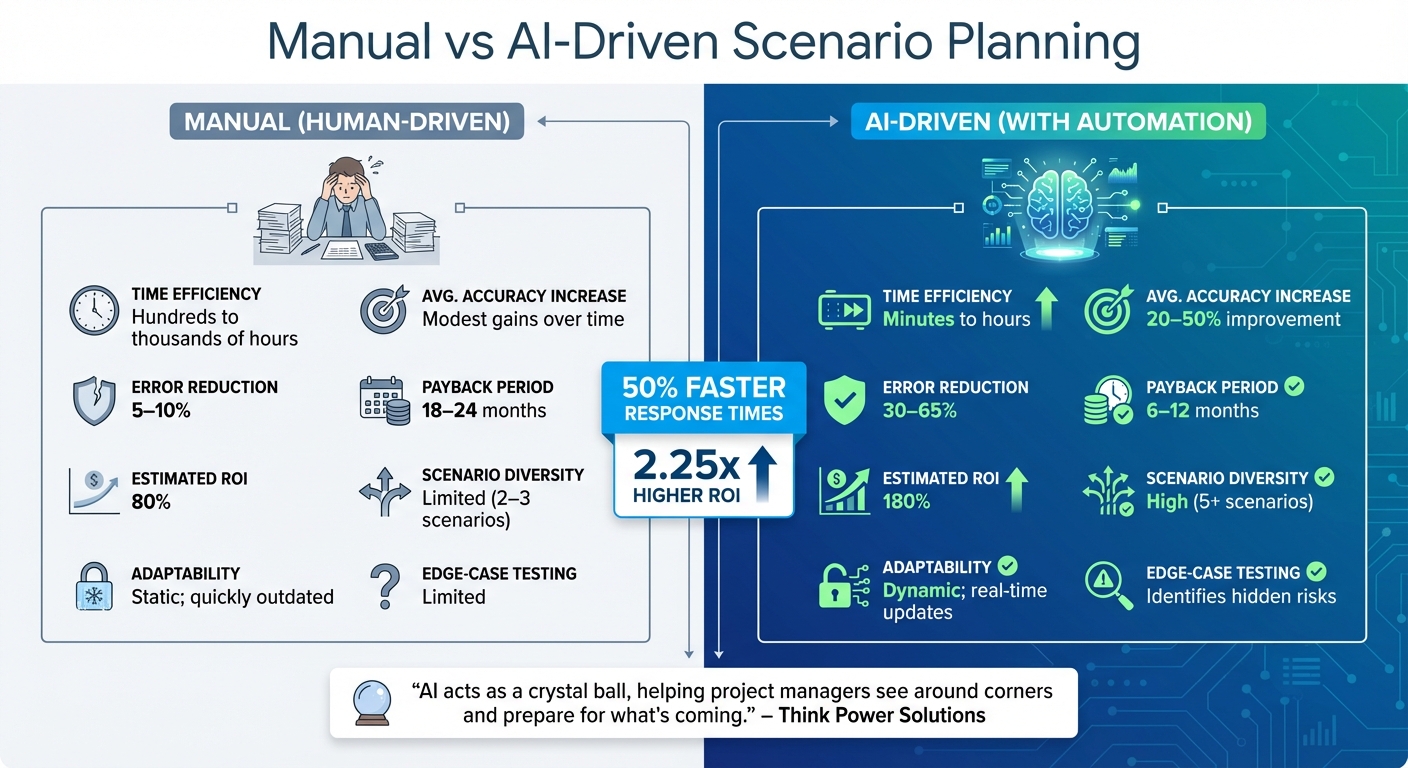
Manual vs AI-Driven Scenario Planning: Efficiency and ROI Comparison
This section dives into how traditional manual scenario planning stacks up against AI-driven methods, building on the earlier discussion of AI technologies and frameworks.
Manual scenario planning often depends on costly offsite workshops, brainstorming sessions, and intuition-based decisions. These methods are hindered by human biases, limited data analysis, and the inability to process vast amounts of variables in real time.
By contrast, AI-driven scenario planning leverages neural networks and ensemble models to simulate multiple future outcomes in a matter of minutes. Instead of relying solely on historical data, AI scans unstructured data sources – like news feeds, social media, and industry reports – to detect early signs of change. For example, Fever-Tree, a premium mixer brand that sources about 55% of the global quinine supply from a high-risk area in the eastern Democratic Republic of the Congo, highlights the critical need for AI’s predictive power.
The difference in efficiency is striking. Companies using AI for scenario analysis report reducing supply chain errors by up to 65% and doubling their decision-making speed.
3 Core Scenario Types: Best-Case, Worst-Case, and Most-Likely
All effective scenario planning models include three key scenario types. The Most-Likely Scenario acts as the baseline, focusing on the outcomes most likely to occur based on current data trends. This scenario is essential for operational budgeting and aligning strategies with the highest probability events.
The Best-Case Scenario envisions an optimistic future where external factors work in the organization’s favor. This scenario helps businesses identify their maximum growth potential and plan the resources needed to scale, especially when preparing for extreme outcomes isn’t feasible.
The Worst-Case Scenario models low-probability but high-impact disruptions, such as pandemics, complete supply chain failures, geopolitical upheavals, or sudden regulatory shifts like a 10% tariff hike. This type of scenario is critical for testing organizational resilience and creating robust contingency plans. AI is particularly effective at simulating these extreme risks, something manual methods often struggle to achieve.
Efficiency and Accuracy Comparison
The differences between manual and AI-driven approaches become evident when comparing performance metrics:
| Feature | Manual (Human-Driven) | AI-Driven (with Automation) |
|---|---|---|
| Time Efficiency | Hundreds to thousands of hours | Minutes to hours |
| Avg. Accuracy Increase | Modest gains over time | 20–50% improvement |
| Error Reduction | 5–10% | 30–65% |
| Payback Period | 18–24 months | 6–12 months |
| Estimated ROI | 80% | 180% |
| Scenario Diversity | Limited (2–3 scenarios) | High (5+ scenarios) |
| Adaptability | Static; quickly outdated | Dynamic; real-time updates |
| Edge-Case Testing | Limited | Identifies hidden risks |
These metrics illustrate why AI tools are becoming essential for modern risk management. While manual methods tend to be reactive – addressing risks after they occur – AI enables proactive management by forecasting potential issues before they arise. Traditional risk registers can quickly become outdated, but AI offers continuous, near-real-time updates, monitoring thousands of risk factors simultaneously, from social media trends to weather patterns and regulatory shifts.
"AI acts as a crystal ball, helping project managers see around corners and prepare for what’s coming." – Think Power Solutions
The adoption of Contingency Scenario Planning (CSP) has revolutionized planning timelines, reducing them from years to mere days. This allows organizations to respond swiftly to emergencies in ways that manual methods simply cannot match. However, as Ville Vaarnas from Inclus warns:
"The integration of AI isn’t without its challenges. Novice or negligent handling of AI technologies can amplify risks rather than mitigate them".
This highlights the need for a "human-in-the-loop" approach, where experienced leaders validate AI outputs and handle ethical decisions that algorithms cannot address on their own.
Implementing AI Scenario Planning with Resilient Power

Custom AI Solutions for Leadership
Resilient Power accelerates leadership decision-making with its tailored 3C-AI Framework, taking what used to take years and condensing it into just days. This science-based approach is designed as a cyclical process, seamlessly integrating AI technologies into leadership workflows. The result? Organizations can adapt quickly to changing circumstances.
At the heart of this system is the Scenario Planning Advisor (SPA). Powered by neuro-symbolic AI and natural language processing, SPA processes authoritative documents, industry reports, and news feeds to create alternative future scenarios in mere minutes instead of months. These AI-driven insights are tailored to the specific needs and contexts of each leader, ensuring that decisions are grounded in relevance and precision.
By combining such advanced tools with strategic implementation, Resilient Power bridges the gap between data accuracy and effective leadership.
Practical Implementation Methods
To make these insights actionable, the first step is integrating data from a variety of sources – IoT sensors, market analytics, and even social media sentiment. This diversity in data ensures that scenario planning is grounded in real-time, comprehensive information, strengthening risk mitigation efforts – an essential goal for modern leadership.
A key focus is human-AI collaboration. While AI excels in analyzing data and identifying patterns, human experts bring strategic insight, ethical judgment, and the final say in decision-making. This partnership ensures that raw data is transformed into actionable strategies, blending technological precision with human expertise.
Resilient Power also emphasizes the importance of testing scenarios in real-world conditions. Their incident response capabilities allow organizations to move from theoretical planning to practical execution. These tailored solutions are designed to fit each client’s unique risk profile and industry landscape, making AI-powered scenario planning accessible – even for those just beginning to explore these technologies.
Continuous Monitoring and Iteration
Scenario planning doesn’t stop once your models are built and simulations are run. It’s an ongoing process, as outlined in the 3C-AI Framework, which emphasizes continuous iteration to keep pace with changing market conditions. AI systems evolve alongside these shifts, and without regular oversight, their performance can degrade quickly. For example, a fraud detection model’s false positive rate can double in just six months – even if no code changes occur.
Traditional quarterly assessments leave a significant gap – 89 out of 90 days remain unmonitored. In contrast, real-time AI monitoring can identify potential threats within hours. This is crucial because today’s risks are interconnected and unpredictable; they don’t wait for your next scheduled review to emerge.
The 3C-AI Framework tackles this challenge through its Iteration phase. Insights from ongoing assessments are used to update risk inventories and refine assumptions. By integrating real-world outcomes through feedback loops, organizations can improve forecasting accuracy by 20% to 50%.
Adapting to Changing Risks
With continuous feedback, organizations can pivot quickly to address emerging challenges. AI enables "Contingency Scenario Planning", which shrinks planning timelines from years to weeks, days, or even minutes – allowing for immediate responses to disruptions. A key part of this process is identifying "signposts", or early warning signals, that indicate when a specific scenario is becoming likely. These indicators help leaders act proactively rather than reactively.
For instance, in October 2025, Maersk showcased this capability by using AI agents and digital twins to simulate 5,000 daily scenarios, including potential Suez Canal blockages. By incorporating weather and geopolitical data, they achieved 92% accuracy in delay predictions and reduced recovery times by 60%. Similarly, DHL’s Resilience360 platform ran 2,000 iterations of air freight network stress-tests. These simulations uncovered a 20% capacity gap during hypothetical fuel shortages, which DHL addressed by shifting to hybrid rail-air solutions before the crisis occurred.
The results speak for themselves. Companies using AI report supply chain error reductions of 30%–65% and an ROI close to 180%. Finance departments leveraging AI automation save up to 25,000 hours annually by minimizing rework and processing errors. Perhaps most strikingly, AI can cut response times to identified risks by 50%, transforming quarterly reviews into real-time strategic adjustments.
This ability to adapt quickly requires close human oversight. Establishing human-in-the-loop systems ensures experienced operators can step in to override AI outputs when necessary. This collaboration helps AI systems continuously learn and reduces false positives in risk detection by 25% each quarter, while preserving the strategic judgment that only humans can provide.
"AI systems don’t fail on a schedule. They drift in production while you’re busy writing the quarterly report or firefighting an unrelated outage – and that drift creates exposure." – John Noonan
The move from static, annual planning to dynamic, real-time adjustments marks a major shift in how organizations manage risk. With 88% of organizations running AI in production as of early 2026, continuous monitoring isn’t just a smart strategy – it’s quickly becoming the standard for effective risk management.
Conclusion
AI is revolutionizing scenario planning by enabling leaders to simulate and analyze vast, interconnected variables in real time. This advancement addresses the shortcomings of traditional, manual forecasting methods, such as human bias, limited data perspectives, and the inability to handle complex, intertwined risks effectively.
The shift to AI-driven scenario planning has measurable benefits. Forecasting accuracy improves by 20%–50%, supply chain errors drop by 30%–65%, and organizations see an ROI of 180% compared to 80% with traditional methods. Response times are slashed by nearly 50%, with payback periods ranging from 6 to 12 months. Dr. Lance Mortlock, EY Canada Managing Partner, highlights this transformation:
"AI allows you to create new and more insightful scenario-related models… processing massive amounts of data quickly and calibrating scenarios in near-real time. Humans can then shift away from feeding the data to focus on taking strategic action as AI offers continuous insight to guide them."
Companies like Resilient Power are leading the charge, reducing scenario planning timelines from months to minutes. Their AI-powered solutions manage intricate interdependencies and transition organizations from reactive to proactive risk management. This approach blends human expertise with machine intelligence, ensuring experienced leaders maintain strategic control while AI handles the heavy computational lifting.
Perhaps one of the most exciting aspects is how AI makes advanced scenario planning accessible to smaller businesses. Tools that were once exclusive to Fortune 500 companies are now within reach for small and medium-sized enterprises. Still, technology alone isn’t the answer. Organizations need to routinely evaluate data sources, integrate human-in-the-loop systems, and establish strong governance practices to ensure AI aligns with their strategic goals. Human oversight remains a crucial element.
As Jamie from Futuretoolkit.ai aptly puts it, "The real risk isn’t AI – it’s business as usual". By embracing AI, leaders can tackle uncertainty with precision, agility, and a forward-thinking approach. The combination of human judgment and AI-driven insights offers a powerful way to navigate an unpredictable future.
FAQs
What data is needed to start AI scenario planning?
To kick off AI scenario planning, having reliable historical data is a must. This data should focus on the key factors that drive performance, such as financial results, operational metrics, market trends, and customer details. The better the quality of your data, the more precise your analysis will be, leading to insights you can actually put into action.
How do we keep humans in control of AI-driven decisions?
Maintaining human oversight in AI-driven decisions means designing systems that assist rather than replace human judgment. In a successful human-AI partnership, the AI offers insights and evaluations, but the ultimate decisions rest with people. Transparent and explainable AI tools play a key role here. When these tools include interactive features, they allow users to better grasp and verify the AI’s outputs, leading to more informed decision-making. This approach keeps humans at the heart of important choices, aligning AI’s strengths with ethical and organizational priorities.
How can we monitor model drift and update scenarios in real time?
Monitoring model drift and making real-time updates are essential for keeping AI-driven scenario planning on point. AI systems excel at analyzing live data, spotting anomalies, and flagging deviations that indicate model drift. This process ensures that any shifts in data patterns don’t go unnoticed.
When it comes to updating scenarios, the use of flexible frameworks is key. Models can be retrained or fine-tuned with fresh data, allowing organizations to react swiftly to new risks or opportunities. This approach helps maintain both resilience and the ability to adapt strategically in an ever-changing environment.