
High-performance teams drive success by combining trust, clear roles, and shared accountability. They consistently meet ambitious goals while maintaining strong engagement. Key traits include psychological safety, strengths-based collaboration, and constructive conflict. Effective leadership accounts for 70% of team engagement, emphasizing clear communication, aligned goals, and regular feedback. Proven frameworks like SMART goals, OKRs, and tools like RACI matrices ensure clarity and efficiency.
Data shows these teams are 23% more profitable and 18% more productive in sales. AI tools and metrics enhance decision-making, while fostering resilience helps teams handle challenges. Start by setting clear goals, defining roles, and building trust to transform your team into a high-performing one.
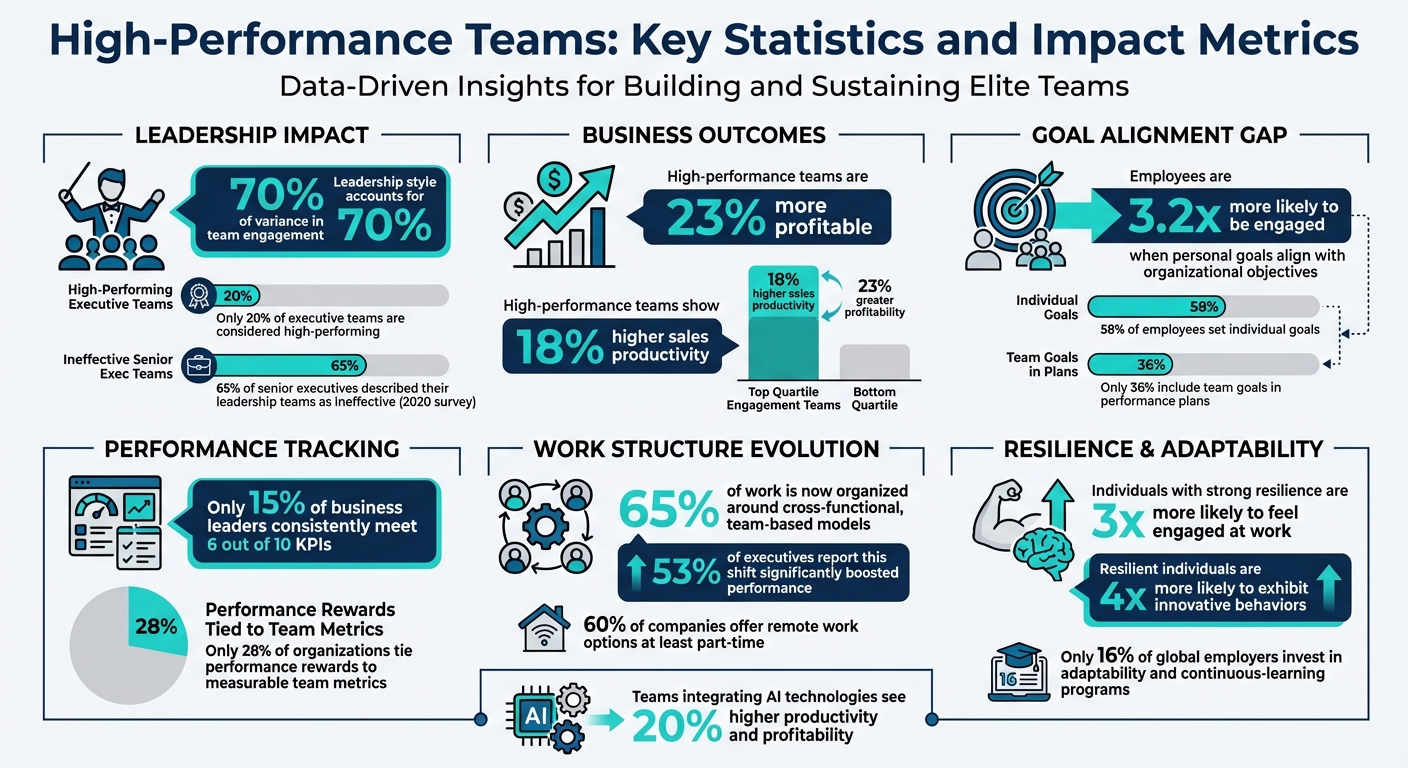
High-Performance Teams: Key Statistics and Impact Metrics
What Makes Teams High-Performing
Key Traits of High-Performance Teams
High-performance teams consistently exhibit five key traits: trust, psychological safety, role clarity, strengths-based collaboration, and constructive conflict combined with continuous feedback. Trust forms the backbone of these teams – members depend on each other, follow through on commitments, and admit when they need help. Psychological safety allows team members to take risks, challenge assumptions, and learn from mistakes without fear of judgment. Clear role definitions, such as the "resuscitation triangle" used in emergency medicine (assigning tasks like airway management, compressions, and medication), eliminate confusion during critical moments. Teams thrive when they leverage each member’s unique strengths, engage in healthy debates, and maintain momentum through regular feedback and recognition.
"We cannot understand greatness by studying the average." – Don Clifton, Father of Strengths Psychology
However, there’s a notable gap in team goal-setting. While 58% of employees set individual goals, only 36% include clear team goals in their performance plans. When individual objectives align with organizational priorities, employees are 3.2 times more likely to feel engaged. These traits create a foundation that empowers leadership to unlock even higher levels of team success.
How Leadership Drives Team Success
Leadership plays a pivotal role in shaping team performance. In fact, leadership style accounts for 70% of the variance in team engagement. Leaders who foster psychological safety, clarify roles, and encourage constructive dialogue can drive teams to achieve 18% higher sales productivity and 23% greater profitability.
Effective leaders also adapt their approach to guide teams through challenges, such as the turbulence of Tuckman’s "Storming" phase. By building resilience and learning from setbacks, they help teams navigate obstacles and emerge stronger. Yet, there’s room for improvement – only about 20% of executive teams are considered high-performing, and 65% of senior executives described their leadership teams as ineffective in a 2020 survey.
Strong leadership lays the groundwork for applying structured models that enhance team alignment and performance.
Proven Models for Team Development
With effective leadership in place, teams can leverage proven frameworks to diagnose and improve their performance. Models like Gallup’s 4-Step Framework and the CliftonStrengths Team Grid offer tools to understand team dynamics and uncover areas for growth.
"The Five Dysfunctions of a Team has been my playbook for developing our staff and locker room culture for the last decade." – Erik Spoelstra, Head Coach of the Miami Heat
Real-world examples showcase these models in action. In 2023, a global restaurant chain used Bain’s Five Behaviors model to strengthen relationships by organizing quarterly market visits and introducing a monthly "Innovation Hour." Meanwhile, a heavy equipment company transitioning to electric vehicles improved alignment by increasing meeting frequency and creating a smaller operating committee. Both approaches helped these organizations align their strategies and foster innovation.
sbb-itb-bc03425
Setting Goals and Aligning Teams
Connecting Vision to Team Purpose
Clearly defining a team’s purpose is crucial for linking overall strategy to everyday tasks. Regular two-way goal-setting discussions and weekly one-on-one meetings are great ways to tie current projects to the team’s broader mission. This approach not only boosts ownership but also ensures alignment. During times of change, leaders must emphasize the "why" behind the work to maintain focus and motivation.
However, there’s a noticeable gap in practice. While 58% of employees have individual goals tied to their performance plans, only 36% include team goals. This imbalance can hinder collaboration and shared accountability. High-performing teams strike a balance, ensuring every member knows their individual role while also working toward shared objectives. This clarity makes it easier to choose the right goal-setting framework to achieve measurable results.
Goal-Setting Methods: SMART, OKRs, and KPIs
Different goal-setting frameworks serve different purposes. SMART goals, OKRs, and KPIs each offer unique advantages depending on the team’s needs. Here’s a quick breakdown:
- SMART Goals (Specific, Measurable, Achievable, Relevant, Time-bound): These are perfect for short-term tasks and professional development. By providing clear parameters, they eliminate ambiguity and help individuals focus on achievable outcomes.
- OKRs (Objectives and Key Results): This method connects ambitious objectives to measurable results, making it ideal for quarterly planning or innovation-focused initiatives.
- KPIs (Key Performance Indicators): KPIs are all about tracking ongoing performance. They help teams monitor progress against specific benchmarks in real time.
| Framework | Core Focus | Best Use Case |
|---|---|---|
| SMART Goals | Clarity and Realism | Individual tasks, short-term projects, professional development |
| OKRs | Alignment and Ambition | Strategic growth, quarterly planning, driving innovation |
| KPIs | Measurement and Tracking | Monitoring operational health and specific performance targets |
Choosing the right framework depends on your team’s goals. Hosting quarterly workshops where team members collaboratively define objectives can ensure everyone understands how their role supports the mission. Using visual dashboards to track these metrics weekly helps identify potential issues early, giving teams the chance to adjust before small problems escalate. A well-chosen framework strengthens a culture of clarity and accountability.
Defining Roles and Responsibilities
Once goals are clear, defining roles becomes the next step in eliminating friction and speeding up progress. Ambiguity about responsibilities often leads to missed deadlines, duplicated work, and unclear accountability. When roles are explicitly defined, teams make decisions faster and work more efficiently.
"Clarity is the foundation of high performance. When everyone knows exactly what they’re responsible for – and how their work connects to the bigger picture – teams move faster and with less friction." – IMD Business School
One effective tool for clarifying roles is the RACI matrix, which identifies who is Responsible, Accountable, Consulted, and Informed for each task. Another helpful resource is a team charter, which outlines responsibilities, decision-making authority, and communication protocols. Reviewing this document quarterly ensures it stays relevant.
Delegating decisions based on expertise and impact also reduces bottlenecks and improves responsiveness. To make this even more effective, consider holding "strengths spotlights", where team members share their unique skills. This helps leaders assign tasks that align with individual talents, boosting both motivation and performance. For high-pressure situations, the "resuscitation triangle" concept from emergency medicine offers a great example – assigning specific, non-overlapping tasks ensures quick, efficient action without hesitation or duplication.
Building Trust and Communication
Creating Psychological Safety
Trust begins with fostering psychological safety – a shared understanding within a team that everyone can voice ideas, admit mistakes, or raise concerns without fear of judgment or repercussions. This concept isn’t just a feel-good idea; it’s a business cornerstone. Take Google’s extensive two-year study, Project Aristotle, which revealed that psychological safety is the most critical factor in creating high-performing teams.
One striking example of leadership driving trust comes from Paul O’Neill, who became CEO of Alcoa in October 1987. O’Neill shared his personal phone number with all employees, encouraging them to contact him directly about safety issues. This bold move not only improved workplace culture but also led to remarkable business results. By the time he retired in 2000, Alcoa‘s annual net income had skyrocketed from $200 million to $1.5 billion, and its market value grew from $3 billion to $27 billion.
"There’s no team without trust." – Paul Santagata, Head of Industry, Google
Psychological safety develops in stages. Teams typically progress through phases: Inclusion Safety (feeling like you belong), Learner Safety (freedom to ask questions), Contributor Safety (comfort in sharing ideas), and Challenger Safety (confidence to question the status quo). Leaders can help accelerate this process by framing work as a collaborative learning opportunity rather than a one-way execution. Admitting when they don’t have all the answers and encouraging questions are simple but powerful ways to cultivate this environment.
A practical strategy to reinforce psychological safety is introducing a "Failure of the Month" segment in team meetings. Instead of hiding mistakes, teams can openly discuss what went wrong and what lessons were learned – focusing on problem-solving rather than assigning blame. Another approach is using strengths-based tools like CliftonStrengths, which help team members discuss their unique contributions in a constructive way. These practices highlight how leadership behavior directly impacts team engagement. Once trust is established, choosing the right communication methods becomes essential to build on that foundation.
Communication Tools and Best Practices
After establishing trust, the next challenge is ensuring effective communication. High-performing teams tend to communicate frequently – about 12 times per working hour – and maintain an equal "talk ratio", where no single person dominates the conversation. In today’s world, where 60% of companies offer remote work options at least part-time, finding the right balance across communication tools is vital.
| Channel | Best Use Case | Best Practice |
|---|---|---|
| Video (Zoom/Teams) | Complex discussions, one-on-ones, social bonding | Keep cameras on to capture body language; always include a video link for hybrid meetings |
| Chat (Slack/Jabber) | Quick updates, urgent questions, informal culture | Use threads for organization; emojis for quick acknowledgment |
| Formal documentation, external communication | Reserve for non-urgent, detailed info requiring a paper trail | |
| Shared Canvas/Wiki | Documenting norms, roles, long-term goals | Pin critical documents to team channels for easy access |
The trick is matching the message to the medium. Video is ideal for nuanced conversations where tone and body language matter. Chat tools shine for quick coordination and fostering a casual, informal culture. Meanwhile, email serves as the go-to for official records. Many successful hybrid teams develop "team charters" – shared agreements outlining expectations for communication and availability, which reduces the need for rigid, top-down rules.
In digital environments, active listening becomes even more crucial. This means paraphrasing key points, maintaining eye contact during video calls (where appropriate), and using verbal cues like "yes" or "I see" to show engagement. For hybrid teams, setting "core hours" when everyone is accessible can prevent scheduling conflicts across time zones while preserving flexibility.
Communicating Under Pressure
When teams face high-stress situations, clear and honest communication becomes even more critical. A great example of this comes from Alan Mulally, former CEO of Ford Motor Company, who introduced a color-coded status report system (green, yellow, red) during the 2008 financial crisis. By encouraging executives to share "red" issues without fear of criticism, the leadership team could collectively address problems, ultimately steering Ford through the crisis without requiring a government bailout.
One effective technique for high-pressure moments is introducing "candor breaks." This allows any team member to pause a meeting to address unresolved issues or share concerns about a project’s direction. Another helpful practice is conducting "temperature checks" at the start of stressful meetings. Team members rate their energy levels on a scale of 1 to 5, helping leaders spot potential burnout or those in need of extra support.
"Even though we’re apart, it’s been obvious this year that around the company, teams and colleagues have been leaning on and counting on each other more than in normal times. I think that instinct, that resilience has been an essential part of how we have navigated this year." – Tim Cook, CEO, Apple
When conflicts arise under pressure, creating neutral spaces for resolution is key. Private discussions or specific norms – like assuming good intent – can help teams focus on resolving the issue rather than targeting individuals. The goal isn’t to avoid disagreements but to channel them productively. Teams that maintain open, honest communication during crises tend to perform better. These techniques complement the broader strategies for building trust and sustaining high-performance teams.
Building Resilience and Managing Change
Strengthening Team Resilience
Resilience is all about breaking through limits and thriving despite challenges. Organizations that can turn setbacks into opportunities for growth often outperform their peers, especially during tough times. In fact, companies with strong resilience have shown measurable financial gains even in economic downturns.
To cultivate resilience, teams need to focus on four key traits: candor (openly discussing challenges), resourcefulness (finding creative solutions despite constraints), compassion (showing genuine care for team members), and humility (knowing when to seek help). A great example of this is Northrop Grumman’s approach to redefining its core values. CEO Kathy Warden paired these values with specific leadership behaviors and implemented training programs to help leaders bring them to life. This initiative gave the company a clear guiding principle – its "North Star" – which helped teams navigate the uncertainty of the pandemic with greater speed and confidence.
"This effort has really given our people a North Star and empowered them to operate within our value system. And over time, it has helped us move faster as an organization." – Kathy Warden, CEO, Northrop Grumman
Another practical way to build resilience is by adopting an Anticipate-Adapt-Assess cycle. This involves spotting changes in the environment, collaborating to adapt, and reflecting on lessons learned. For instance, a large pharmaceutical company used this approach when it introduced resilience training to over 9,000 employees. The training was delivered in "social learning" waves: starting with in-person sessions for top leaders, followed by digital training for 4,000 managers, and finally extending to individual contributors. Over three months, this effort significantly boosted adaptability and overall well-being across the organization.
When teams are equipped with these proactive traits and tools, they’re better prepared to respond decisively when crises arise.
Responding to Incidents and Crises
While resilience helps teams prepare, they also need strategies to respond effectively during crises. One way to do this is by forming tiger teams – temporary groups of cross-functional experts assembled to solve urgent problems. These teams disband once the crisis is resolved. For example, a multinational manufacturer reorganized its workforce into thousands of "microenterprises", each consisting of about a dozen employees. This gave the teams autonomy over their goals and internal operations, enabling them to quickly adapt to market changes.
Clear decision-making processes are also essential during high-pressure situations. Tools like "Who has the D?" – which clarify who has final decision-making authority – can reduce confusion and ensure swift action when time is critical. Another useful tactic is conducting premortems, where teams imagine a project’s failure and work backward to identify potential risks and solutions. This approach can uncover issues before they escalate into full-blown problems.
Proactive vs. Reactive Resilience Approaches
The best teams know how to strike a balance between preparing for challenges and responding to them. Proactive resilience focuses on minimizing the impact of disruptions through strategic planning, while reactive resilience emphasizes adapting to crises and finding opportunities for growth.
| Approach | Focus | Key Practices | Leadership Role | Outcome |
|---|---|---|---|---|
| Proactive (Anticipate) | Preparing before disruptions occur | Scenario planning, premortems, aligning with a "North Star" | Modeling well-being and reinforcing core values | Agility and readiness for market changes |
| Reactive (Respond/Adapt) | Managing crises and recovering stronger | Tiger teams, incident response, postmortems | Guiding teams through change and reorientation | Turning challenges into growth opportunities |
Interestingly, only 16% of global employers invest in adaptability and continuous-learning programs. Yet, individuals with strong resilience and adaptability are over three times more likely to feel engaged at work and nearly four times more likely to exhibit innovative behaviors. The most effective teams don’t choose between proactive and reactive resilience – they excel at both. By preparing for known risks and staying flexible enough to handle unexpected obstacles, these teams maintain high performance even during periods of significant change and uncertainty.
Using AI and Data to Improve Performance
Using Metrics to Track Team Performance
Hitting performance targets consistently is a challenge for most leaders. In fact, only 15% of business leaders say their organizations consistently meet at least 6 out of 10 key performance indicators (KPIs). The issue often isn’t effort – it’s the lack of actionable data. High-performing teams rely on a mix of employee sentiment surveys (active signals) and workplace analytics (passive signals) to measure performance effectively. Passive signals might include data like time spent in meetings, after-hours work, focus time without interruptions, and collaboration patterns through network analysis.
To track team performance effectively, focus on three key phases: Breadth (engagement levels), Depth (employee commitment), and Business Impact (connecting tool usage to outcomes like cycle times or quality improvements). For instance, teams in the highest quartile of employee engagement show 18% higher sales productivity and 23% greater profitability compared to teams in the lowest quartile.
"Productivity is often seen as the key driver to business performance, but we found that employee engagement is equally important." – Sunita Khatri, Head of Product Marketing, Microsoft Viva
While resilience and clear communication are essential for team success, data and AI give leaders the tools to make faster, more informed decisions. When performance metrics are clear, AI can step in to simplify tasks and improve efficiency.
AI Tools for Leadership and Collaboration
AI isn’t just about automating tasks – it’s about removing the administrative burdens that drain energy. Tools powered by AI can summarize meetings, draft emails, and even build presentations, freeing up time for leaders and employees to focus on strategic priorities. Leaders can also leverage AI for scenario planning, risk assessments, and predictive analytics to enhance operational decision-making.
However, adopting AI successfully requires more than just installing new tools – it’s a shift in how work gets done. As Matt Nigh from GitHub puts it:
"Companies fail at AI adoption because they treat it like installing software when it’s actually rewiring how people work"
Organizations that succeed with AI often use a tiered approach to tools. Fully vetted Tier 1 tools handle sensitive data, while Tier 2 tools are reserved for non-sensitive tasks. Additionally, designating AI Advocates within the organization can help drive adoption and ensure the tools are used effectively. When combined with strategies for building trust, clarifying roles, and maintaining accountability, AI integration can significantly enhance team performance.
Adding AI to Daily Leadership Tasks
To make AI a lasting part of leadership practices, it’s crucial to integrate it into daily workflows. Assigning a Directly Responsible Individual (DRI) to oversee AI initiatives ensures there’s someone accountable for managing tools, driving adoption, and aligning AI strategies with team goals. This person helps embed AI into operations, making it a functional part of everyday work rather than a tool that gets sidelined.
Organizations can also create a central resource hub to lower barriers to adoption. This hub might include real-world AI use cases, a list of approved tools, and learning resources to help employees get started.
"The difference between success and failure isn’t buying licenses. It’s building the human infrastructure that turns skeptical employees into power users." – Matt Nigh, Program Manager Director of AI for Everyone, GitHub
Another practical step is fostering communities of practice, such as Slack channels or forums, where employees can share knowledge and collaborate across teams. Leaders should also prioritize AI training during onboarding, making it a core part of the company culture from day one. By weaving AI into daily tasks – whether it’s for managing workloads or supporting decisions – teams can shift their focus to creative problem-solving, leaving repetitive tasks to the machines.
Maintaining High Performance Over Time
Evolving Team Structures as You Grow
As your organization grows, adapting team structures and leadership becomes critical. Rigid, traditional hierarchies often slow progress, especially in larger organizations. Today, 65% of work is organized around cross-functional, team-based models, and 53% of executives report this shift has significantly boosted performance.
Scaling up isn’t just about adding more people – it’s about ensuring you have the right managerial talent. Skilled managers can lead larger teams effectively, while those with moderate skills may thrive with smaller groups. Instead of layering on more management levels, focus on developing your managers’ abilities. Strategic delegation becomes a key tool during growth, enabling the exchange of ideas and ensuring everyone contributes meaningfully.
For hybrid or remote teams, clear communication norms are essential to maintain alignment as you scale. High-performing teams also make it a habit to regularly evaluate their dynamics and performance metrics, adjusting strategies in response to both market trends and internal feedback.
Developing Future Leaders
Identifying future leaders requires attention to their Cognitive (CQ), Drive (DQ), and Emotional Quotients (EQ). Research involving 1,800 candidates found that individuals with high potential in these areas were over three times more likely to be top performers within their first year.
Take, for example, a Fortune 500 company that used this model between 2020 and 2022. They identified a high-potential leader, Maya, whose CQ and DQ stood out despite initial perceptions that she "lacked gravitas." Her ability to evaluate strategic scenarios and lead mentorship initiatives earned her targeted EQ coaching in stakeholder management. After a cross-functional rotation, Maya advanced two levels within 24 months, landing in a high-visibility role where senior leadership hailed her as a "rock star".
To nurture emerging leaders like Maya, consider strategies such as stretch assignments that rotate them through different markets or functional areas, exposure to senior-level meetings to observe strategic decision-making, and 1-on-1 meetings that focus on career growth rather than just status updates. Tools like talent reviews and 9-box grids can help you proactively identify rising stars and prepare them for impactful roles. These pipelines ensure your leadership bench is ready to support long-term success.
Governance for Long-Term Success
Sustaining high performance isn’t just about individual excellence – it requires team-based accountability. Yet, only 28% of organizations currently tie performance rewards to measurable team metrics. A balanced approach might involve using individual performance to determine base salaries while team-level achievements inform bonuses. This setup motivates both personal and collective success.
Goal alignment is another cornerstone of sustained performance. Employees are 3.2 times more likely to be engaged when their personal goals are tied to the organization’s objectives. Performance development plans should include three types of goals: individual, team, and customer-focused. Regular talent reviews, supported by calibration sessions with multiple evaluators, help maintain fairness and flag potential risks early.
Effective governance connects individual contributions to team success. Structured feedback loops ensure alignment, while managers – responsible for 70% of the variance in team engagement – play a pivotal role. Consistent 1-on-1 meetings provide opportunities for coaching, removing obstacles, and discussing development needs. For hybrid teams, co-creating behavioral expectations and shared commitments fosters accountability without relying solely on rules. By combining these governance practices with ongoing skill development and peer learning, organizations lay the groundwork for sustained high performance as they evolve.
Amy Edmondson on Building High-Performing Teams
Conclusion: Your Path to High-Performance Teams
High-performance teams don’t rely on perfect individuals – they thrive when the right conditions are in place. When employees’ personal goals align with the organization’s purpose, they’re 3.2 times more likely to feel engaged. Tools like OKRs or SMART goals can help solidify this connection, ensuring everyone is moving in the same direction.
At the heart of a strong team lies trust and psychological safety. These aren’t just buzzwords – they’re the foundation of real performance. In environments where team members feel safe to admit mistakes, challenge ideas, and take risks, innovation flourishes. As Don Clifton, the Father of Strengths Psychology, once said:
"We cannot understand greatness by studying the average"
Rather than fixating on weaknesses, focus on individual strengths. This approach not only boosts morale but also encourages diverse thinking, which is a key driver of creativity and problem-solving.
Leadership is the cornerstone of team success. Effective leaders close the gap between talent and outcomes by fostering growth and communication. Use practical tools like the SBI model (Situation, Behavior, Impact) to give clear, actionable feedback. Regular 1-on-1 meetings should prioritize development over routine updates. Strong leadership doesn’t just guide – it empowers teams to adapt and innovate.
What sets exceptional teams apart is their resilience and adaptability. Building "power skills" like empathy and communication before challenges arise ensures teams are ready for whatever comes their way. Modern tools like AI and data-driven platforms can also enhance collaboration, with teams that integrate these technologies seeing 20% higher productivity and profitability compared to their peers.
To start building your high-performance team, take small but meaningful steps today. Conduct a strengths audit, create a team charter for hybrid work, or establish a rhythm of weekly feedback. High performance isn’t a one-time achievement – it’s an ongoing process of alignment, trust, and adaptability. Teams that master these fundamentals consistently deliver outstanding results.
FAQs
What steps can leaders take to create a culture of psychological safety in high-performance teams?
Psychological safety plays a key role in building high-performing teams. When team members feel safe to share ideas, take risks, and learn from mistakes without fear of judgment, collaboration thrives. Leaders can cultivate this environment by modeling vulnerability – openly share your own challenges, ask for input, and admit when you don’t have all the answers. This approach fosters trust and encourages openness.
To ensure everyone’s voice is heard, actively invite quieter team members to share their thoughts and genuinely value honest feedback. Shift the perspective on mistakes by framing them as opportunities to learn and grow, which helps normalize experimentation and innovation. Recognize and celebrate efforts that embrace trying new things, even when outcomes aren’t perfect.
Regular, constructive feedback is another cornerstone of psychological safety. Pair this with creating low-pressure ways for team members to express concerns, such as quick check-ins or anonymous surveys. By consistently practicing these strategies, leaders can build trust, enhance collaboration, and set their teams up for lasting success.
What’s the difference between SMART goals, OKRs, and KPIs?
SMART goals, OKRs, and KPIs each serve a distinct purpose in performance management.
SMART goals are all about setting clear, actionable objectives. These goals are defined by being Specific, Measurable, Achievable, Relevant, and Time-bound. They’re great for pinpointing precise targets but aren’t meant for monitoring ongoing metrics.
OKRs, or Objectives and Key Results, blend a qualitative objective with a few quantitative key results to track progress. They’re designed to align teams with broader strategic goals, encourage ambitious thinking, and push for measurable achievements that often exceed current expectations.
KPIs, or Key Performance Indicators, focus on ongoing metrics that monitor performance in critical areas such as revenue, customer satisfaction, or productivity. Unlike SMART goals or OKRs, KPIs don’t define goals – they simply provide a real-time snapshot of performance.
To put it simply: SMART goals clarify what you aim to achieve, OKRs outline where you’re headed and how to track progress, and KPIs measure how well you’re performing in essential areas.
How can leaders use AI tools to enhance team performance and efficiency?
AI tools are transforming the way leaders manage their teams by simplifying everyday tasks and freeing up time for what truly matters – team success. By automating repetitive duties like drafting project briefs, organizing meeting agendas, and assigning follow-up tasks, AI not only saves valuable time but also keeps everyone on the same page. On top of that, these tools can identify patterns in task management, spotting potential bottlenecks early so leaders can tackle issues head-on and adjust resources as needed.
With AI-powered analytics, leaders gain access to real-time insights through interactive dashboards. These tools make it easy to monitor progress, compare results against goals, and make data-driven decisions. Even better, custom workflows can trigger timely notifications or recommend adjustments based on performance metrics, ensuring every action is purposeful and strategic. By offloading administrative and analytical work to AI, leaders can focus on what drives team success: coaching, setting a clear vision, and building a culture of collaboration.