Executive stress is a serious issue, with 70% of senior leaders reporting burnout affecting their decisions and 69% considering stepping down due to well-being concerns. Stress not only impacts individual performance but also ripples through teams and organizations. This article outlines six practical techniques to help executives manage stress effectively and maintain focus under pressure:
- Mindfulness Exercises: Quick resets like a six-second breath focus or ending meetings early for reflection.
- Delegation: Hand off tasks to free up time for high-priority decisions while empowering your team.
- Time Management: Use 90-minute work sprints and prioritize tasks based on energy levels and impact.
- Physical Health Routines: Incorporate small habits like walking meetings, short breaks, or a simulated commute to reset.
- Cognitive Reframing: Shift perspectives during challenges to reduce anxiety and improve decision-making.
- Leadership Coaching: Build resilience and gain external support for navigating high-pressure situations.
These strategies are actionable and designed to fit into even the busiest schedules. Start small, track your progress, and create habits that support long-term well-being and effective leadership.
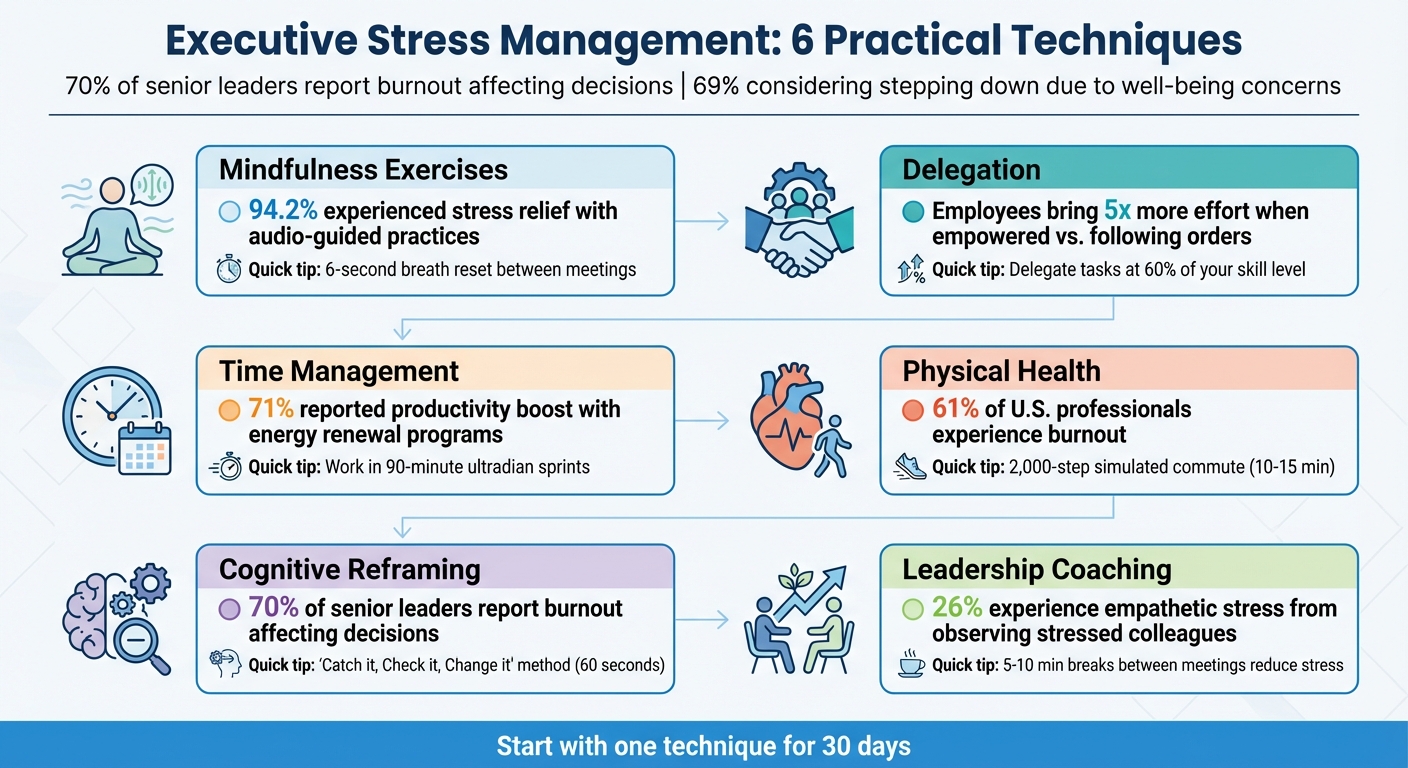
6 Executive Stress Management Techniques with Key Statistics
1. Mindfulness Exercises Between Meetings
Practicality for Executive Schedules
Forget hour-long meditation sessions – micro-mindfulness can fit seamlessly into your day, even during packed schedules. Chade-Meng Tan highlights that a simple six-second reset can shift your mindset and improve leadership focus.
Try this: end meetings five minutes early and use that time to regroup. Spend two minutes focusing on your breath – counting your exhalations can help ground you. Or, set a timer for a one-minute mental check-in every hour. These aren’t indulgences; they’re brief, intentional moments that keep your brain sharp and engaged when facing high-stakes decisions.
These small practices have been shown to reduce stress and build resilience, supported by recent research.
Evidence-Based Impact on Stress Reduction
A 2024 study involving 2,239 participants demonstrated that mindfulness exercises, particularly body scans (effect size d = -0.56), significantly reduced short-term stress. Notably, 94.2% of participants experienced stress relief using audio-guided mindfulness practices without needing a professional instructor.
The science behind this is compelling. Mindfulness shifts the brain from a "fight-or-flight" state – dominated by stress hormones like cortisol and adrenaline – to what researchers call "Level 3." This state promotes engagement and connection, activating the release of oxytocin and regulating your physiological responses.
Applicability to High-Stakes Decision-Making
Mindfulness isn’t just about relaxation – it’s a tool for navigating pressure. Take consultant Robert E. Quinn’s experience in January 2021. Facing a tense call, he used a self-regulation process: acknowledging his anxiety, recalling past successes, setting a clear intention, and showing vulnerability. This helped create a "co-regulation" effect, calming the CEO and inspiring her to adjust her strategy. Within a month, her board responded with renewed commitment and optimism.
Stress often narrows your focus, leading to "tunnel vision" that blinds you to subtle signals and strategic opportunities. A quick six-second mindfulness reset before negotiations or meetings can clear mental clutter, helping you read the room and make better decisions.
These techniques are just the beginning of a broader toolkit designed to enhance resilience in leadership roles.
Alignment with U.S. Cultural and Professional Norms
In the U.S., leadership increasingly values "calm confidence" and emotional intelligence, especially in high-pressure situations. Mindfulness, once considered niche, has become mainstream. Companies like SAP have embraced mindfulness programs, evolving from grassroots efforts into formal professional development initiatives between 2014 and 2024. This reflects a growing acknowledgment that managing attention is just as critical as technical expertise in today’s fast-paced, information-heavy environment.
A study of 27,000 healthcare workers found that those practicing self-regulation techniques were far less likely to experience burnout, even under resource constraints. Incorporating mindfulness into your routine doesn’t just clear your mind – it creates a leadership culture where stress management is a priority, ensuring long-term effectiveness and well-being.
sbb-itb-bc03425
2. Delegation Using Clear Decision Rights
Making Time for What Matters
Did you know that executives often spend up to 80% of their time on tasks that someone else could handle? That’s a lot of missed opportunities to focus on big-picture goals. Start by taking a hard look at your weekly schedule – are there tasks you’re doing out of habit? If someone on your team can complete a task at roughly 60% of your skill level, it’s worth handing it off. Instead of micromanaging every detail, define the desired outcomes and use frameworks like Objectives and Key Results (OKRs) to set clear goals. Add a weekly check-in to offer guidance and ensure progress without hovering. This approach not only clears your plate for strategic priorities but also gives your team a chance to grow.
Less Stress, More Engagement
When employees feel trusted and empowered, they bring up to five times more effort to the table compared to those who simply follow orders. A study involving 27,000 healthcare workers backs this up – those who felt safe to voice opinions and make decisions reported less stress and were less likely to experience burnout.
"Effective delegation is based on trust. And a culture with a foundation of trust will always flourish… Micromanaging is depressing and deprives people of ownership." – Dominic Monkhouse, Business Coach and Leadership Expert
Trust isn’t just a nice-to-have; it’s a game-changer for both team morale and productivity.
Delegation Under Pressure
Delegation isn’t just for routine tasks – it’s a lifesaver in high-stakes scenarios. Take the example of a tech CEO in January 2021, who faced intense pressure from an aggressive investor. With help from consultant Robert E. Quinn, the CEO used a neuroscience-based strategy to delegate the task of understanding the investor’s motives to board members. This move not only strengthened board engagement but also secured long-term funding, transforming a $6 million problem into a strategic win. Delegating effectively in high-pressure situations frees up your mental bandwidth for strategic thinking. Tools like the Eisenhower Matrix can help you decide what to keep on your plate and what to pass along.
Delegation and U.S. Workplace Dynamics
In the U.S., delegation isn’t about giving up control – it’s about empowerment. Leaders are expected to build systems that support strategic decision-making without micromanaging. Nitin Nohria, former Dean of Harvard Business School, put it perfectly:
"Being in charge is about shaping decisions, not always making them."
To make delegation work, match tasks to your team’s strengths. Tools like Working Genius or Gallup Strengths can help you align responsibilities with individual aptitudes. Clear boundaries also promote autonomy and support a healthier work-life balance. When done right, delegation doesn’t just lighten your load – it builds a stronger, more capable team.
3. Time Prioritization Based on Energy and Business Value
Practicality for Executive Schedules
Your body operates on 90- to 120-minute energy cycles, and ignoring signals like restlessness, hunger, or loss of focus can drain your energy faster than you think. The solution? Work in 90-minute "ultradian sprints" followed by short breaks. This approach proved transformative for Jean Luc Duquesne, Vice President at Sony Europe. Back in 2006, he restructured his mornings to tackle his most critical strategic issue first – before diving into emails. By 10:00 AM, he felt as productive as he used to feel at the end of an entire day.
Here’s a simple trick: identify your top priority the night before and make it the first thing you focus on in the morning. Steve Wanner, a partner at Ernst & Young, adopted a similar strategy by checking emails only twice a day – at 10:15 AM and 2:30 PM. He allocated 45-minute blocks to manage his inbox, avoiding the constant distraction of notifications. This shift not only improved his focus but also boosted his overall engagement. These small, intentional changes can pave the way for noticeable performance improvements.
Evidence-Based Impact on Stress Reduction
In 2006, Wachovia Bank launched an energy management program involving 106 employees across 12 regional banks. Participants, including VPs like Gary Faro and Dan Cluna, adopted practices like scheduled breaks and ultradian sprints. Within three months, they outperformed a control group by 20 percentage points in year-over-year revenue growth from deposits, maintaining this advantage for an entire year. Dan Cluna even relocated to a conference room for tasks requiring deep focus, cutting the time needed to complete reports by two-thirds.
The science backs these methods. Multitasking, for instance, can increase the time needed to complete a primary task by up to 25%. Meanwhile, 71% of participants in energy renewal programs reported a significant boost in productivity and performance. These findings highlight how thoughtful scheduling can enhance decision-making and reduce stress under pressure.
Applicability to High-Stakes Decision-Making
"The core problem with working longer hours is that time is a finite resource. Energy is a different story." – Tony Schwartz, CEO, The Energy Project
This insight emphasizes the importance of batching low-value tasks and reserving peak energy for high-stakes decisions. Strategic challenges require your sharpest mental state, which is why it’s essential to block time for focused work. Instead of letting email dictate your day, schedule specific periods to clear your inbox and dedicate your most productive hours to complex problem-solving. Even small actions, like a 30-second break to focus on a plant or take deep breaths, can activate your parasympathetic nervous system and help break the cycle of chronic stress.
Alignment with U.S. Cultural and Professional Norms
In the U.S., more executives are embracing "no-meeting zones" – dedicated hours, such as 8:00 AM to 9:00 AM, reserved for deep, uninterrupted work. This shift from managing "minutes" to managing "stamina" reflects a growing acceptance of practices like midday workouts, intermittent breaks, and protected focus time. With the rise of remote work, some have even adopted "fake commutes", such as short walks, to create a mental boundary between work and personal time. The takeaway? Recovery isn’t just a perk – it’s a smart strategy for sustained performance.
4. Resilience Routines Built on Physical Health
Practical Tips for Busy Schedules
Maintaining physical health doesn’t mean you need hours at the gym or indulgent wellness retreats. Simple, quick breaks – lasting anywhere from 30 seconds to 5 minutes – can work wonders for resetting your nervous system and managing stress. For example, something as small as focusing on a plant on your desk or taking three deep breaths before your next video call can activate your parasympathetic nervous system, which naturally helps reduce stress.
If you’re working remotely, consider creating a "simulated commute." A quick 2,000-step walk (about 10–15 minutes) at the start and end of your workday can help establish a mental boundary between "work mode" and "home mode". Walking meetings are another great option – status updates or casual one-on-one calls that don’t require screen sharing can help you stay active while avoiding the sedentary trap of back-to-back video calls. These small adjustments are simple to implement and backed by research.
How These Practices Reduce Stress
Science backs up these strategies, showing they can significantly lower stress levels.
"Research shows that people who are sleep deprived are less cooperative and more selfish." – American Psychological Association
Getting 7–9 hours of quality sleep can improve both your mood and your ability to collaborate. To set yourself up for better sleep, avoid caffeine after 2:00 PM, and replace late-night screen time with calming activities like a warm shower. It’s also worth noting that using your smartphone during breaks doesn’t help your brain recover. Instead, try taking 5–10 minutes each hour to check in with your body, practice deep breathing, or go for a brisk 10–15 minute walk – these habits can help regulate your emotions and even reduce inflammation.
Adapting to U.S. Workplace Trends
These practical, research-backed habits reflect a growing trend in U.S. workplaces. Many American executives are introducing meeting-free blocks and promoting walking meetings to address burnout, which affects about 61% of professionals in the country. This shift highlights a broader movement toward maintaining boundaries between work and personal life. Some leaders are even adding email disclaimers like, "I am sending this email at a time that suits my work schedule; please do not feel obliged to reply outside of your working hours". By modeling these boundaries, they reinforce the idea that recovery is not optional – it’s essential for long-term success.
5. Cognitive Reframing for High-Pressure Decisions
For Executive Schedules
Cognitive reframing is a quick and simple stress management technique that doesn’t require any tools and can be done mentally, even during short breaks. It’s about shifting how you view a stressful situation to reduce feelings of anxiety and overwhelm. For instance, instead of seeing a crisis as a looming threat, you can frame it as a chance to demonstrate your leadership skills. This mental adjustment can take as little as 60 seconds, making it a practical tool for leaders constantly making decisions throughout their day.
A helpful method for reframing is the "Catch it, Check it, Change it" approach. When a negative thought pops up, pause to identify it, evaluate whether it’s based on solid evidence, and then reframe it with a more balanced perspective. For example, instead of thinking, "If this deal falls apart, I’ll lose my job", you might tell yourself, "I’ve dealt with challenges before, and I have multiple ways to handle this." This process can be done silently during a brief moment between meetings or even while walking to your next appointment.
These small mental adjustments can lead to noticeable stress relief.
Evidence-Based Impact on Stress Reduction
Research backs up the benefits of cognitive reframing. A 2017 study showed that those who used this technique experienced less burnout and better stress management. During the COVID-19 pandemic, a 2021 study highlighted how reframing helped reduce anxiety and depression while improving overall quality of life. This is especially relevant for executives, as 70% of senior leaders report that burnout is affecting their ability to make decisions, and 69% of executives have considered stepping down due to concerns about their well-being.
"The frame through which a person views a situation determines their point of view. When that frame is shifted, the meaning of that situation changes, and thinking and behavior often change along with it." – Amy Morin, LCSW
Cognitive reframing doesn’t just change how you think – it also impacts your body. It helps shift your nervous system out of "fight-or-flight" mode into a more engaged and connected state. This shift triggers the release of oxytocin, a hormone linked to creativity and teamwork, while reducing stress hormones like cortisol and adrenaline. The result? You move from feeling stuck or overly rigid to being more open and solution-focused.
Applicability to Critical Decisions
In January 2021, Robert E. Quinn, Professor Emeritus at the University of Michigan, worked with a CEO facing a crisis: board members were pulling financial support due to pressure from an assertive investor. Recognizing the CEO’s "fight-or-flight" response, Quinn used techniques like "Recall" and "Intention" to help the CEO self-regulate and collaborate effectively. This reframing shifted the CEO’s focus from "securing promised resources" to "revisiting original goals", leading to a new funding strategy that gained board approval within a month.
A Five-Step Framework for Self-Regulation offers a structured way to apply reframing:
- Understanding: Learn how stress affects your body.
- Awareness: Pay attention to physical signs like a racing heart.
- Recall: Reflect on past successes to build confidence.
- Intention: Shift focus to a higher purpose instead of personal ego.
- Trusting the Process: Allow solutions to emerge naturally.
Before a challenging meeting, take a minute to clarify your primary goal – such as, "I want to find the best solution for the team", instead of "I need to win this argument." This simple shift can stimulate oxytocin release, helping you move from a defensive mindset to a collaborative one.
This approach works well alongside other stress-management strategies, offering clarity and focus when making critical decisions.
Alignment with U.S. Cultural and Professional Norms
Cognitive reframing aligns with the growing emphasis on mental fitness in U.S. leadership. Terms like "mental fitness" and "resilience" are becoming staples in executive culture, often supported through coaching and peer advisory groups like Vistage. American leaders increasingly value emotional agility and the normalization of emotions, making reframing an effective tool for high-performing professionals. Many executives are also adopting short 5–10 minute breaks every hour during crises to check in with their stress levels and emotional state before making decisions. This practice reflects a broader acknowledgment of the importance of recovery and mental resets for maintaining effective leadership in high-pressure situations.
How To Manage Stress (with former CEO)
6. Leadership Resilience Coaching and Support Systems
Leadership resilience coaching builds on the idea of mental resets by offering external support to help leaders maintain their composure and effectiveness during high-pressure situations.
Practicality for Executive Schedules
Resilience coaching is designed to fit seamlessly into even the busiest schedules. The most effective methods rely on short, focused interventions – perfect for slipping into the gaps between meetings and calls. For example, a Microsoft study revealed that taking just 5–10 minutes to pause between meetings can significantly reduce stress and improve focus. These quick breaks allow you to recognize stress signals and reset before diving into your next task.
Coaching also helps leaders shift from a reactive "fight-or-flight" mindset to what researchers call "Level 3" – a state of engagement where you can read nonverbal cues and think strategically. Rather than adding to your workload, this approach creates mental breathing room by encouraging effective delegation and fostering trusted relationships. This opens up space for you to focus on the decisions that truly demand your attention.
Evidence-Based Impact on Stress Reduction
These micro-practices aren’t just convenient – they’re backed by science. Research involving 27,000 healthcare workers found that those who felt safe speaking up (a concept known as psychological safety) experienced lower stress levels and were less prone to burnout. This is critical because unchecked stress narrows your focus, making it harder to innovate or project confidence to your team.
Neuroscience-based coaching also promotes collaboration by triggering the release of oxytocin, a hormone that reduces defensive behavior. Interestingly, stress isn’t just personal – it can be contagious. Studies on "empathetic stress" show that 26% of people observing someone under stress experience elevated cortisol levels themselves. This means your stress can ripple through your team, but their support can also help regulate your emotional state. Coaching offers an external, unbiased perspective for discussing sensitive challenges that might be difficult to address within your organization’s structure.
Applicability to High-Stakes Decision-Making
The lessons from resilience coaching directly enhance decision-making during critical moments. By teaching you to identify when you’re in a defensive state and how to shift out of it, coaching helps you avoid tunnel vision during high-pressure situations. This is especially valuable during negotiations or other scenarios where missing nonverbal cues or alternative solutions could lead to poor outcomes.
Alignment with U.S. Cultural and Professional Norms
Executive coaching aligns with a broader U.S. trend emphasizing emotional transparency and resilience. Backed by neuroscience and data, these strategies are becoming increasingly valued in professional circles. More executives are openly sharing their mental health practices, breaking away from outdated notions that equate vulnerability with weakness. Leaders like former Coach CEO Lew Frankfort now openly discuss how they care for themselves and their teams, signaling a shift from superficial emotional displays to genuine honesty.
"Modeling emotional honesty in a grounded and intentional way sets the tone for everyone." – Dina Denham Smith, Author
Despite this progress, many executives still associate success with relentless effort and avoiding any appearance of vulnerability. Resilience coaching reframes this perspective, showing that building psychological safety and emotional awareness prevents mistakes under pressure. By moving away from masking emotions and toward fostering open, supportive environments, leaders can reduce stress, lower burnout rates, and align with modern leadership values. This makes resilience coaching not only a practical tool but also a strategic advantage in today’s professional landscape.
How to Implement These Techniques: 30 to 90 Days
To tackle stress effectively, try breaking the process into three phases. These steps build on techniques like mindfulness, delegation, time management, physical activity, cognitive reframing, and coaching. With 66% of full-time workers reporting burnout at any given time, this phased approach can help you create lasting habits while improving your leadership skills.
Days 1–30: Build Awareness and Start Small
Start by paying attention to your body’s stress signals – tight muscles, headaches, or a racing heart. Set a timer to take a one-minute deep-breathing break every hour to activate your parasympathetic nervous system. By the second week, use time-blocking to focus on high-priority tasks and reduce digital distractions by tweaking your phone settings. In Week 3, squeeze in 10–15 minutes of physical activity or turn status meetings into walking meetings. At the 30-day mark, track your progress with tools like heart-rate variability (HRV) monitoring or by journaling to identify stress triggers early.
Days 31–60: Strengthen Systems and Improve Delegation
This phase is all about streamlining your workflow. Use project management tools like Asana or Trello to improve delegation and time-tracking apps like Toggl or Harvest to uncover time-wasting activities. Create a simple end-of-day ritual to review changes and plan the next day’s priorities, helping you stay in control. Schedule time for reflective thinking – set aside moments to read, brainstorm, or simply step away from constant decision-making. You can also add an email signature like this one:
"I am sending this email at a time that suits my work schedule; please do not feel obliged to reply outside of your working hours" (Email Signature Example, McKinsey & Company).
This small gesture can help set healthy boundaries for both you and your team. As you refine your systems, focus on building trust and deepening support.
Days 61–90: Build Long-Term Support and Fine-Tune Habits
In this final phase, focus on creating a strong support network. Join professional groups, or consider executive coaching to address challenges like perfectionism. Use tools like the Eisenhower Matrix weekly to prioritize tasks that align with strategic goals. Research shows that leaders who manage their time well can reduce stress by up to 40%. Strengthen accountability by creating regular feedback loops with team members to ensure tasks are on track and trust is growing. By Day 90, you’ll have a clearer picture of which techniques work best for your stress triggers and leadership style, allowing for ongoing adjustments to maintain balance.
| Checkpoint Frequency | Action Item | Goal |
|---|---|---|
| Hourly | 5–10 min "Stress Signal" check | Notice physical tension and reset with deep-breathing exercises |
| Daily (Morning) | Intention Setting | Focus on your purpose and shift from "fight-or-flight" thinking to a more open mindset |
| Daily (Evening) | Tomorrow’s Map | Plan the next day to reduce nighttime anxiety and boost control |
| Weekly | Eisenhower Matrix Review | Organize tasks to prioritize strategic, high-value work |
| Monthly | Support Network Check-in | Stay connected with mentors or peers to avoid leadership isolation |
Self-awareness is your most valuable tool. Keep a journal to track how your body reacts to different activities, helping you pinpoint what triggers stress versus recovery. Celebrate small victories along the way – acknowledging progress keeps your mindset positive and reinforces the changes you’re making. Also, be mindful of your caffeine intake, as it can linger in your system and disrupt sleep quality.
Conclusion
Managing executive stress requires channeling pressure into productive focus. The six techniques we’ve discussed – mindfulness exercises, clear delegation strategies, energy-based time management, physical resilience practices, cognitive reframing, and leadership coaching – offer actionable ways to move from a reactive "fight-or-flight" state to one of engagement and control.
Start by choosing one approach that resonates with your stress triggers and commit to practicing it consistently for 30 days. It could be as simple as taking a five-minute breathing break between meetings or dedicating an hour each day to focused work with your phone tucked away. Psychiatrist Daniel Siegel aptly notes:
"Where attention goes, neural firing flows and neural connection grows".
By consistently applying these practices, you’ll begin to reshape your response to stress.
Your approach to stress management doesn’t just impact you – it sets a tone for your entire team. In a time when burnout is increasingly common, modeling healthy boundaries and stress habits can inspire those around you to do the same. This ripple effect fosters a stronger, more adaptable team, better equipped to face future challenges together.
To make these changes stick, consider implementing a structured 30-to-90-day plan. Such a framework helps you turn small, daily actions – like microbreaks, end-of-day rituals, or delegating tasks – into lasting habits. These aren’t just ways to manage stress; they’re essential leadership tools that sharpen decision-making, nurture relationships, and safeguard your long-term effectiveness.
Leadership begins with managing your own stress. Take that first small step today. By embracing these techniques, you’re not just managing pressure – you’re reinforcing your resilience as a leader.
FAQs
How can busy executives incorporate mindfulness into their daily routines?
Mindfulness can easily weave into a busy executive’s day with small, intentional practices tied to everyday tasks. For example, before stepping into a high-stakes meeting, take a moment to focus on your breath or silently repeat a calming phrase to reset your mindset. During natural pauses – like walking to a meeting or waiting for a reply – try taking three slow, deep breaths, noticing your surroundings, and grounding yourself in the present.
To make mindfulness a regular part of your routine, carve out 5-10 minutes in the morning or after lunch to center yourself and boost clarity. Link these moments to habits you already have, such as sipping coffee, reviewing your to-do list, or checking emails, so they blend seamlessly into your day. Even mindful walking during hallway strolls or pausing briefly before sending an important message can make a difference. These subtle shifts allow mindfulness to become part of your schedule without interrupting your flow.
How does delegation help executives manage stress more effectively?
Delegation enables executives to hand off routine tasks to trusted team members, giving them more time and energy to focus on strategic priorities. This shift not only helps leaders tackle long-term goals but also minimizes decision fatigue and lowers the risk of burnout caused by juggling daily operations.
When done thoughtfully, delegation strengthens trust and teamwork. It moves leaders away from micromanaging, eases the burden of trying to handle everything alone, and helps build a more skilled and self-sufficient team. As team members develop their abilities and take on greater responsibility, executives face fewer disruptions and emergencies. This leads to better work-life balance and a more adaptable organization overall.
How can cognitive reframing improve decision-making under pressure?
Cognitive reframing involves changing the way you interpret a stressful situation. Instead of seeing high-pressure moments as threats, try viewing them as opportunities to tackle a challenge. This shift in perspective can actually lower stress hormones like cortisol, which often cloud judgment and make problem-solving harder. By reframing, you can stay calm, think more clearly, and approach decisions with a sense of creativity and confidence.
For instance, swapping a thought like “I must get this perfect, or everything will fall apart” with “This is an opportunity to learn and adapt” can ease mental tension and open up new possibilities. This practice doesn’t just sharpen your focus and decision-making – it also builds emotional resilience, helping you handle tough situations with a steady and strategic mindset.