
Collaborative decision-making is powerful but often fraught with challenges. Misaligned goals, poor communication, lack of trust, and decision fatigue are just a few factors that can derail teams. Studies show that 75% of companies lack structured decision-making processes, and 50% of organizational decisions fail. These inefficiencies lead to wasted resources, stalled projects, and disengaged teams.
Key Challenges Teams Face:
- Misaligned Goals: Conflicting priorities and unclear objectives hinder progress.
- Poor Communication: Information silos and lack of cross-functional support create inefficiencies.
- Eroding Trust: Distrust and fear of sharing differing opinions stifle collaboration.
- Decision Overload: Too many meetings and unclear responsibilities slow down progress.
- Weak Leadership: Hierarchical barriers and lack of vision undermine teamwork.
Solutions to Improve Collaboration:
- Use frameworks like OKRs (Objectives and Key Results) to align goals.
- Break down silos by centralizing data and fostering cross-team communication.
- Build trust through psychological safety and structured conflict resolution.
- Simplify decision-making by clarifying roles and reducing unnecessary meetings.
- Strengthen leadership by clearly articulating vision and involving diverse perspectives.
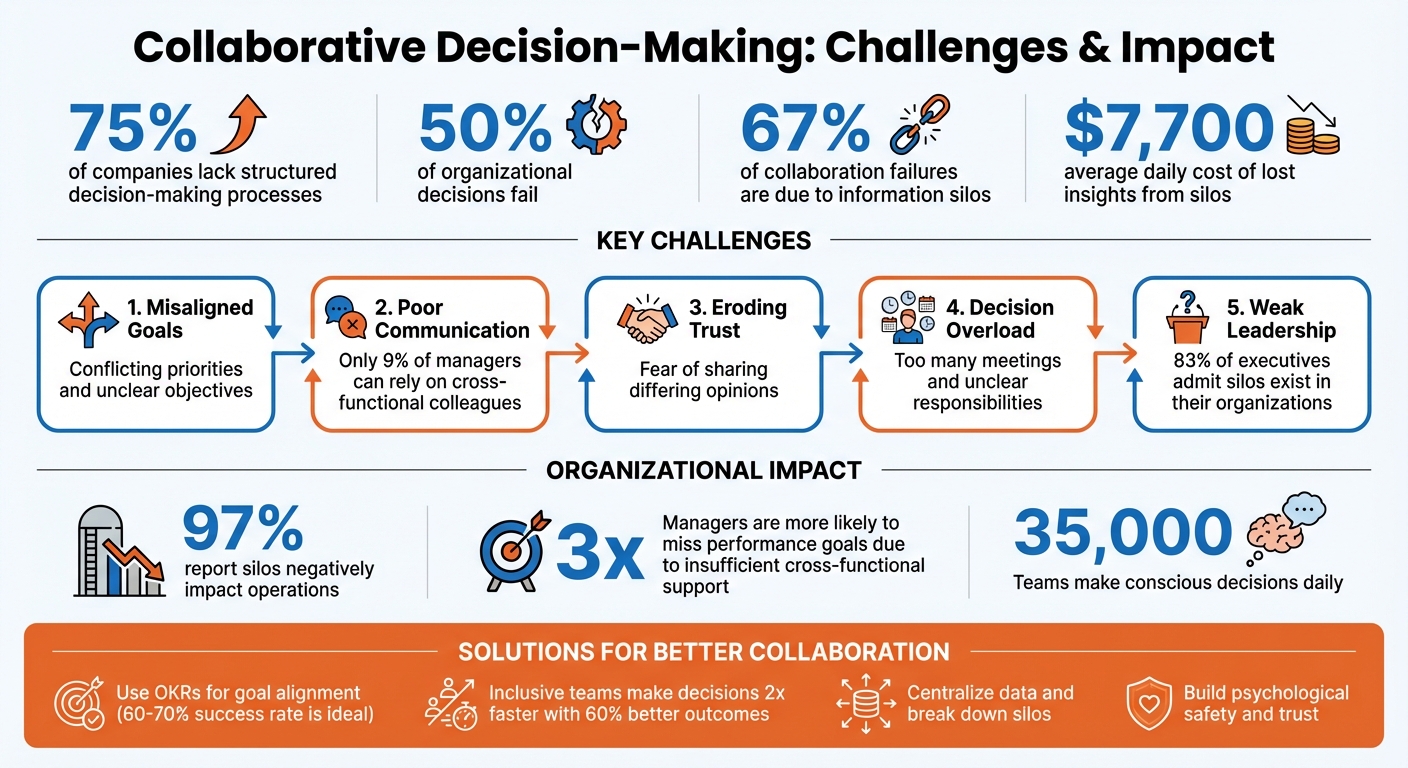
Collaborative Decision-Making Challenges: Key Statistics and Solutions
How Do Teams Make Decisions Together (The Dynamics of Group Decision-Making)
Common Challenges in Collaborative Decision-Making
Collaborative decision-making can fall apart for various reasons. Recognizing these stumbling blocks is the first step to overcoming them. Below, we explore some of the most frequent challenges that hinder effective teamwork.
Misaligned Goals and Priorities
When team members have conflicting goals, collaboration suffers. Poorly defined strategies or clashing incentives can make it difficult for everyone to rally around a shared objective. A 2024 study revealed that over half of companies struggle with decision-making approaches that lead to stalled or unclear progress. Lisa Schwarz, Senior Director of Global Product Marketing at NetSuite, captures this issue well:
"Decision-makers rarely hit the mark when the company lacks clear objectives and well-defined priorities."
Misalignment often leads to frustration. Team members may become disengaged when they can’t see how their efforts align with the company’s direction. Instead of solving problems, teams may resort to blame, causing projects to fall behind. To address this, leaders must clearly communicate goals and explain how individual roles contribute to achieving them. If priorities shift due to changes in leadership or strategy, a formal reset can help keep everyone on track.
Even with aligned goals, poor communication can derail progress.
Poor Communication and Information Silos
Information silos – where departments or teams hoard insights – are a major barrier to collaboration. They lead to misunderstandings, inefficiencies, and missed opportunities for informed decision-making. Research shows that silos account for 67% of collaboration failures, costing organizations an average of $7,700 daily in lost insights.
A great example of tackling silos comes from Virginia Mason Franciscan Health’s Patient Financial Services department. Between 2021 and 2023, they implemented shared workspaces called "the Nexus" and used visual management boards to improve communication. These changes reduced days revenue outstanding from 29.7 to 28.6 – a record for the department – eliminated three full-time manager positions, and boosted job satisfaction among managers by 41%.
As organizations grow, communication challenges often intensify. Beyond 150 people – a threshold linked to Dunbar’s Number – communication tends to break down unless addressed intentionally. Alarmingly, only 9% of managers feel they can consistently rely on colleagues from other functions, and they’re three times more likely to miss performance goals due to insufficient cross-functional support.
To break down silos, organizations can replace department-specific metrics with shared goals, ensuring that success in one area benefits the entire company. Cross-training employees in additional functional areas can also improve information sharing. As Rhonda Stewart from the Virginia Mason Institute explains:
"Visual management boards maintain the peace by making visible in one central place what used to be scattered across memos, trapped in people’s heads, and communicated erratically across teams."
Lack of Trust and Conflicting Perspectives
Trust is essential in any collaborative effort, but it often falters when leaders or departments withhold information to maintain control. Past experiences of misuse can also make team members hesitant to share. Without trust, transparency fades, and rebuilding confidence becomes an uphill battle. Jill Geisler, Clinical Professor at Loyola University Chicago, emphasizes this point:
"Transparency thrives with trust and disappears without it."
Diverse perspectives, while valuable, can lead to tension if team members don’t feel safe expressing differing opinions. This "groan zone" can cause teams to splinter before reaching a decision. Over time, decisions made without inclusive input may lack support, leading to resistance or passive undermining during implementation.
Persistent distrust reinforces silos, as teams become more inward-looking and less willing to share. Fear of failure and over-analysis can leave teams stuck in endless debate without making meaningful progress. Creating psychological safety is key. Leaders should encourage open dialogue and ensure team members feel secure sharing their thoughts without fear of backlash. Tools like "gradients of agreement" allow team members to express varying levels of support rather than forcing binary choices. Engaging with other teams intentionally can also help break down hierarchical barriers.
When trust erodes and perspectives clash, teams face delays that can lead to decision fatigue and collaborative inertia.
Decision Overload and Collaborative Inertia
Too many meetings and unclear decision-making processes can overwhelm teams, causing progress to grind to a halt. This often happens when organizations confuse collaboration with consensus, believing every decision requires equal input from everyone.
Rob Cross, Professor of Global Leadership at Babson College, highlights this issue:
"Collaborative failures can stem from a variety of conditions. Sometimes they are woven into the fabric of groups when they are formed, perhaps because team members’ incentives are misaligned or decision rights haven’t been defined."
When decision rights aren’t clearly defined, confusion arises over who is responsible for making key choices. This uncertainty leads to delays and internal friction. Streamlining meetings and clarifying decision roles can prevent these issues. For instance, Virginia Mason Federal Way Medical Center transformed its hour-long morning huddles into five-minute, action-oriented sessions. This shift allowed teams to accomplish in minutes what previously required extensive follow-up.
Ineffective Leadership and Organizational Barriers
Poor leadership can derail collaboration when decision-makers act independently, ignoring input from experts or team members. This "lone wolf" approach not only undermines teamwork but also fails to leverage the collective expertise of the group.
Organizational barriers further complicate matters. Hierarchical structures often create power imbalances, leaving some team members feeling their contributions are undervalued. Limited resources and rigid departmental boundaries also stifle the exchange of ideas, which is critical for progress. A staggering 83% of executives admit silos exist within their organizations, and 97% report that these silos negatively impact operations.
Frequent changes in leadership or strategy without a clear reset of priorities can leave teams feeling lost. Employees may struggle to see how their work fits into the bigger picture, leading to frustration and disengagement. To combat this, leaders should articulate a clear vision and ensure every team member understands their role in achieving it. Forming ad-hoc teams with diverse perspectives – from finance to operations – can also reduce the risk of missteps. Early on, defining roles and establishing a shared vision can keep participation consistent and focused.
Without strong leadership, the combined effects of misaligned goals, poor communication, and eroding trust create significant barriers to collaboration.
Solutions to Overcome Collaborative Decision-Making Challenges
To tackle the challenges of collaborative decision-making, it’s essential to identify the obstacles first and then address them head-on. Below are practical solutions to overcome issues like misaligned goals, communication breakdowns, trust barriers, decision fatigue, and leadership struggles.
Aligning Goals and Objectives
Clear, shared goals are the backbone of effective collaboration. The OKR (Objectives and Key Results) framework is a powerful tool to help teams set ambitious yet focused targets that align daily tasks with the company’s broader mission. Daniel Montgomery, Founder and Managing Director at Agile Strategies, puts it this way:
"The OKR method is best if you’re trying to get to someplace you haven’t been before, you don’t quite know how to get there, and you need a team to do it."
Google’s success with OKRs highlights the importance of bottom-up input. Around 60% of their team goals are created by employees themselves, ensuring that critical gaps aren’t overlooked by leadership. To keep goals manageable, limit each team to no more than three objectives per quarter. An ideal success rate for OKRs is between 60% and 70% – if teams are hitting 100%, the goals likely weren’t challenging enough.
The RACI matrix is another tool that clarifies roles and responsibilities:
| Role | Description |
|---|---|
| Responsible | The individual who carries out the work to complete the task. |
| Accountable | The person with ultimate authority who approves the decision. |
| Consulted | Subject matter experts who provide input before decisions are made. |
| Informed | Individuals kept updated on progress but not directly involved in decision-making. |
Pairing OKRs with SMART criteria (Specific, Measurable, Achievable, Relevant, Time-bound) ensures clarity and accountability. Assigning an OKR "champion" to oversee the process can further streamline efforts and keep teams on track.
Once goals are aligned, the next step is to improve the way teams communicate and share information.
Improving Communication
Breaking down communication barriers is essential for effective collaboration. Start by centralizing data and sharing relevant materials before meetings to keep discussions focused on decision-making.
Establish clear ground rules to promote balanced participation, such as “one voice at a time,” “no interruptions,” and “respect all input.” Rotating speaking order can also prevent dominant personalities from monopolizing discussions.
Research shows that inclusive teams make decisions twice as fast and achieve outcomes that are up to 60% better. Tools like Slack provide instant feedback and maintain searchable histories, while project management platforms help track responsibilities and deadlines, enabling smoother collaboration.
When conflicts arise, use the "When you/Then I" approach to address behavior without escalating tensions. For example: "When you check your phone while I’m speaking, I feel disrespected." This shifts the focus to specific actions and their impact, making resolution easier.
Even small changes, like using first names instead of formal titles, can reduce hierarchy and encourage open participation.
With communication in place, the focus turns to trust-building and conflict resolution.
Building Trust and Managing Conflicts
Trust doesn’t happen by accident – it requires deliberate effort and an environment where team members feel safe sharing ideas without fear of judgment. Leaders play a key role in fostering this psychological safety by being mindful of their non-verbal cues, which can unintentionally stifle open dialogue.
To avoid groupthink, separate idea generation from evaluation. The Nominal Group Technique, where team members write down ideas privately before sharing, ensures everyone’s voice is heard. Assigning a devil’s advocate can also help uncover risks that might otherwise go unnoticed.
It’s important to distinguish disagreements over ideas from personal conflicts. Address disrespectful behavior directly using structured communication techniques. Additionally, clarifying decision-making authority with models like Consensus, Leader-with-Input, or Consensus-with-Fallback ensures everyone understands how their input will be used. As Judith Stein from MIT explains:
"Consensus is achieved when everyone on the team has had ample opportunity to have his or her ideas considered and can fully support the team’s decision."
A four-point consensus check can confirm alignment by ensuring everyone feels heard, mutual listening has occurred, no one’s values are compromised, and all members can support the decision. If consensus isn’t reached within a set timeframe, a fallback plan empowers a designated decision-maker to move forward.
Streamlining Decision-Making Processes
Too many meetings and unclear processes can lead to decision fatigue. To combat this, limit the number of decisions requiring full team input – not every choice needs to involve everyone.
On average, people make about 35,000 conscious decisions daily. Categorizing decisions by impact and urgency helps teams prioritize their energy. Tools like the "Five Whys" can also help identify root causes and streamline problem-solving.
To improve meeting efficiency, make sessions focused and time-bound. Whenever possible, use asynchronous collaboration tools like shared documents to gather feedback without overloading team schedules.
Improving Leadership and Organizational Alignment
Strong alignment starts with leaders who articulate a clear vision that connects individual efforts to the company’s overarching goals. As Elie Casamitjana from OKRmentors notes:
"Becoming proficient in OKRs requires time and effort. But the leaders and organizations who prioritize mastering OKRs experience significant improvements in all areas of strategic execution – by impressive margins."
Leadership isn’t about making decisions in isolation. Instead, it’s about creating an environment where collaboration thrives, ensuring every contribution is valued and every voice is heard.
sbb-itb-bc03425
How Resilient Power®️ Supports Collaborative Decision-Making

Resilient Power®️ tackles the core challenges of collaborative decision-making by combining proven methodologies, refined communication strategies, and cutting-edge AI tools. Their approach equips leaders with the skills and systems needed to make collaborative decisions effectively. By addressing common obstacles like misaligned goals, lack of trust, and decision fatigue, this comprehensive framework strengthens teamwork and streamlines the decision-making process.
Science-Based Methodologies for Resilience
At the center of Resilient Power®️’s strategy lies the Decision Engineering Methodology, a structured framework designed to define decisions, explore alternatives, and outline actionable steps. This methodology draws upon modern decision theory, including principles from von Neumann and Morgenstern’s utility theory, to guide organizations in making optimal choices.
A key aspect of this methodology is its emphasis on balancing intuitive and analytical thinking. Leaders learn to adjust their decision-making styles depending on the urgency and complexity of the situation. This adaptability helps avoid impulsive decisions while also steering clear of the dreaded "analysis paralysis."
Executive Communication and Conflict Resolution
Effective communication is essential for overcoming trust issues and resolving conflicts that often hinder collaborative efforts. Resilient Power®️ emphasizes active listening and emotional intelligence as critical tools for fostering constructive dialogue. These skills help leaders and teams approach disagreements with a problem-solving mindset, ensuring that diverse perspectives are heard and valued.
Additionally, the program focuses on self-regulation and executive communication techniques, enabling leaders to manage their own emotional responses. By modeling open and respectful communication, leaders can create an environment where trust flourishes and teams are more likely to reach a consensus.
AI-Driven Solutions for Decision Optimization
To address challenges like decision overload and information silos, Resilient Power®️ integrates AI-powered tools that simplify and enhance the decision-making process. For instance, AI-driven assistants handle tasks like automated summarization and transcription, capturing key discussion points and action items without the need for manual note-taking.
Another powerful tool is the use of data visualization dashboards with real-time analytics. These role-based dashboards provide instant access to critical information across departments, breaking down silos and ensuring that everyone is working with the same data. This shared access to accurate, up-to-date information helps teams make informed, collaborative decisions more efficiently.
Conclusion
Collaborative decision-making is undeniably important, but it comes with its share of challenges. The stakes are clear: studies reveal that 50% of organizational decisions fail, and nearly 75% of companies lack a structured approach for handling major, complex decisions. These shortcomings often result in missed opportunities, delayed projects, and wasted resources.
The strategies discussed here aim to tackle these issues directly. By aligning team goals, enhancing communication, fostering trust through structured conflict resolution, streamlining processes to avoid overanalyzing, and strengthening leadership skills, organizations can create an environment where collaboration thrives. As Mark A. Wilson points out, effective team collaboration helps counteract the cognitive biases that often cloud judgment.
To support these efforts, Resilient Power®️ offers targeted solutions that bring these strategies to life. Combining science-based methods, executive communication training, and AI-powered tools, Resilient Power®️ helps break down information silos and reduce decision fatigue.
The outcome? A decision-making culture that values diverse perspectives, mitigates biases, and enables teams to move forward with confidence and unity. By adopting these approaches, leaders can improve decision quality while building the resilience and alignment needed for long-term success. Taking action on these strategies today lays the groundwork for a stronger, more adaptable future.
FAQs
What are the best ways to align team goals during collaborative decision-making?
Aligning team goals starts with a clear and shared purpose that everyone on the team understands and supports. Leaders should craft a straightforward goal statement tied to measurable outcomes. From there, break the goal into smaller, specific, and time-bound targets that the whole team can track together. Using structured decision-making methods – like framing the issue, evaluating alternatives, and choosing actionable steps – keeps discussions focused and aligned with these objectives. Regular check-ins, such as weekly stand-ups or quick review meetings, provide an opportunity to catch misalignments early and make adjustments as needed.
Building consensus is just as important. When team members see how their individual efforts contribute to the broader goal, they’re more likely to stay engaged and motivated. Inclusive practices like round-robin discussions, silent brainstorming sessions, or voting on priorities ensure that everyone’s input is considered. Visual aids, such as goal trees or balanced scorecards, can also help clarify trade-offs and simplify adjustments when plans need to shift.
For organizations looking for expert help, Resilient Power®️ provides science-backed strategies and AI-powered tools designed to help leaders align goals, encourage collaboration, and achieve better business results.
How can teams overcome communication silos to improve collaboration?
Breaking down communication silos takes deliberate action to boost transparency and teamwork across different departments. One effective step is to hold regular cross-team meetings where updates and priorities are shared. This helps surface potential roadblocks early and keeps everyone on the same page. Additionally, using a shared digital workspace can centralize documents, decisions, and progress updates, ensuring all teams have access to consistent information.
Designating liaisons, or "bridge" roles, to interpret technical jargon and provide context between teams can make complex insights easier to act on. Standardizing documentation – like using the same templates for meeting notes and decision logs – ensures knowledge is well-organized and accessible for future reference. Leadership also plays a critical role by promoting open communication, being transparent about goals and challenges, and encouraging a culture where information flows freely.
Resilient Power®️ supports organizations in implementing these strategies by offering tailored solutions, AI-powered tools, and expert coaching, helping teams stay aligned and work collaboratively.
How does psychological safety help build trust in team collaboration?
Psychological safety is the confidence that team members can express ideas, ask questions, or admit mistakes without fear of judgment or negative consequences. When a team cultivates this kind of atmosphere, individuals feel free to be themselves, which is a cornerstone for building trust. Trust, in turn, deepens as team members consistently demonstrate honesty and respect, creating an environment where everyone’s contributions are genuinely appreciated.
In collaborative decision-making, psychological safety plays a critical role by encouraging open conversations and constructive debates. This openness allows diverse viewpoints to surface, leading to more effective problem-solving and stronger team alignment. Through tools like leadership coaching and team workshops, Resilient Power®️ helps organizations create psychological safety, laying the groundwork for trust and achieving impactful results.