
Most leadership programs fail. Despite organizations spending $60 billion annually, only 13% believe their efforts work, and just 7% of senior managers feel their companies excel at building leaders. Why? Traditional methods rely on outdated, one-size-fits-all approaches that focus on fixing weaknesses, often delivering minimal results.
Science-based leadership development offers a better path. Grounded in neuroscience and behavioral research, it amplifies strengths, builds resilience, and drives measurable improvements in decision-making, communication, and stress management. By leveraging how the brain works, these methods create lasting behavioral changes, unlike conventional programs.
Key Takeaways:
- Traditional methods: Standardized, deficit-focused, lack personalization, and fail to drive lasting impact.
- Science-based methods: Strength-focused, rooted in neuroscience, emphasize real-world application, and show measurable success.
- Results: Teams using science-based approaches report 86% more agility, 21% higher profitability, and 17% increased productivity.
Leadership development is no longer about fixing what’s broken – it’s about building on what works. If you’re ready to move beyond outdated methods, science-backed strategies are the way forward.
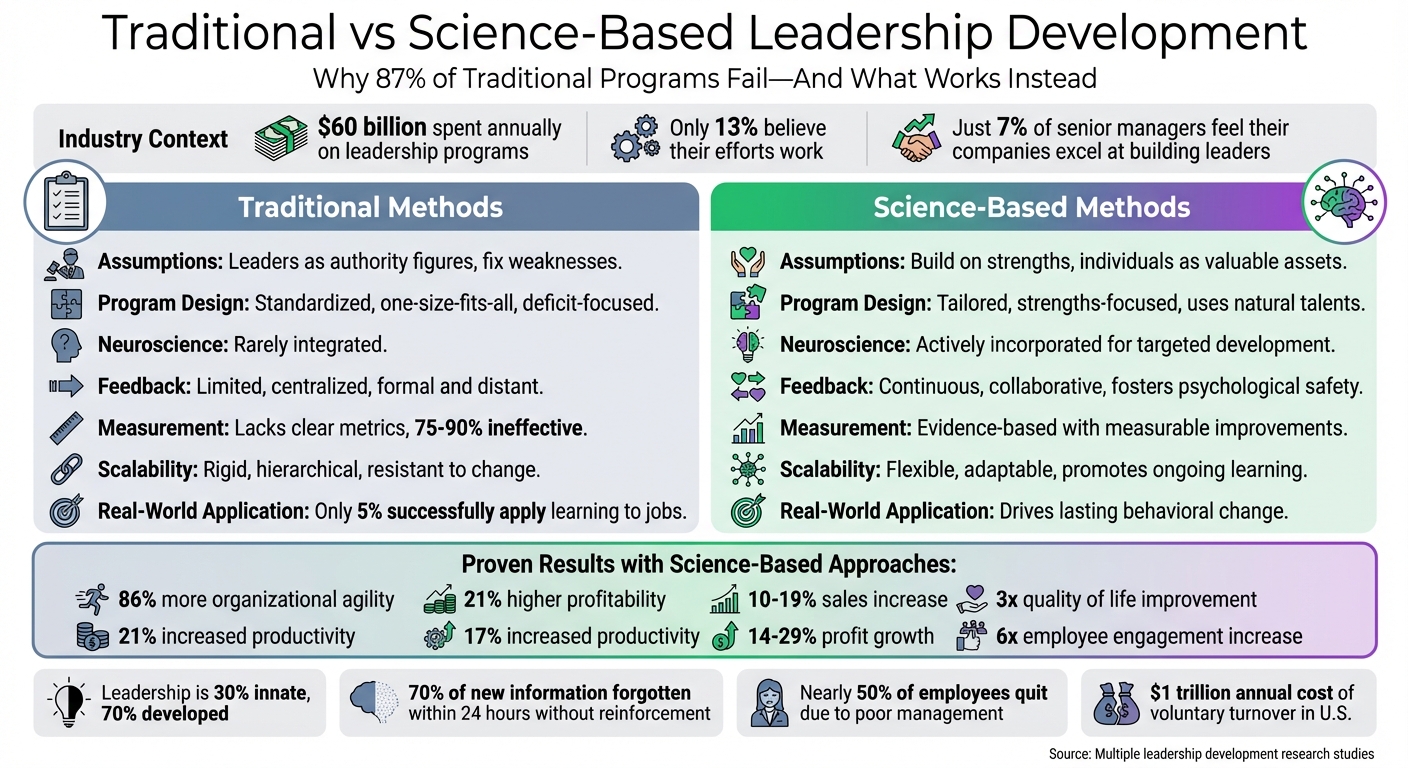
Traditional vs Science-Based Leadership Development: Key Differences and Results
Traditional Leadership Development Methods
Common Traditional Practices
Traditional leadership development often leans on classroom seminars, personality workshops, and standardized assessments. These methods typically pull leaders away from their daily responsibilities to focus on generalized skills training, offering little room for personalization based on individual or organizational needs. They tend to follow a top-down structure, emphasizing clear hierarchies and transactional leadership styles. While this approach worked well for stable, well-established organizations, it often falls short in more dynamic, fast-changing environments.
Assumptions and Limitations
Traditional methods frequently assume that leadership is rooted in inherent traits, a notion reminiscent of the 19th-century "great man" theory. Even with modern updates, many of these programs remain overly standardized.
"The idea that some cookie-cutter leadership approach will work in vastly different contexts just doesn’t make sense".
The limitations of these methods are hard to ignore. Despite the global leadership training industry being valued at $60 billion, only 13% of organizations believe they are effective at leadership development, even though 86% consider it a critical priority. A McKinsey study revealed that just 7% of senior managers feel their companies excel at building strong leaders. Compounding the issue, research shows that nearly 70% of new information is forgotten within 24 hours unless it’s reinforced, and without consistent follow-up or coaching, leaders often fail to sustain the behaviors taught in training.
Traditional programs also tend to neglect critical areas like emotional intelligence and interpersonal skills, leaving leaders unprepared for the demands of today’s workplace. This gap has real consequences: many leaders revert to old habits shortly after training, contributing to significant challenges like high employee turnover. In fact, nearly half of employees who quit their jobs cite poor management as the reason, costing U.S. businesses an estimated $1 trillion annually in voluntary turnover.
While these methods provide a structured framework, their inability to drive lasting behavioral change undermines their effectiveness in addressing modern leadership challenges.
Where Traditional Methods Work
Despite their flaws, traditional methods do offer value in certain contexts. They provide a solid foundation of theoretical knowledge, which can be particularly useful in organizations that prioritize stability and well-defined hierarchies. However, their utility is often limited to laying the groundwork.
"I avoid using the term ‘benchmark’ because I think it’s outdated and it’s limiting. I don’t want to be on par with someone else. I want to raise the bar in a way that is informed by, but not limited by, information about what others have done".
While these traditional models can deliver essential insights, they often fail to produce the kind of lasting behavioral shifts required for effective leadership in today’s fast-paced, ever-changing business world.
How to Translate Brain Science into Leadership Skills
Science-Based Leadership Development Methods
Science-based leadership views leadership as a skill set that can be learned, practiced, and improved over time.
Core Principles of Science-Based Methods
At its heart, science-based leadership focuses on specific, high-impact behaviors rather than broad personality traits. The approach includes structured practice, real-world application, and evidence-backed measurement. By zeroing in on behaviors that yield measurable results, these methods encourage deliberate practice, targeted feedback, and continuous improvement. Insights from neuroscience and behavioral science further strengthen this framework, making it both practical and results-oriented.
The Role of Neuroscience and Behavioral Science
Neuroscience and behavioral science play a crucial role in shaping these methods. For instance, neuroscience sheds light on how the brain operates under stress. The limbic system, which governs emotional responses, often clashes with the prefrontal cortex, responsible for logical thinking. Effective leaders work to maintain this balance. However, when stress activates the amygdala, it can overwhelm the prefrontal cortex, leading even experienced leaders to make poor decisions.
The concept of neuroplasticity – the brain’s ability to form and strengthen new connections – offers hope for continuous growth. By integrating deliberate practice and feedback, science-based methods help leaders hardwire new behaviors, ensuring they become lasting tools for success.
Resilient Power‘s Approach to Science-Based Leadership

Resilient Power applies these principles through data-driven coaching designed to enhance critical leadership behaviors. Using incident response strategies and AI-supported tools, their approach strengthens resilience while improving stress management, decision-making, and team dynamics. By staying rooted in evidence-based practices, Resilient Power ensures its methods are both practical and effective, bridging the gap between theory and real-world leadership challenges.
Traditional vs Science-Based: Direct Comparison
Key Comparison Dimensions
Traditional leadership development focuses on fixing weaknesses, while science-based approaches aim to amplify strengths. Traditional methods often rely on standardized programs that address deficiencies, whereas science-based strategies leverage neuroscience and behavioral research to build on existing talents. An analysis of over 100,000 leaders highlights that focusing on strengths yields better results than attempting to fix weaknesses.
| Dimension | Traditional Leadership Development | Science-Based Leadership Development |
|---|---|---|
| Assumptions | Leaders are viewed as authoritative figures, with an emphasis on correcting weaknesses and deficiencies | Leaders grow by building on existing strengths, with individuals seen as valuable assets |
| Program Design | Standardized, deficit-focused, and often one-size-fits-all, emphasizing shortcomings | Tailored, strengths-focused, utilizing natural talents and neural pathways |
| Neuroscience Application | Rarely integrated as a foundational principle | Actively incorporates neuroscience for targeted and accelerated development |
| Practice and Feedback | Limited feedback and centralized decision-making, with formal and distant interactions | Continuous, collaborative feedback in an open environment that fosters trust and psychological safety |
| Outcome Measurement | Often lacks clear metrics; billions are spent annually with 75–90% ineffectiveness | Evidence-based metrics showing measurable, statistically significant improvements |
| Scalability | Rigid and hierarchical, resistant to change | Flexible and adaptable, promoting ongoing learning and decentralized decision-making |
These differences highlight why science-based methods are gaining traction, supported by growing research.
Research Supporting Science-Based Methods
Studies consistently show the benefits of focusing on strengths. For example, prioritizing strengths has been linked to tripling quality of life and increasing employee engagement sixfold. On the business side, teams that received strengths-based interventions saw sales rise by 10% to 19% and profits grow by 14% to 29%. Another study found that emphasizing strengths improved performance by 1.6 times for average performers and by eight times for those naturally talented in a given area.
Leadership training rooted in science-based principles has also demonstrated measurable success. Research shows improvements across key areas: reactions (δ = .63), learning (δ = .73), transfer (δ = .82), and results (δ = .72). These findings challenge the traditional model, which often leads to leaders being merely adequate instead of excelling where it counts most.
sbb-itb-bc03425
Building Executive Resilience with Science-Based Methods
What Executive Resilience Means
Executive resilience is the ability to maintain consistent performance, emotional balance, and sound decision-making under ongoing pressure. In simple terms, it’s about staying effective when the stakes are high. For leaders, managing stress isn’t just a personal challenge – it directly impacts their teams, operations, and overall business outcomes. When stress is poorly managed, it can ripple through an organization, disrupting everything from morale to productivity.
Grasping these challenges is the first step toward adopting science-backed strategies to handle stress more effectively.
The Science Behind Resilience
Resilience isn’t something you’re simply born with – it’s a skill you can build through practice and experience. This idea ties closely to neuroscience-based leadership principles. When stress levels rise, the amygdala – the brain’s center for processing emotions – takes over, reducing the activity of the prefrontal cortex, the area responsible for rational thinking. This physiological response can make it harder to think clearly and make good decisions.
Science-based methods aim to help leaders manage this reaction. They focus on key physiological processes, like heart rate and hormonal shifts, which often drive behavior before we’re even aware of it. By understanding how the brain predicts threats and allocates energy, leaders can learn to disrupt automatic stress responses. This allows them to stay focused and maintain cognitive control when it’s needed most.
How Resilient Power Builds Resilience
Resilient Power takes these scientific principles and turns them into actionable leadership training. It combines neuroscience-based techniques across three key areas: incident response, coaching, and self-regulation practices. This approach bridges the mind-body connection, emphasizing how factors like physical movement, quality sleep, and exposure to natural light can enhance cognitive performance.
One of the core skills leaders develop is recognizing when their amygdala is overriding their prefrontal cortex. Through specific strategies, they learn to shift brain activity back into balance. The training is designed for practical use, helping leaders apply these techniques in real-world situations. Thanks to the brain’s ability to form new neural pathways – a process known as neuroplasticity – executives can strengthen their ability to manage emotions and make better decisions under pressure. With regular practice, these skills become second nature, empowering leaders to perform at their best even in the toughest circumstances.
How to Implement Science-Based Development with Resilient Power
Implementation Steps
To align science-based leadership development with your business goals, start with a skill assessment and define the specific behaviors you want to target. Establish measurable goals at three levels: learner experience, on-the-job performance, and business impact. Use clear success indicators to monitor progress over time. The program should be flexible, offering various delivery methods like in-person sessions, virtual training, one-on-one coaching, or group coaching. This flexibility ensures the training fits seamlessly into daily workflows, allowing you to embed techniques and track outcomes as they happen. These steps are especially suited to the unique demands of U.S. organizations.
Adapting to U.S. Organizational Needs
Since many U.S. companies operate in hybrid work environments, training programs must function effectively across office, remote, and mobile settings. Distributed teams often collaborate across time zones, so the program should accommodate this dynamic. Additionally, compliance with regulatory and industry-specific requirements is critical. Tailoring the program to meet these factors ensures it aligns with each organization’s specific needs.
Resilient Power’s Experience
Resilient Power has a proven track record of customizing solutions for organizations ranging from Fortune 500 companies to tech startups. Their personalized, one-on-one approach supports every phase – from the initial assessment to ongoing integration – ensuring that science-based strategies become a natural part of your company culture. By combining neuroscience-backed methods with practical implementation strategies, Resilient Power helps teams align, enhances executive communication, and strengthens risk management. Using a blend of AI tools and human expertise, they empower leaders to make sound, pressure-tested decisions when it matters most.
Conclusion
Traditional methods aim to fix weaknesses, while science-based methods focus on amplifying strengths. The older, conventional approaches often rely on hierarchical structures, correcting deficiencies, and generic, one-size-fits-all training programs. Unfortunately, these methods rarely translate into improved workplace performance – only about 5% of participants successfully apply what they learn in traditional leadership programs to their jobs. In contrast, science-based methods tap into neuroscience, behavioral science, and individual strengths to drive measurable improvements in areas like resilience, communication, and decision-making.
The numbers speak volumes. Companies that implement science-driven leadership development programs are 86% more agile, achieve 21% higher profitability, and see 17% increased productivity. Considering that leadership is 30% innate and 70% developed, the right approach to development can profoundly impact both individual leaders and organizational success. These statistics highlight the shortcomings of traditional training and point to the transformative potential of science-based strategies.
Practical application is key. Understanding how the brain works provides leaders with actionable tools to enhance performance. This isn’t just theory – it’s about using proven methods to build psychological safety, improve team dynamics, and make sound decisions under pressure.
Resilient Power takes this evidence-based approach to the next level, combining neuroscience, AI tools, and expert coaching to integrate effective leadership development into organizational culture. Whether you’re managing hybrid teams, navigating global time zones, or bolstering risk management strategies, their results show what’s possible when science meets real-world challenges.
For those ready to move beyond outdated methods and invest in leadership development that delivers measurable outcomes, exploring Resilient Power’s solutions is a logical next step. The science backs it, the benefits are clear, and there’s no better time to act than now.
FAQs
How does science-based leadership development use neuroscience to improve skills?
Science-based leadership development draws on neuroscience to explore how the brain shapes behaviors, emotions, and decision-making. By delving into the brain’s inner workings, this method helps leaders build essential skills like managing emotions, handling stress, and staying flexible in challenging situations.
It often uses techniques like neurofeedback, brain imaging, and behavioral simulations to pinpoint and enhance the neural pathways linked to leadership abilities. The outcome? Leaders who communicate more effectively, solve problems with greater clarity, and foster healthier team relationships.
What are the proven benefits of using science-based leadership techniques?
Science-driven leadership strategies provide practical tools to sharpen decision-making, strengthen emotional intelligence, build resilience, and encourage creativity. These approaches empower leaders to elevate team performance, enhance employee satisfaction, and achieve more effective organizational results.
Studies indicate that organizations applying leadership methods rooted in science can experience up to a 72% return on investment (ROI). Additionally, such strategies often lead to significant increases in team motivation and engagement. By applying principles from neuroscience and behavioral science, leaders can implement actionable techniques that deliver impactful and lasting outcomes.
Why don’t traditional leadership development programs achieve lasting results?
Traditional leadership programs often miss the mark because they lean on outdated methods that don’t draw from science or evidence-based practices. These programs tend to emphasize one-size-fits-all strategies, ignoring the specific needs of individuals or organizations. As a result, participants often struggle to translate what they’ve learned into practical, everyday situations.
What’s more, these traditional models rarely tap into insights from neuroscience or behavioral science – fields that are key to understanding how leaders think, make decisions, and adapt under pressure. Without this modern perspective, the training can feel disconnected from real-world challenges, leading to poor retention of skills and minimal long-term value.